Stretching the Classroom To Washington—and Michigan
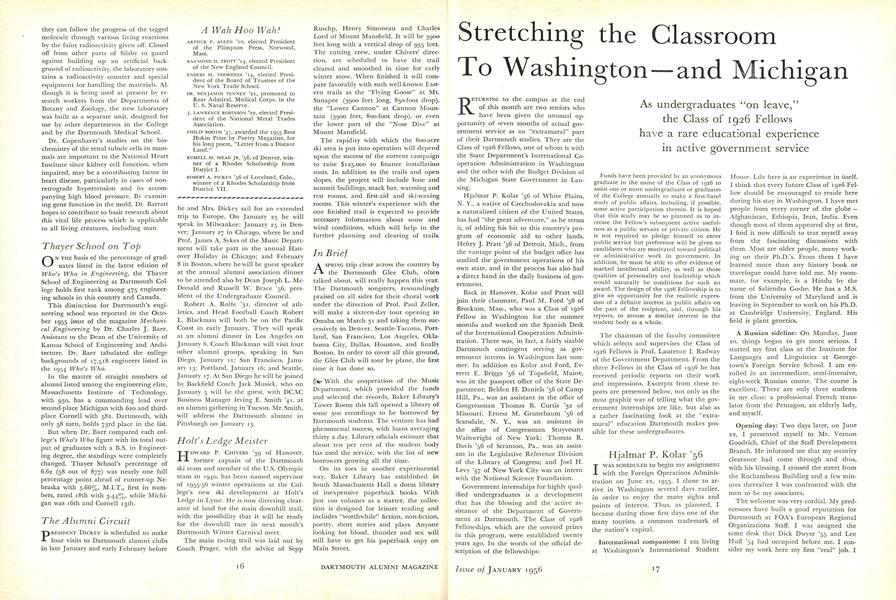
As undergraduates "on leave," the Class of 1926 Fellows have a rare educational experience in active government service
RETURNING to the campus at the. end of this month are two seniors who have been given the unusual opportunity of seven months of actual government service as an "extramural" part of their Dartmouth studies. They are the Class of 1926 Fellows, one of whom is with the State Department's International Cooperation Administration in Washington and the other with the Budget Division of the Michigan State Government in Lansing.
Hjalmar P. Kolar '56 of White Plains, N. Y., a native of Czechoslovakia and now a naturalized citizen of the United States, has had "the great adventure," as he terms it, of adding his bit to this country's program of economic aid to other lands. Henry J. Pratt '56 of Detroit, Mich., from the vantage point of the budget office has studied the government operations of his own state, and in the process has also had a direct hand in the daily business of government.
Back in Hanover, Kolar and Pratt will join their classmate, Paul M. Ford '56 of Brockton, Mass., who was a Class of 1926 Fellow in Washington for the summer months and worked on the Spanish Desk of the International Cooperation Administration. There was, in fact, a fairly sizable Dartmouth contingent serving as government interns in Washington last sum- mer. In addition to Kolar and Ford, Everett E. Briggs '56 of Topsfield, Maine, was in the passport office of the State Department; Belden H. Daniels '56 of Camp Hill, Pa., was an assistant in the office of Congressman Thomas B. Curtis '32 of Missouri; Ernest M. Grunebaum '56 of Scarsdale, N. Y., was an assistant in the office of Congressman Stuyvesant Wainwright of New York; Thomas R. Davis '56 of Scranton, Pa., was an assistant in the Legislative Reference Division of the Library of Congress; and Joel H. Levy '57 of New York City was an intern with the National Science Foundation.
Government internships for highly qualified undergraduates is a development that has the blessing and the active assistance of the Department of Government at Dartmouth. The Class of 1926 Fellowships, which are the coveted prizes in this program, were established twenty years ago. In the words of the official description of the fellowships:
Funds have been provided by an anonymous graduate in the name of the Class of 1926 to assist one or more undergraduate or graduates of the College annually to make a first-hand study of public affairs, including, if possible, some active participation therein. It is hoped that this study may be so planned as to increase the Fellow's subsequent active usefulness as a public servant or private citizen. He is not required to pledge himself to enter public service but preference will be given to candidates who are motivated toward political or administrative work in government. In addition, he must be able to offer evidence of marked intellectual ability, as well as those qualities of personality and leadership which would naturally be conditions for such an award. The design of the 1926 Fellowship is to give an opportunity for the realistic expression of a definite interest in public affairs on the part of the recipient, and, through his reports, to arouse a similar interest in the student body as a whole.
The chairman of the faculty committee which selects and supervises the Class of 1926 Fellows is Prof. Laurence I. Radway of the Government Department. From the three Fellows in the Class of 1956 he has received periodic reports on their work and impressions. Excerpts from these reports are presented below, not only as the most graphic way of telling what the government internships are like, but also as a rather fascinating look at the "extramural" education Dartmouth makes possible for these undergraduates.
Hjalmar P. Kolar '56
I WAS SCHEDULED to begin my assignment with the Foreign Operations Administration on June 22, 1955. I chose to arrive in Washington several days earlier, in order to enjoy the many sights and points of interest. Thus, as planned, I became during those first days one of the many tourists, a common trademark of the nation's capital.
International companions: I am living at Washington's International Student House. Life here is an experience in itself. I think that every future Class of 1926 Fellow should be encouraged to reside here during his stay in Washington. I have met people from every corner of the globe-Afghanistan, Ethiopia, Iran, India. Even though most of them appeared shy at first, I find it now difficult to tear myself away from the fascinating discussions with them. Most are older people, many working on their Ph.D.'s. From them I have learned more than any history book or travelogue could have told me. My roommate, for example, is a Hindu by the name of Saliendra Goshe-. He has a M.S. from the University of Maryland and is leaving in September to work on his Ph.D. at Cambridge University, England. His field is plant genetics.
A Russian sideline: On Monday, June 20, things began to get more serious. I started my first class at the Institute for Languages and Linguistics at Georgetown's Foreign Service School. I am enolled in an intermediate, semi-intensive, eight-week Russian course. The course is excellent. There are only three students in my class: a professional French translator from the Pentagon, an elderly lady, and myself.
Opening day: Two days later, on June 22, I presented myself to Mr. Vernon Goodrich, Chief of the Staff Development Branch. He informed me that my security clearance had come through and thus, with his blessing, I crossed the street from the Rochambeau Building and a few minutes thereafter I was confronted with the men to be my associates.
The welcome was very cordial. My predecessors have built a good reputation for Dartmouth at FOA's European Regional Organizations Staff. I was assigned the same desk that Dick Dwyer '55 and Lee Huff '54 had occupied before me. I consider my work here my first "real" job. I am impressed by the studious and quiet atmosphere of this office, which exudes a touch of the "planning" or "executive" atmosphere. From my window I can see the White House - a fact which assures me that I am a part, even though a very tiny one, of the Executive Branch of this government.
Mr. Alex E. Lachman is Acting Chief of the Regional Organizations Staff. He is an expert on the European Payments Union, and in addition is charged with the general supervision of this office. I have great respect for him. He is a brilliant economist and a hard worker. A few days ago we had lunch together and this was my first opportunity for talking to him informally.
A Dartmouth colleague: I was pleas- antly surprised on June 37 when Lee Huff '54, former Class of 1926 Fellow, was introduced to the office. He plans to work here until September. His main job is to familiarize himself with U. S. policy in regard to the General Agreement of Tariffs and Trade. He will be the International Cooperation Administration's expert on GATT.
The "mystery" of EPU: A good part of my first two weeks of work were spent in attending a special orientation program, designed to familiarize ICA personnel, about to go overseas, with the life as well as the problems they are likely to encounter.
My main assignment will be an attempt to become an "expert" on the EPU. Since Mr. Lachman, the real expert on the European Payments Union, is very busy as acting chief of the Regional Organizations Staif, I will try to lessen the burden upon him by helping out on some of the EPU work. I must confess that I have not yet entirely solved the "mystery" behind this rather complicated international clearing mechanism. One research project has already been assigned to me.... I have completed two other research assignments, one on the amount of trade liberalization that has taken place in Europe since the beginning of the year. Trade liberalization is closely connected with the problem of convertibility.... lam to take over the writing of the monthly EPU report. Incidentally, Mr. Lachman and Dick Dwyer '55 devised the method for computing the financial positions of the individual countries. ... In addition, I have also had the opportunity to read many cables from ICA missions in foreign countries which reach this office daily. It would be profitable to make college students familiar with the style in which many of these cables are written. It is amazing how much information is condensed in a few well-composed words.
A classmate encountered: Besides the Dartmouth students who live in my immediate vicinity and whom I associate with frequently, I have also met Teg Briggs '56, who is employed in the State Department's passport office. Through Ted I received a dinner invitation to the home of Mr. Maurice Kidd of the State Department, Chief of German Political Affairs. Mr. Kidd was about to leave for the Geneva Conference and, as might be expected, our conversation centered mainly on that subject. Although a native American, Mr. Kidd speaks German without any accent whatsoever, as well as nearly perfect Russian. To me he is another example of the highly qualified men who are servants of this government.
Visit to the Hill: On June go I attended my first session at the House of Representatives. The occasion was the discussion of the President's Foreign Aid Bill. I was struck by the informal atmosphere-and by the fiery and emotional speeches by some of the representatives.
Hotter than Sahara: Washington's infamous climate deserves mention. It is best characterized by the comment of an Ethiopian student who exclaimed the other day: "Why did I ever leave my cool, refreshing Africa?"
Sherman Adams: The outstanding event of the bygone period occurred on August 10, when at 9:30 a.m. the doors of the White House executive offices were opened to a group of Dartmouth students and we were permitted to spend more than an hour in the company of Sherman Adams '20, Assistant to the President. Our delegation consisted of Daniels, Ford, Grunebaum, Levy, Davis, Briggs, Huff and myself.
After having been introduced to the "Governor," as well as to another rather well-known Dartmouth alumnus, Nelson Rockfeller '30, Mr. Adams took us on a tour of the executive offices, the Cabinet Room, the indoor swimming pool, and the President's personal office. The latter is a large circular room with a huge mahogany desk at one end and numerous bookcases set into the walls. The walls were adorned with several oil paintings, depicting Alpine scenes. While in this awe-inspiring place, the air of which seemed to exude the burden of weighty decisions, we were overcome by a feeling of reverence, the reason for almost unbroken silence on the part of our group.
The conversation with the Governor centered mainly on his position as the President's chief of staff. My greatest impression from the visit to the White House stems not from the facts that Sherman Adams told us; it was his way of presenting them. The man who today holds one of the nation's very top positions sat with a group of students, previously unknown to him, calling them by their first names, talking frankly to them and treating them as equals. The most dignified ode could not have been paid better tribute to the principles of democracy.
A Congressman at close range: With four other Dartmouth students, I had the opportunity to attend an interesting luncheon with Mr. Thomas B. Curtis '32, the Republican Representative of District 2, Missouri. The luncheon was attended by Daniels, Ford, Grunebaum, Levy and myself. Mr. Curtis is a vigorous man who states what he believes about national and international issues, and the discussion was extremely lively.
Memories: On August 11 I had an unexpected opportunity to hear a first-hand report on the country of my origin. Together with Ted Briggs, I was invited to dinner by Col. Edward Whitman, who had recently returned from Czechoslovakia. He had served there three years as U. S. air attache. He had been in contact with many of the famous, or rather infamous, communist leaders of that country, among them the former president, Klement Gottwald. It was fascinating to listen to Colonel Whitman's personal impressions. The talk that evening brought back many long-forgotten memories.
Relief! Cool breezes and the return to Standard Time herald a new season, and they are also reminders of the beginning of a new college semester. Even though I envy my schoolmates who, high up north in the beautiful Granite State, are trying to find solutions to dividing their time between books and the football field, I nonetheless am certain that no lecture nor any number of reading assignments could equal the practical experience I am in the process of acquiring in the service of this government.
Top secret: Several days ago I received official notice of my final ICA security clearance. Almost immediately Mr. David Richardson, who is Acting Chief while Mr. Lachman is in Paris for the Senior Economic Officers Meeting, gave me what I consider the most interesting and stimulating assignment so far. This work is in connection with NATO, and I am privileged to take part, even though on a very minute scale, in a fascinating project. The handling of "top secret" material is very educational.
Hanover via TV: Saturday afternoon, October 22. My comfortable chair in the lounge of the International House became suddenly transformed into a seat on Memorial Field's 50-yard line. It was the Dartmouth-Harvard game which, thanks to the magic of television, I was able to watch from this vantage point. I recruited a group of Ethiopian students, recently arrived in this country, to join me. They had heard much about Harvard, and from me they received a short sketch of Dartmouth. They knew nothing about football. Thus they were treated to an educational experience.
By the time I saw the close-up of Bill Beagle carrying the ball across for the deciding touchdown my mind was made up that it was time for me to see Hanover again, a venture I plan to undertake on Armistice Day weekend. I believe a reunion with the College as well as a short absence from Washington's bureaucratic atmosphere will do me good.
Commerce and a collision: In early October, in response to a request from the textile committee of the OEEC in Paris, I drew up a report on the U. S. textile industry's development during fiscal 1955. This involved my spending four days in the Textile Division of the Department of Commerce, preparing eight tables and a memorandum. Even though this was not the most stimulating project I have undertaken here in Washington, it was educational.
Indirectly it entangled me in a little incident which I shall not soon forget. Shortly after having finished the textile research, I raced back to my office to have the tables typed. I crossed Pennsylvania Avenue near the Treasury Building, and just as I was in the middle of the street the traffic sign changed to "Don't Walk." With my eyes fixed on the sign, I began to storm ahead, suddenly colliding with a man. Apologizing, I stepped back and almost froze when I saw myself confronted with the large, stately frame of Dean Acheson.
Henry J. Pratt '56
MY internship in the Budget Division of the Michigan State Government began on June 21, 1955. Mr. James W. Miller, Controller of the State, with whom I had a very helpful interview during spring vacation, had suggested the Budget Division as a good vantage point from which to get a broad view of the state government process, because of its contacts with all state agencies and its participation in policy formulation.
The Director of the Budget Division is Mr. Frank M. Landers, a top man in his field and president of the National Asso- ciation of State Budget Officers. His office staff of seventeen includes seven budget examiners, each of whom handles one or more of the areas into which the state government is divided for budgetary purposes. My immediate supervisor is Mr. Paul Wileden, head of the research section of the Budget Division. Next to Mr. Landers he probably has the broadest actual view of the budget process.
Work begins: From my first day on the job and extending for the better part of the next two weeks, Mr. Wileden gave me documents, reports and office memoranda to read, in an effort to give me a general background for the work I would be doing in the coming months. My seven-month period here could not be better timed, for it exactly corresponds to the budget preparation period, extending from the beginning of the fiscal year, July 1, until the Legislature reconvenes in January.
Rental review: Early in July I launched upon a series of projects arranged by Mr. Wileden with the dual aim of increasing my background knowledge and providing the Budget Division with some useful information. The first of these was an analy- sis of office rental practices by the state agencies, some of which occupy stateowned buildings while others rent space from private owners. The whole situation had been made more confusing by legislative action requiring certain agencies to pay rent regardless of where they were located, and by the fact that appropriations for this purpose were either clearly itemized or buried in various general accounts. My job was simply to work up a detailed list of line-item rental appropriations and combine it with the actual amounts for rent buried in other appropriations. It is hoped that the list will be helpful in deciding in specific cases who must pay and who must not pay for use of office quarters.
No mansion: Project No. 2 had no di- rect connection with the budget but was interesting in a more general way. The Governor of Michigan has no executive mansion, and the Legislature has shown some sympathy to the idea of building one. As a preliminary to the Governor's writing to other states on this matter, I was given the task of determining the ten leading states which could provide information about executive mansions and make suggestions as to how Michigan might go about erecting one.
My most recent undertaking is by far the most ambitious. I have gone back to 1948, when the Department of Administration was organized, to make a year-by-year and function-by-function survey of the relationship between agency requests, Budget recommendations, and legislative appropriations. In addition to dollar amounts, graphs were made for each function to indicate yearly percentage reductions (in some cases increases) made by Budget and the Legislature from proposals submitted to them.
Another intern: On July 19, Avelino Lim, a 23-year-old student from the University of the Philippines began a sixweek internship in our office. He is an ICA scholar who has degrees in both law and public administration and is studying for one year in this country. Upon completion of his work here Avelino plans to enter the Maxwell School of the University of Syracuse to study fiscal administration, and next spring plans to enter the state government in Albany. 'Ave" and I have adjoining desks and we have become close friends in the brief time of our acquaintance.
Princeton prof: Since I have taken no Dartmouth courses in political theory, I decided to see what summer school courses in that subject were offered at Michigan State University, which is so close to my place of work. I was pleased to learn that Dr. William Ebenstein of Princeton, one of the top men in the field, was teaching a graduate-level course covering the political philosophies of men from Plato to Machiavelli. Even though still an undergraduate, I was permitted to register for his class, largely as a result of my Class of 1926 Fellowship.
Expert guidance: Mr. Wileden, in spite of his many duties, has been more than willing to answer my questions and assist me whenever possible. Mr. Landers also has shown an active interest in my progress. Today, for example, was typical in that Mr. Landers, Mr. Wileden, Lim and I took our coffee break together and discussed government problems. Even Mr. Miller, the Governor's chief administrative officer, occasionally stops at my desk to find out how things are going. Two weeks ago Mr. Miller invited me to attend a Department of Administration staff conference, and also I attended a meeting of the Governor with the heads of all state agencies.
The view widens: A new dimension was added to my picture of state government during the month of August. On several occasions arrangements were made for Lim and me to visit operating agencies of the State. For the first time we could sense how the government actually affects the people of the State, and at the same time we saw the way in which operating agencies are affected by such central units as the Budget Division.
On August 10, Avelino and I reported to the General Operations Division of the Department of Conservation for a three-day tour. We met and talked with men in the three conservation divisions of fish, field administration, and game. . . . The next week Mr. Landers arranged for us to tour the Purchasing Division of the Department of Administration. The general message of the men with whom we talked was the same as in Conservation: a radical improvement in the efficiency and effectiveness of the organization since the introduction of Civil Service in 1941. With a guide from the Purchasing Division, Avelino and I visited the Kalamazoo State Mental Hospital and the Southwestern Michigan State Tuberculosis Sanitorium.
Two days later we were conducted through the State Prison of Southern Michigan at Jackson, the world's largest walled prison. It was rather frightening at first, but as none of the 6,000 inmates
seemed to pay any particular attention to us, we soon felt at ease. Jackson Prison reflects the modern trend in penal institutions which emphasize rehabilitation over punishment. We had an excellent meal in the staff cafeteria and it was identical with that served in the main prison dining room a few feet away. ... Perhaps the most pleasant thing about our visit there was that we could walk out of the gates the same day we went in.
On August 25, Avelino and I visited the State Civil Service Department, located on the floor above the Budget Division. We learned that the Michigan Civil Service was one of the few, if not the only one in the country, that functions under the provisions of a constitutional amendment rather than a legislative act. ...In the Technical Services Division of Civil Service we took the examination for budget examiners. The fact that we scored well indicates that we have been learning something.
Gasoline and minutes: Amidst these various jaunts, I tackled more projects in the Budget office. For Mr. Landers I compiled some data needed for an article on fiscal management for the Book of the States. Later on, I did some work toward finding a more accurate base for estimating the revenue from the gasoline tax, which is second only to the sales tax as the State's largest source of income....I was asked to take notes and write the minutes for the two Budget staff meetings during August. I have attended all the staff meetings since coming to Lansing, but some of the conversations were beyond me.
Miami ahead: The proposed trip to the annual meeting of the National Association of State Budget Officers in Miami, mentioned in my July report, is now arranged. By living frugally I can stay in Miami for only a few dollars more than it costs my parents to support me for the same length of time in Lansing. The convention will be at the plush, new Hotel Fountainbleu. Avelino and I have reserved a room there. We will leave Lansing on September 8 and arrive back on the 17th. We will drive down and back with one of the budget examiners.
An idea corrected: Prior to my arrival in Lansing, I had been led to believe that a significant percentage, if not most, of the competent people in state government looked upon their job merely as a stepping stone to a position with the federal government. All my associates to whom I have mentioned this idea seemed surprised at my assumption. Several had served in federal agencies, but not one felt that his move into state government had been a step backward. I have also sounded out some specialists in other divisions, but even here there seemed to be little thought of federal service, though a few did mention a possible move into private business. I have been gratified by the number of able and ambitious persons I've talked to who look upon service in the Michigan state government as a lifetime career.
A change of scene: On Saturday night, September 10, three of us from the Budget Office arrived at the Hotel Fountainbleu in Miami Beach after a 1500-mile automobile drive. The NASBO convention which began there the following Monday gave vivid documentation to the fact that the problems and practices with which a person becomes familiar in one state often are common to many states. The delegates were from more than thirty states. It was noted that many old-line political appointees had been replaced by a group of young, competent and vigorous public administrators who surpass their predecessors in formal education and in willingness to accept new ideas. The success of the meetings must be ascribed largely to the very able chairmanship of Mr. Landers, who stepped down as NASBO president at the final session. . . . One of the most interesting portions of the convention was the discussion concerning the report of the Federal Commission of Intergovernmental Relations (Kestnbaum Commission). This was a topic I had heard discussed several times at Dartmouth.. .. That evening at a banquet given by the State of Florida, I had the opportunity of discussing the Commission's work with a distinguished gentleman from the Department of Health, Education and Welfare, Mr. George E. Biggs, who is the Department's expert on federal-state relations. Mr. Biggs succeeded Dartmouth's Professor Larmon as Special Assistant to the Commission. ... My total expense for the trip was about $80. It was worth every cent.
Taxes, farm values, etc.: On September 20 I was back at the office and continued work for Mr. Wileden on revenue estimates for the Michigan Motor Vehicle Weight Tax. ... After this project, Mr. Landers gave me the job of tabulating replies to questionnaires sent out in an attempt to evaluate the long-range value of farms now operated by State mental and correctional institutions.... Mr. Wileden has temporarily become the budget examiner on welfare matters, and on September 22 he invited me to accompany him on visits to state institutions in two cities. In Flint, we were conducted through the Michigan School for the Deaf. . . . That afternoon we went to the Employment Institution for the Blind at Saginaw.
Into high gear: During October the job of formulating the state budget moved into high gear. With the deadline for submitting tentative recommendations to the Governor set at November 18, the Budget Office has held a series of hearings with the various agencies and has stepped up its activity all along the line. I found time to sit in on the hearings for the Departments of Public Instruction, Social Welfare, and Highway.
Data and more data: Mr. Miller, the Controller, sent word that the Governor wanted a tabulation by function of state expenditures during his administration, 1949 to the present. The figures I compiled showed that total state operating expenditures had doubled in six years. Later on, I recorded sales tax data by type of business and by country for Mr. Wileden. These records maintained for revenue estimating purposes help make the difference between "scientific" estimates in Michigan and those of some other states based mainly on guesswork.
Paul M. Ford '56
WHEN I arrived in Washington on June 21, I was, as had been prearranged, assigned to the Foreign Operations Administration. The specific office I had chosen was the Spain-Portugal Division, which deals with economic aid to those countries. My chief interest is in Spain, since I have some background in the history, literature and language. My immediate
superior and the Chief of this Division is Clarence Gulick, a Harvard economist. The chief function of the Spanish desk here in ICA (into which FOA has just been transformed as a permanent part of the Department of State) is to keep in constant touch with the U. S. Mission in Madrid, concerning the needs and desires of the Spanish government so far as economic matters are involved. A major part of the paper work is done here in preparing briefs and appropriation estimates that must be drawn up for Congressional review before Congress will approve the proposals for economic aid made on the basis of recommendations from the Spanish government and the Mission in Madrid.
Digging into Spain: For the first few weeks my work was devoted to individual study of our whole economic and military aid program for Spain. I followed our negotiations from their enunciation through to the present U. S. policy as it has been amended with time and circumstance. Fortunately I received my security clearance very soon after my arrival here and so have been able to get a good deal of the background by reviewing foreign service dispatches and airgrams containing essential information.
Electric power project: After this period of basic orientation and familiarization with policy, I was given the assignment of evaluating the joint U. S. and Spanish program for developing electric power in Spain. A special problem resides in the fact that Spain is so dependent upon rain for her hydroelectric plants, supplying 71% of the total power produced, and falls far short of her power demand when there is a drought.
My job has been to study the surveys done by different U. S. teams and the results achieved in relation to the work of these men. Because I have a reading knowledge of Spanish, I have also been able to do some work with pamphlets and books published by that government concerning the power problem. My objective is to bring together all that Spain and the U. S. have done from the beginning of these development projects up to the present day. The brief will be circulated among our Mission in Madrid and the power programming people here in Washington. The task is especially interesting in that no other full study of this phase of U. S. aid to Spain is anywhere near up to date. I know it will be beneficial to me and I hope that it will be helpful to others who might want to catch up on the power situation quickly.
Bubbles and burns: Washington is a little too warm now and then, but for a New Englander I feel that I've survived rather well. Tar roofs bubble and sidewalks burn the feet, but it seems that anywhere you find yourself here a certain beauty is imparted to the scene by splashes of green which are the parks and river drives within the metropolitan district itself. The park at DuPont Circle, very close to where I live, is a wonderful place to sit and listen as the water pours from the fountain and the pink sky greys. In the calm that precedes night all movement seems to cease and you would never realize that this is near the center of a great city.
An attraction across the street: I live with three other Dartmouth men and we all agree that there is a great deal of valuable experience outside the office. Of particular appeal to me is the music performed at the Carter Barron Amphitheater. Their programs have tremendous range. ... We four from Dartmouth are fortunate enough to have a group of girls from Mt. Holyoke College right across the street. This, of course, injects new life into the social possibilities here. I have been very favorably impressed with these young ladies. They all appear to be doing a good job in their internships and enjoy their work. They are attractive, intelligent, and worth talking to.
Foreign student neighbors: Since we all live next to the International Student House, it is very easy to become acquainted with foreign students. For the most part they are very much like us. Some are homesick at times, others timid. In general they behave just as Americans do at their age. This association with people from other countries is an excellent way to spread understanding of the American people. The foreigner here naturally sees both the good and the bad. They sometimes scold us for being in such a hurry, but also they appreciate us as good-natured human beings. When foreign students write home about us, I think they tell their relatives what they express to us - that we are a generous and friendly people.
A plug for '39: Here in Washington I have met a good many men in responsible positions. One with whom I have been especially impressed is Mr. Charles Urschel Jr., who is Regional Director for ICA/Europe. He is Dartmouth '39, a big, broad-shouldered Texan who doesn't have to utter a word before you are aware of his strength. He is not a career man but was appointed by the present administration. There seems to be great satisfaction with the job he has done for this agency.
Adult treatment: I have been treated as an equal by the people with whom I am working here. I am permitted to use my own ideas and to go about my assignments with a great deal of freedom. The Chief has been generous in giving me a day off now and then to go to Congress or make some such tour. I sometimes feel guilty about leaving the office on these excursions, because there is so much to be done with my individual project and in my whole study of Spain.
The little men: The time I am spending in Washington is proving of great value to me. For the most part, I enjoy what I am doing in this office, and one of the most important things to me as an individual citizen is the confidence I have gained in the men who run our government. I find them an unselfish group, willing to stay late if necessary to complete something that will keep this whole great machine going. From the people I have met and talked with in ICA, I have the feeling that they can be trusted, that they will do the job. These are the little men, the men who keep this government moving and are the heart of the machine.
Files over textbooks: Since my last report I have been assigned to what might appear to be a menial task - that of filing airgrams and cables from our different reporting sources. These are our own ICA communications and, since we are now a part of the State Department, they include foreign service dispatches relevant to our knowledge and understanding of Spain. It was clear to me after a day or two of this filing task that it is the best means of gaining a real knowledge of Spain today. This is the kind of education that could not be duplicated with textbooks.
Railroad project: Along with the filing of reports, I have been assigned another industrial survey project similar to the one related to power development. This new project concerns the reconstruction of roadbeds and other facilities necessary to modernize the Spanish railroads. Something of the problem involved is indicated by the fact that half of the locomotives in Spain as of October 1954 were more than fifty years old. Existing railroad lines, which have not received normal repairs and upkeep, are extremely crowded and little has been undertaken in the way of constructing new lines. The U. S. and Spain are working together to solve this transportation problem, so vital to the economic development of that country.
A Senatorial diversion: Before I had gone very deeply into the railroad study, I was asked to transfer my efforts to preparing, for Senator Capehart and a group going to Spain, a brief on the extent of our Technical Exchange Projects with Spain. These projects fall into two main categories: (1) those permitting Spanish engineers and experts in agriculture and business to study developments in this country, and (2) those sending U. S. specialists to Spain to assist in carrying out technical and agricultural programs. For the fiscal year 1955 more than forty projects of the first type were planned.
Sherman Adams: Representative Curtis of Missouri was kind enough to arrange an appointment with Sherman Adams for a group of us from Dartmouth.... Mr. Adams is not a large man in the physical sense, but his intellectual competence seems to me to raise him head and shoulders above the other men with whom I have become acquainted. His ability was demonstrated during our group discussion with him, when questions were asked about everything from Dixon-Yates to foreign policy. He had good knowledge of all the subjects raised, but readily admitted, when such was the case, that he did not know all the pertinent facts. There was no bluff about the man. I can give no better evaluation of him than to say that he is the kind of man I would expect to see as the Assistant to the President of the United States.
A proud people: I attach great value to the experience of meeting different representatives of Spanish industry and government. These men expressed certain impressions about life in the United States and the way we accomplish things. They all seemed to find us a friendly people, not quite so materialistic as our reputations abroad would make us out to be. One member of a team here to study U. S. railroads said that he never felt alone while he was in America. This is certainly a tribute to us.
I came to realize that these people have tremendous pride and that you must be careful not to offend it.... It would be extremely worth while for us to spend a little more money on exchange programs which would enable us to become familiar with other peoples and enable them to see that we are not so terrible as Russia tries to make them believe. If there is to be peace in the world, it can come only through mutual understanding and respect, and a sense of responsibility and restraint to be gained only from a firsthand knowledge of other peoples.
A new awareness: This summer has greatly increased my knowledge of Spain, but more than that, and more important, it has given me a new awareness of our own government, its functions, and the general excellence of those who carry on its business throughout the year. It has been a stimulating experience that I wish more could share.
Hjalmar Kolar '56 at his desk at ICA headquarters in Washington
Everett E. Briggs '56 shown in Washington where he was a summer intern in the State Department's passport office. He is the son of Ellis O. Briggs '21, United States Ambassador to Peru.
Henry J. Pratt '56, whose Class of 1926 Fellowship has permitted him to spend sevenmonths with the Budget Division of Michigan's Department of Administration, checksa fiscal question with his supervisor, Paul Wileden, research chief of the budget office.
Ernest M. Grunebaum '56 (left) and Belden H. Daniels '56, who were government interns in the Washington offices of two U.S. Congressmen this summer, shown back in Hanover, in the Public Affairs Laboratory of the Great Issues course.
Paul M. Ford '56, an ICA intern, in front of the old State Department building.
Joel H. Levy '57, an intern with the National Science Foundation in Washington, shown at the International Student House.
Features
-
 Feature
Trustees Meet with Alumni Council
FEBRUARY 1972 -
 FEATURES
World Serious
SEPTEMBER | OCTOBER 2022 -
 Feature
First
MAY | JUNE 2016 -
 Feature
Making Contact
SEPTEMBER 1990 -
 Feature
Where Are the Silver Cornets? or Twenty Versts to Nizhni Novgorod
-
 Cover Story
Carl Wallin Bary Harwick '77 Ellen O'Neil '87 Sandy Ford-Centonze
OCTOBER 1997


