Teacher-Scholar-Mountaineer
WALTER HUGO STOCKMAYER is one of America's distinguished physical chemists. Until last spring he was comfortably ensconced as a full professor at a distinguished institution that was also his alma mater, the Massachusetts Institute of Technology. Today he is Professor of Chemistry at Dartmouth and his reasons for moving tell you some things about the man, but a great deal more about what's happening in the sciences at Dartmouth.
The story involves a chance meeting with a Dartmouth Medical School professor, a visit to two of his former teachers who are now in Hanover, a love for the mountains and - finally and most to the point — an opportunity he saw at the College to participate in an exciting new teaching and research program.
Dartmouth is delighted he's here, of course, and with reason. Professor Stockmayer has an impressive list of creden- tials. He was graduated from M.I.T. in 1935 and won a Rhodes Scholarship. He earned a bachelor of science degree at Oxford, then returned to M.I.T. to take his doctorate in 1940. From 1937 on, except for two years at Columbia in 1941-43, he was on the M.I.T. faculty until last spring. During those years he was engaged in extensive research and published the results in 61 articles for professional journals. He has been consultant for several leading chemical companies; he was a principal lecturer and U.S. delegate to the International Symposium on Macromolecules of the International Union of Pure and Applied Chemistry; lie is- a member of the National Academy of Sciences, the American Association for the Advancement of Science, the American Chemical Society, and so on and on. He is a member of the editorial boards of the Journal ofPolymer Science, the Journal of PhysicalChemistry, and the Annual Review ofPhysical Chemistry; he was a member of the National Research Council's Committee on Macromolecules and the National Science Foundation's Committee on Postdoctoral Fellowships in Chemistry.
So much for the Who's Who sort of record. It's only important in indicating his standing among his peers.
The story of Professor Stockmayer's coming to Dartmouth began in Boulder, Colo., in 1958 when he was taking part in the National Institutes of Health's Study Program on Biophysical Science. He chanced to remark to Dr. Manuel Morales, then a Dartmouth Medical School biochemist, "Gee, you're lucky to live in such beautiful country." He went on to describe his love of the mountains, of mountain-climbing, and skiing. He soon forgot the conversation, but Dr. Morales didn't. He mentioned it to the late Donald H. Morrison, then Provost of the College, who later made an exploratory call on Professor Stockmayer at M.I.T. "I was happy there and nothing came of it immediately," Professor Stockmayer said.
When Provost Morrison died he wrote Prof. John Wolfenden of the Chemistry Department expressing his sympathy and later visited Hanover to see Professors Wolfenden and Francis Sears. He had known both as a student. He had attended Wolfenden's lectures at Oxford and had taken courses from Sears at M.I.T. ("In fact, he kicked me out of class once for some horseplay.") Professor Wolfenden had come to Dartmouth after teaching at Oxford and service in wartime Washington as principal scientific officer for the British Commonwealth Scientific Office. He liked Dartmouth and stayed on. Professor Sears had come from M.I.T. as a visiting professor of physics for one year in 1955 — and stayed on.
Former mentors, even those who kick you out of class, leave their mark on a student and they teach most effectively by example.
Professor Stockmayer was and is an avid mountain lover. He helps write the White Mountain Guide of the Appalachian Mountain Club and is a charter member of the 4,000-footer Club composed of those who have climbed all 46 of the 4,000-foot mountains in New Hampshire. His wife and two teen-aged sons are also interested in these sports. "They're much better skiers than I am," he added.
The opportunity to live in the center of hiking and skiing country was very attractive. But scientists don't live by pleasant surroundings alone. They work best with the stimulus of interesting students, interesting colleagues, and interesting research.
Professor Stockmayer explained some of his views recently in his cluttered, nononsense office just across from one of the student chemistry labs in Steele Hall.
"I've always enjoyed teaching undergraduates and getting to know them personally." he said. At M.I.T. he taught a junior-level class of 200 in physical chemistry. This fall at Dartmouth he taught an introductory class of 150 freshmen and this winter will have six to ten undergraduates in an advanced physical chemistry seminar.
This feeling for teaching is reflected in effectiveness. In 1960 the Manufacturing Chemists Association cited him for "outstanding performance" as a teacher. The award was one of six the association made nationally.
"Education," he continued, "especially in the natural sciences, must change as the times change and knowledge changes. If your grandfather wasn't interested in the sciences he could avoid them and not suffer. Today everyone must have some grasp of scientific concepts to be effective in almost any endeavor.
"Too many science departments concentrate so heavily on courses for majors in their subjects that the non-science student can't get what he needs. . . ."
(At this point a freshman from the lab across the hall interrupted. "Is there something wrong with this solution?" "What's the concentration?" An exchange in technical talk followed.)
He continued: "Courses must constantly be replanned as developments warrant." He seldom uses the same lecture notes from year to year and even hides them to avoid the temptation to do so.
(Another student interrupted with an experiment. "The solution turned red, but the color disappeared fast." "Did you mark the point at which it started to fade?" And so on with technical talk.) "At M.I.T.," he went on, "I found myself with less time to get to know students. As our family came along we had to move to Weston and what with commuting and other responsibilities we found less time for close contacts, for chaperoning dances, etc."
"I'm enjoying this phase of my work at Dartmouth."
Another attraction at Dartmouth, he said, was that it was "not just another college aspiring to better high-level scholarship. There's a close working relationship among all the life and physical scientists in the College, Medical School and Thayer School that is harder to achieve in a larger community."
The talk turned to a Nobel Prize-winning physicist from the University of California who is now studying biology at Harvard.
"It's becoming more and more apparent that nature is not easily divisible into neat disciplinary categories. There have been tremendous advances in quantitative biology recently and all scientists are finding related areas to explore."
Where does he stand? "I like to think of these developments as a suspension bridge between the disciplines with physics and chemistry on one side and biology on the other. I suppose that right now I'm at one of the towers - the one closest to the physical sciences side."
As an example he cited the genetic apparatus, PNA. In spite of startling recent advances, many questions remain to be answered that are beyond the special field of genetics. Physicists, chemists among others are trying to unravel some of these mysteries.
Professor Stockmayer's principal research interests are macromolecules (according to Webster, "large molecules or a grouping or combination of simple molecules capable of independent existence").
Professor Stockmayer is particularly pleased to have Dr. John Hearst, Yale '57, Cal Tech Ph.D. '61, collaborating on his current research. Dr. Hearst is in Hanover on a National Science Foundation postdoctoral fellowship.
The Stockmayers (she's the former Sylvia Kleist Bergen of Quincy, Mass.) are now subleasing an apartment in Hanover while building a hilltop home in Norwich. Their new home will have a spectacular view of the Connecticut River Valley and the surrounding mountains. The road up the hill has recently been improved, but the house still is not too accessible and during the winter months with the snow piled deep ... ? But, what's a little snow to the skiing, mountain-climbing Stockmayers?
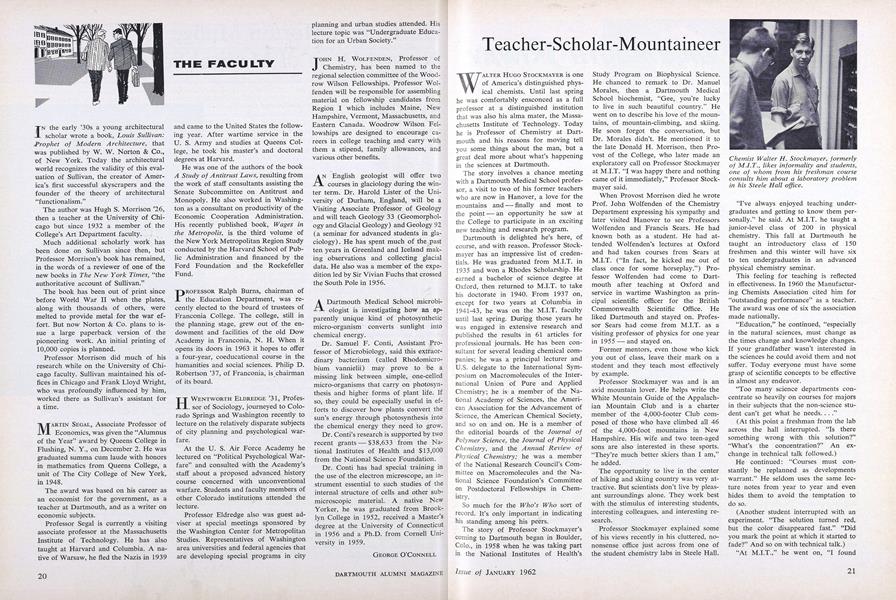
Chemist Walter H. Stockmayer, formerlyof M.I.T., likes informality and students,one of whom from his freshman courseconsults him about a laboratory problemin his Steele Hall office.
More From This Issue
-
 Feature
A Gulf That Needs Closing
January 1962 -
 Feature
John Wheelock's Laws of Conduct and Regulations for Students
January 1962 -
 Feature
DARTMOUTH SKIWAY
January 1962 -
 Feature
The Erickson-Bismarck Plan
January 1962 -
 Feature
Dr. Gilbert Horton Mudge Named Dean of Medical School
January 1962 -
 Class Notes
1956
January 1962