The Arts in Our Colleges
are ever in danger of being talked to death says the American composer who heads New York's Lincoln Center
DARTMOUTH has always been known as a singing college. Through the years I have noticed that it takes only two Dartmouth men at any social gathering for an immediate rendering of "Eleazar Wheelock" and other of your fine songs. It is now encouraging to note that with your great new Hopkins Center for the arts, Dartmouth men will have an increased awareness of artistic values to add to "the granite of New Hampshire in their muscles and their brains." Who knows, perhaps the singing might even improve.
Art centers are going up in many parts of the country. At the last count some 69 were under way or in the planning stages. It has even been said - not by me - that the arts in America now have an edifice complex. While it is true that the arts need housing, we know that their excellence is not primarily related to real estate. Yet what could be more fitting than that the arts function in a physical plant that is in itself a work of art? This is precisely what you have in the Hopkins Center, with Wallace Harrison's imaginative and gracious structure. We at Lincoln Center can feel a special kinship with you for a number of reasons. Surely a principal one is that we, too, have the good fortune of having Wallace Harrison, not only as the architect of the new Metropolitan Opera House which will rise at Lincoln Center, but as the chairman of our panel of distinguished architects.
Soon, if it has not happened already, your Center will be taken for granted. These days especially, even the most sensational developments are quickly taken for granted, as witness the conversation overheard between a mother and her child.
The mother: "Isn't it great that Grandma and Grandpa are taking a trip around the world?" The child: "How many times?"
A Center such as yours suggests two questions. One pertinent - can the arts survive without the academic community? The other - impertinent - can the arts survive within the academic community? I won't attempt to answer these questions, but rather to comment on issues germane to the answers. One of the greatest perils to the arts in academic life is that they are ever in danger of being talked to death - a proposition I trust my brief remarks will not prove.
Let me begin by saying that it is not only a pleasure to participate in these historic ceremonies - it is an honor. I believe that the Hopkins Center is a giant step forward for the arts in academic life. And in our country institutions of higher learning are becoming increasingly important to the well-being of the arts - not as a part of academic life in an isolated sense, but as part of the grand design of artistic enrichment for the creator, performer, and observer. In short, the disciplines of practice, perception, and patronage.
Practice, perception, and patronage are not words chosen for their alliterative appeal, although I confess my pleasure in their sound, but because they describe, to my mind, the place of the arts in the academic community. And this place can no longer be confined to a limited role which admits some kinds of art studies as legitimate concerns of general education, and others as suspect. It is wholly specious to view as academically respectable such traditional humanistic studies as the history of painting, while denying the same status to work in a studio with a living artist; as musicology, while denying the same status to mastery of the intellectual and technical demands, as well as esthetic insights, of actual musical performance; or, stated generally, to honor studies which concern the place of things, the investigating of things, the tools of scholarly research - all these rather than the things them selves. Let me see if I can make my point clear to you.
If we forget the arts for a moment, and turn to the automobile, we might envision two courses listed in the catalogue of your favorite college which I present to you in my own form of avant-garde, purple-prose pedagese:
COURSE 17-A. 3 points. THE AUTOMOBILE IN AMERICAN LIFE. A study of the societal implications of the wheel, with special reference to such historic precedents as the tandem bicycle, the surrey with the fringe on top, contrasted with the canoe and walking.
I will spare you a description of my second course which would be on the anatomy of the automobile and would deal with how it is built and how it operates.
Our first course tells us a great deal about how we use automobiles, but nothing about the machine itself. Our second course is not the least bit concerned with anything except how the machine is built and how it works. These examples may sound extreme if you translate them to the study of the arts in our colleges. But it is surprising how apposite they are for the point I wish to stress in relation to academic acceptance. Acceptance is not used in the narrow sense of giving course credits for applied work in the arts, since the institutions of higher learning withholding such recognition grow fewer. Acceptance is used in the broader sense of academic respectability.
The study of Art History, Philosophy of Art, Esthetics, and the like, are traditionally accepted as the stuff of liberal education. They are concerned with evaluations, with understanding the place of things, the nature of things, the interrelationship of things; and, to the extent required to reach such understanding, they investigate things them selves, but necessarily from the point of view of the evaluator rather than the practitioner. Indeed it is this very distinction of objectivity rather than emotional involvement which sets such studies apart from the active practice of art. Surely, they are informative and educational and deal with historic societal values, as did our first automobile course. They are time-honored and respected adjuncts of academic life. But what about our other automobile course - the one concerned with how it is built and how it functions. In terms of art, this means recognizing that the work of art itself is the stuff of education.
Too much of academic pursuit of the arts is concerned with talk or writing about art - talk about form, talk about expression, talk about execution, talk about talk and writing about other writing - but not with art in direct experience, not with performing a great play or symphony, not with making a poem, a dance, a painting. We best come to know the arts, not by prodigious feats of reading and talking, but by the not so simple acts of trying to create and perform works of art, and by cultivating the techniques of penetrative observation.
For work in applied arts to be accepted as academically respectable, there must be insistence on the highest level of professional intention. Here one must be careful to differentiate between professional level ability (given to few) and professional level intention and approach, possible for any strongly motivated student, even one with the most modest artistic abilities. I am saying that it is not enough to make the plea that achievement in painting, acting, and musical performance is worthy of academic respectability and acceptance, but that basic to such acceptance should be not only high artistic purpose but a professional level intensity and comprehensiveness. These criteria apply to teachers as well as to students.
A single point of view or allegiance to one esthetic is as much the right of a college professor of the arts as of any artist, but there is for him a moral as well as educational responsibility with which the non-teaching artist need not concern himself. The great creative figures of the arts are identified by strong personal profiles. It is precisely their individuality that interests us, and we are not concerned with the catholicity of their views. But teachers in an academic institution have a different responsibility. It is their duty to bring the entire body of work and the enormous variety of techniques and approaches to the attention of the student. Unless the teacher does so, there inevitably results control of education in the arts which, in my view, is antithetical to the ideals of liberal education. Democracy of education in the arts does not mean a common denominator of quality or taste. It does mean complete dissemination of materials so that the student is free to form his own judgments.
A mouse may look at a king. One need not expect a student to have the universality of a giant artist to acquire the insights of the disciplines of the arts. He will achieve far more than the mastery of craft to the degree possible for him. He will acquire a basic understanding of the processes of producing art, and no other kind of learning in the arts can give him such insights. This kind of experience is at once humbling, inspirational and, in its deepest sense, educational.
The arts, then, require that the world of education admit their entire gamut - their practice and perception without false limitations based on academic traditions no longer germane to our needs. No function of the academic community in relation to the arts is more important than that of patronage. The university's role as patron can quickly be measured when one realizes that an exceedingly high percentage of composers, painters, and sculptors are teachers, or "artists-in-residence," as they are often euphemistically called. In recent days, professional theater groups too are becoming associated with the academic community, a development of singular importance. The academic community is a great consumer of art. All these functions and practices are established and flourishing. Yet the real opportunity of patronage is often lost through a lack of the sense of adventure towards the production of controversial art in the form of new works. Our opportunity, especially in the colleges, is to explore the present as well as the past. Art is not concerned with conformity, but, on the contrary, with new forms, new vistas, new techniques. We must be alive to them if we are fully to experience their riches.
The Hopkins Center will meet the challenge of its grand concept. It will do so by being faithful to the ideals of liberal education and the values of American society. It will do so by helping us to realize that in the arts civilized man has one of his chief currencies for communication. It will do so by helping us to a greater understanding of the humanity of the arts - a humanity incapable of definition in words, although suggested by Thomas Wolfe in his preface to Look Homeward Angel:
"Which of us has known his brother? Which of us has looked into his father's heart? Which of us is not forever prison-pent? Which of us is not forever a stranger and alone?"
These questions cannot be answered - they can only be experienced. They speak of the fundamental meanings and mysteries of life. And it is in this realm that the arts speak to us in their special way. It is in this way that the arts communicate. And it is this power to communicate among men that is the secret of their universality and the reason why this great institution has built a monument to their practice, perception, and patronage.
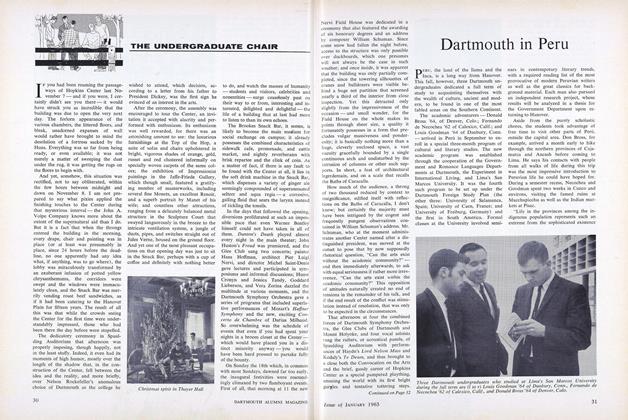
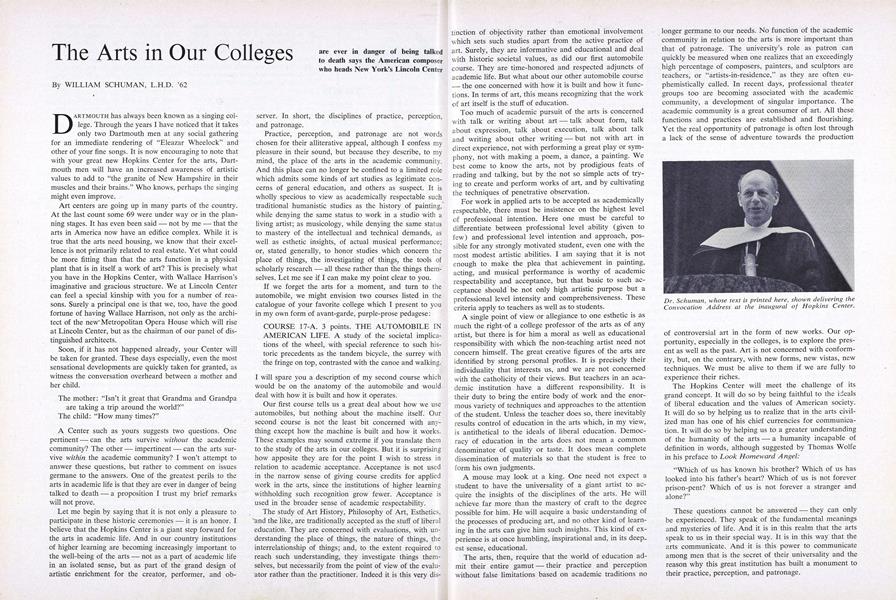
Dr. Schuman, whose text is printed here, shown delivering theConvocation Address at the inaugural of Hopkins Center.