1921's 45th
With Irish ebullience, Tommy Keane, former Dartmouth golf coach, opined, "Not bad for a hot day after a hot night." Ever- conservative Doug Storer burst out, "Amazing but true." He meant the 46th and also the 1921 golf tournament. Norm Carver won it with a fantastic 62, eight below par. If he had not had six penalty strokes and four-putted three greens, the count would have been even lower. Birdying the last seven holes, Big Boomer Dan Patch, 66, was a gallant loser. Third with 69, Ike Chester set the crowd up with two cases of champagne, for he had two holes in one (the 7th, 300 yards, and the 13th, 350 yards). Sharing in the $125,000 prize money but off their game were Bord Helmer,Harry Chamberlame, and DOB Morse, each with 70. Hilt Campbell (71), Martha Burroughs (72), Ted Sonnenfeld (73), Red Stanley (74), Chick Stiles (75), and Jack Hurd (118) were all disqualified for failing to meet the 70 cut-off.
An intellectual class, an aristocracy of brains, '21ers listened with old-fashioned respect to authoritative voices in the panel discussion, Whither Dartmouth. Dean Seymour praised undergraduates whose points of view have not always found commendation by Manchester Loebites. Impressed with our present gifted students and their intense desire to take advantage of cultural opportunities, the Dean is equally impressed with their moral earnestness. In times of unprecedented stress, they are passionately occupied with ethical justice. Hence Kodak, Wallace, and Vietnam with its upsetting dilemma. Is that war immoral? Adverse criticism of it immoral? Gone are the apathy of past generations and Campion elegance of dress. Down to the naked man, let's skip the cologne. Let's strip down governmental rhetoric and get the facts. In Dean Seymour's opinion, such questioning is good because with freshness and light it forces older persons, freed from cant, to speak sincerely and clearly. The problem at Dartmouth today is how to close the gap between the classroom and laboratory with tight discipline (necessary for graduate school) and "the world of reality." The student experimental college is heartening with some 23 courses a term one evening a week with 1000 participants exploring such diverse subjects as the stock market, rock and roll, computers, poverty and slums, Japanese and Arabic, bridge for beginners, advertising, the Cuban Revolution, and American and European movies. Our job is to teach patience to an impatient generation long on short-term crises and short on long-term goals.
Dean Tribus of Thayer School pointed out that families today, utterly different, are not producers but consumers. So are the sons fashioned, perpetual consumers with no motivation, no hungers, deceptively bright but potentially parasitical and decadent. The Engineering School attempts to give a student chances to become creative in and out of the classroom. Challenge him to become expert in something. Two sample projects. Drink a glass of brakish water from South Dakota. Why must communities put up with such foul menaces to decency and health? Go ahead and find out with Chemistry, Physics, City Planning, Geology, and Ethics. How about costs? Play your findings on tape to your fellow-workers. If they cannot understand you, is the fault theirs? Must not an engineer be required to communicate in business? Second: crippled kids at Crotched Mountain. Problem: inexpensive and practical machines to help kids and nurses. You're too generous and idealistic to patent your invention? But no manufacturer will risk capital without patents. Want to form a company and make money? Why not?
Poker faced, Ellis Briggs, Master of Ceremonies, pointed out how differently persons view a problem and the events of a year. Take 1962. The major impression for one man was the superlative football player, Billy King, and the Dartmouth Ivy League Football Championship. For a second man it was the erection of Hopkins Center with its potential as a Congregation of the Arts. More than a little profanely practical, a third exclaimed with passionate promptness, "1962 was when Hanover installed those god-damned traffic lights." 1967 was even more controversial.
If intellectually oriented, 1921 has its light touch. Unable to down 1917 Sargent sweet cider syphoned into jugs from kegs on a horse-drawn wagon, tent patrons, stimulated by cola and ginger, coffee and toast-side-of peanut, sweet mashes, and unbearded barley water, applauded Ted Sonnenfeld with his nostalgic songs: " I can dance with everybody but my wife," "Where did Robinson Crusoe go with Friday on Saturday Night?", "If that's where the bees get honey, no honey for me," and "If that's all there is, there ain't no more blues." And then the dancers of dear departed days: Jack Donahue with Marilyn Miller, Ray Bolger in "The Wizard of Oz," Royal and Dixon, Moran and Mack (The Two Black Crows), Pat Rooney, and Fred Stone of Montgomery and Stone. With Roberta at the piano, Bill Embree parodied them all, and he even gave a stylized version of himself in 1917. He did so well that he had some men falsifying Ted's first song and humming, "I can dance with nobody but my wife" and proving it—almost. Without pushing back the furniture in "the good old days," one danced without the violent contortions of rock and roll in spacious discotheques. We were products of Doc Bowler's disciplined gymnastics where Rubbery Roger Wilde won honors on horses and cross bars.
Content with the girl just like the girl that married dear old Dad, you may be concerned with coeducation at Dartmouth and the impact on future female integrity. Dean Seymour has given us the word. 1. He has heard of no administrative colleague giving serious consideration to Dartmouth coeducation because of other difficult problems in the next ten years (faculty salaries and graduate schools). 2. If a woman's college with millions should buy immense tracts of land in Norwich, Dartmouth might cock an ear. 3. Dartmouth students favor for Norwich the Powers Modelling School. 4. They lack interest in higher education for women. Dominantly male, they limit their dream world to a coeducational Dartmouth where they may choose among 2500 beauties for weekend dates. The men are broad- minded enough, however, to stay within "the world of reality" and question seriously whether a fresh date every evening would be entirely beneficial for the highest fulfillment of the masculine mind as challenged by Tribus, Seymour, and the faculty.
This brief report, only 1000 words, can do no justice to the variety of emotional and intellectual fulfillments of the 46th. It will be augmented by Dan Haggles' Smoker with a detailed report including John Sullivan's reminiscences contrasting events and personalities of 1917 with those of 1967.
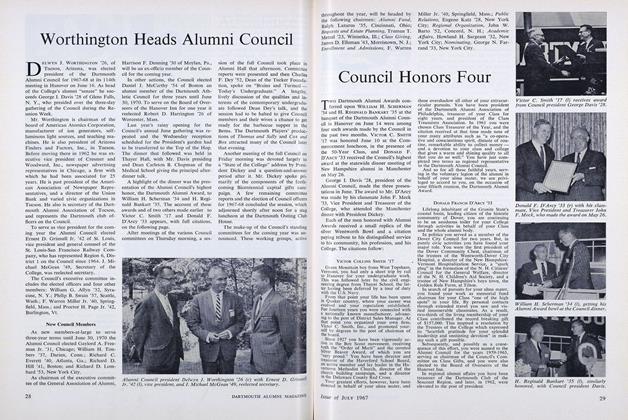
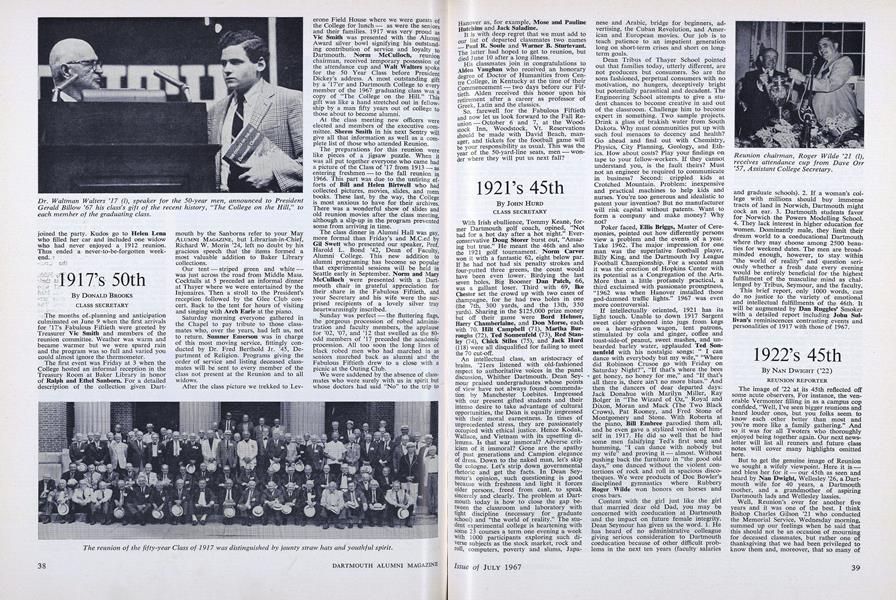
Reunion chairman, Roger Wilde '21 (I),receives attendance cup from Dave Orr'57, Assistant College Secretary.
CLASS SECRETARY