Police Commissioner
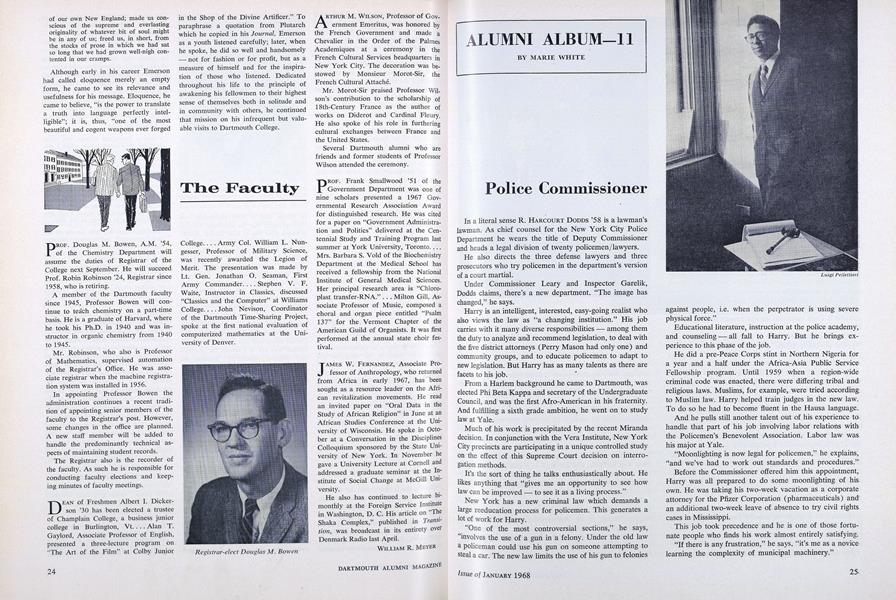
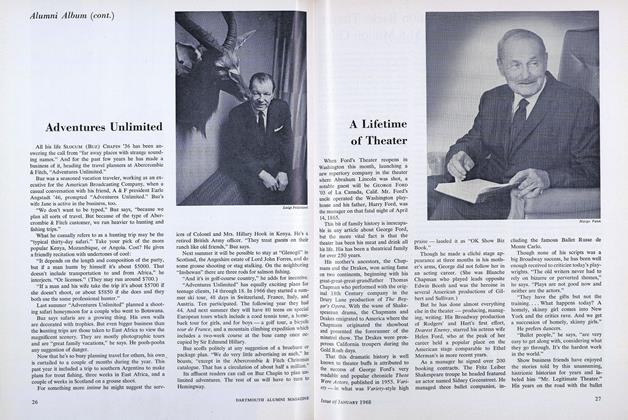
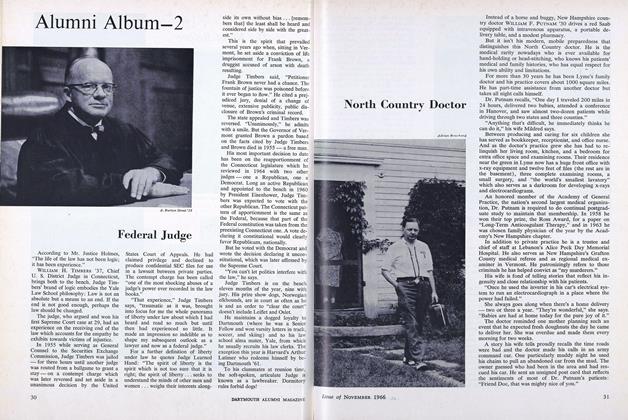
In a literal sense R. HARCOURT DODDS '58 is a lawman's lawman. As chief counsel for the New York City Police Department he wears the title of Deputy Commissioner and heads a legal division of twenty policemen/lawyers.
He also directs the three defense lawyers and three prosecutors who try policemen in the department's version of a court martial.
Under Commissioner Leary and Inspector Garelik, Dodds claims, there's a new department. "The image has changed," he says.
Harry is an intelligent, interested, easy-going realist who also views the law as "a changing institution." His job carries with it many diverse responsibilities - among them the duty to analyze and recommend legislation, to deal with the five district attorneys (Perry Mason had only one) and community groups, and to educate policemen to adapt to new legislation. But Harry has as many talents as there are facets to his job.
From a Harlem background he came to Dartmouth, was elected Phi Beta Kappa and secretary of the Undergraduate Council, and was the first Afro-American in his fraternity. And fulfilling a sixth grade ambition, he went on to study law at Yale.
Much of his work is precipitated by the recent Miranda decision. In conjunction with the Vera Institute, New York City precincts are participating in a unique controlled study on the effect of this Supreme Court decision on interrogation methods.
It's the sort of thing he talks enthusiastically about. He likes anything that "gives me an opportunity to see how law can be improved - to see it as a living process."
New York has a new criminal law which demands a large reeducation process for policemen. This generates a lot of work for Harry.
"One of the most controversial sections," he says, "involves the use of a gun in a felony. Under the old law a policeman could use his gun on someone attempting to steal a car. The new law limits the use of his gun to felonies against people, i.e. when the perpetrator is using severe physical force."
Educational literature, instruction at the police academy,, and counseling - all fall to Harry. But he brings experience to this phase of the job.
He did a pre-Peace Corps stint in Northern Nigeria for a year and a half under the Africa-Asia Public Service Fellowship program. Until 1959 when a region-wide criminal code was enacted, there were differing tribal and religious laws. Muslims, for example, were tried according, to Muslim law. Harry helped train judges in the new law. To do so he had to become fluent in the Hausa language.
And he pulls still another talent out of his experience to handle that part of his job involving labor relations with the Policemen's Benevolent Association. Labor law was his major at Yale.
"Moonlighting is now legal for policemen," he explains, "and we've had to work out standards and procedures."
Before the Commissioner offered him this appointment, Harry was all prepared to do some moonlighting of his. own. He was taking his two-week vacation as a corporate attorney for the Pfizer Corporation (pharmaceuticals) and an additional two-week leave of absence to try civil rights, cases in Mississippi.
This job took precedence and he is one of those fortunate people who finds his work almost entirely satisfying.
"If there is any frustration," he says, "it's me as a novicelearning the complexity of municipal machinery."