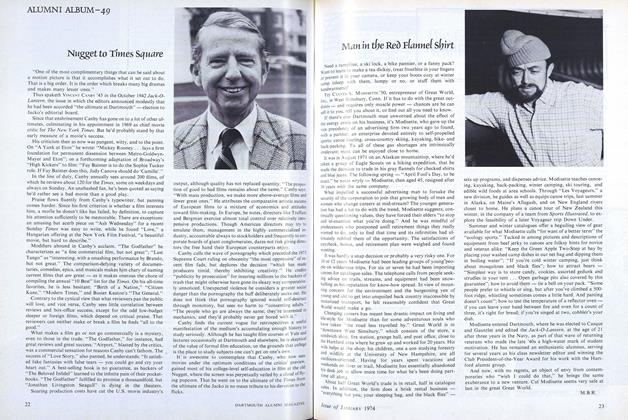
Nugget to Times Square
"One of the most complimentary things that can be said about a motion picture is that it accomplishes what it set out to do. That is a big order. It is the order which breaks many big dramas and makes many lesser ones."
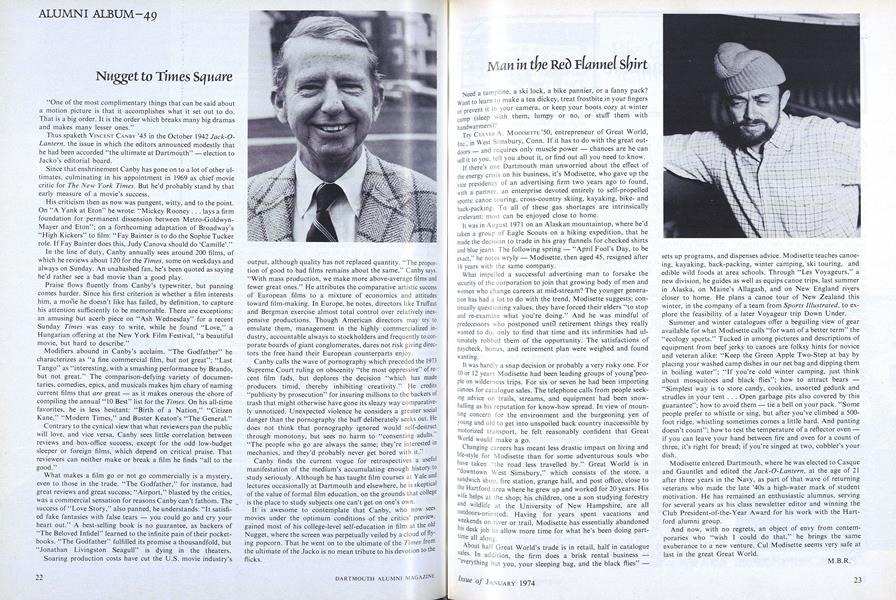
Thus spaketh VINCENT CANBY '45 in the October 1942 Jack-O-Lantern, the issue in which the editors announced modestly that he had been accorded "the ultimate at Dartmouth" election to Jacko's editorial board.
Since that enshrinement Canby has gone on to a lot of other ultimates. culminating in his appointment in 1969 as chief movie critic for The New York Times. But he'd probably stand by that early measure of a movie's success.
His criticism then as now was pungent, witty, and to the point. On "A Yank at Eton" he wrote: "Mickey Rooney ... lays a firm foundation for permanent dissension between Metro-Goldwyn- Mayer and Eton"; on a forthcoming adaptation of Broadway's "High Kickers" to film: "Fay Bainter is to do the Sophie Tucker role. If Fay Bainter does this, Judy Canova should do 'Camille'."
In the line of duty, Canby annually sees around 200 films, of which he reviews about 120 for the Times, some on weekdays and always on Sunday. An unabashed fan, he's been quoted as saying he'd rather see a bad movie than a good play.
Praise flows fluently from Canby's typewriter, but panning comes harder. Since his first criterion is whether a film interests him, a movie he doesn't like has failed, by definition, to capture his attention sufficiently to be memorable. There are exceptions: an amusing but acerb piece on "Ash Wednesday" for a recent Sunday Times was easy to write, while he found "Love," a Hungarian offering at the New York Film Festival, "a beautiful movie, but hard to describe."
Modifiers abound in Canby's acclaim. "The Godfather" he characterizes as "a fine commercial film, but not great"; "Last Tango" as "interesting, with a smashing performance by Brando, but not great." The comparison-defying variety of documentaries, comedies, epics, and musicals makes him chary of naming current films that are great as it makes onerous the chore of compiling the annual "10 Best" list for the Times. On his all-time favorites, he is less hesitant: "Birth of a Nation," "Citizen Kane," "Modern Times," and Buster Keaton's "The General."
Contrary to the cynical view that what reviewers pan the public will love, and vice versa, Canby sees little correlation between reviews and box-office success, except for the odd low-budget sleeper or foreign films, which depend on critical praise. That reviewers can neither make or break a film he finds "all to the good."
What makes a film go or not go commercially is a mystery, even to those in the trade. "The Godfather," for instance, had great reviews and great success; "Airport," blasted by the critics, was a commercial sensation for reasons Canby can't fathom. The success of "Love Story," also panned, he understands: "It satisfied fake fantasies with false tears — you could go and cry your heart out." A best-selling book is no guarantee, as backers of "The Beloved Infidel" learned to the infinite pain of their pocket-books. "The Godfather" fulfilled its promise a thousandfold, but "Jonathan Livingston Seagull" is dying in the theaters.
Soaring production costs have cut the U.S. movie industry's output, although quality has not replaced quantity. "The proportion of good to bad films remains about the same," Canby says. "With mass production, we make more above-average films and fewer great ones." He attributes the comparative artistic success of European films to a mixture of economics and attitudes toward film-making. In Europe, he notes, directors like Truffaut and Bergman exercise almost total control over relatively inexpensive productions. Though American directors may try to emulate them, management in the highly commercialized industry, accountable always to stockholders and frequently to corporate boards of giant conglomerates, dares not risk giving directors the free hand their European counterparts enjoy.
Canby calls the wave of pornography which preceded the 1973 Supreme Court ruling on obscenity "the most oppressive" of recent cent film fads, but deplores the decision "which has made producers timid, thereby inhibiting creativity." He credits "publicity by prosecution" for insuring millions to the backers of trash that might otherwise have gone its sleazy way comparatively unnoticed. Unexpected violence he considers a greater social danger than the pornography the buff deliberately seeks out. He does not think that pornography ignored would self-destruct through monotony, but sees no harm to "consenting adults. "The people who go are always the same; they're interested in mechanics, and they'd probably never get bored with it.
Canby finds the current vogue for retrospectives a useful manifestation of the medium's accumulating enough history to study seriously. Although he has taught film courses at Yale and lectures occasionally at Dartmouth and elsewhere, he is skeptical of the value of formal film education, on the grounds that college is the place to study subjects one can't get on one's own.
It is awesome to contemplate that Canby, who now sees movies under the optimum conditions of the critics' previewgained most of his college-level self-education in film at the old Nugget, where the screen was perpetually veiled by a cloud of flying popcorn. That he went on to the ultimate of the Times from the ultimate of the Jacko is no mean tribute to his devotion to the flicks.