1932
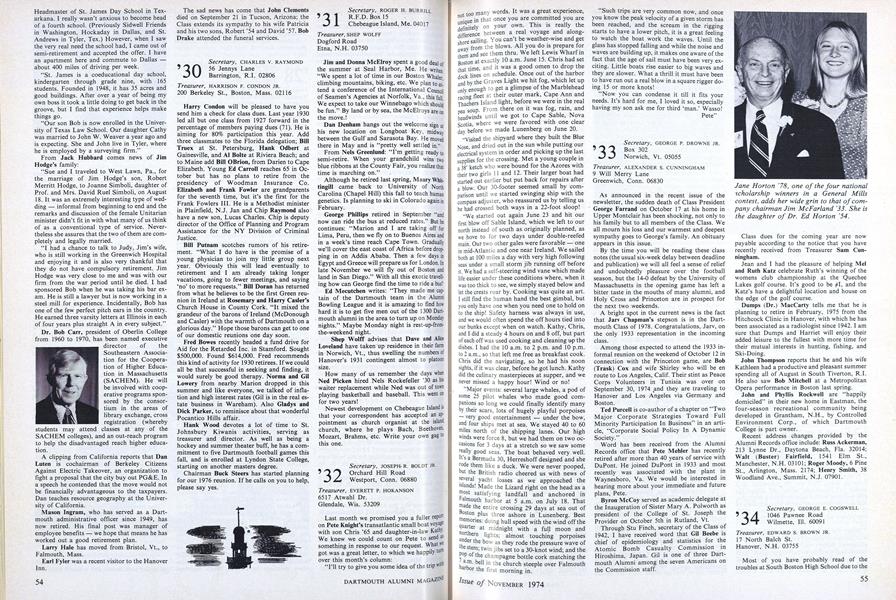
Last month we promised you a fuller report on Pete Knight's transatlantic small boat voyage with son Chris '65 and daughter-in-law Kathy. We knew we could count on Pete to send us something in response to our request. What we got was a great letter, to which we happily over this month's column:
"I'll try to give you some idea of the trip with not too many words. It was a great experience, not too that once you are committed you are definitely on your own. This is really the difference between a real voyage and along-shore sailing- You can't be weather-wise and get away from the blows. All you do is prepare for them see them thru. We left Lewis Wharf in Boston at exactly 10 a.m. June 15. Chris had set that time, and it was a good omen to drop the dock lines on schedule. Once out of the harbor and by the Graves Light we hit fog, which let up only enough to get a glimpse of the Marblehead racing fleet at their outer mark, Cape Ann and Thachers Island light, before we were in the real pea soup. From there on it was fog, rain, and headwinds until we got to Cape Sable, Nova Scotia, where we were favored with one clear day before we made Lunenberg on June 20.
"Visited the shipyard where they built the Blue Nose, and dried out in the sun while putting our electrical system in order and picking up the last supplies for the crossing. Met a young couple in a 38' ketch who were bound for the Azores with heir two girls 11 and 12. Their larger boat had started out earlier but put back for repairs after a blow. Our 30-footer seemed small by comparison until we started swinging ship with the compass adjuster, who reassured us by telling us he had crossed both ways in a 22-foot sloop!
"We started out again June 23 and hit our first blow off Sable Island, which we left to our north instead of south as originally planned, as we hove to for two days under double-reefed main. Our two other gales were favorable - one in mid-Atlantic and one near Ireland. We sailed both at 100 miles a day with very high following seas under a small storm jib running off before it. We had a self-steering wind vane which made life easier under these conditions where, when it was too thick to see, we simply stayed below and let the crests roar by. Cooking was quite an art. I still find the human hand the best gimbal, but you only have one when you need one to hold on to the ship! Safety harness was always in use, and we would often spend the off hours tied into our bunks except when on watch. Kathy, Chris, and I did a steady 4 hours on and 8 off, but part of each off was used cooking and cleaning up the dishes. I had the 10 a.m. to 2 p.m. and 10 p.m. to 2 a.m., so that left me free as breakfast cook. Chris did the navigating, so he had his noon sights, if it was clear, before he got lunch. Kathy did the culinary masterpieces at supper, and we never missed a happy hour! Wind or no!
"Major events: several large whales, a pod of some 25 pilot whales who made good companions so long we could finally identify many by their scars, lots of hugely playful porpoises - very good entertainment - under the bow, and four ships met at sea. We stayed 40 to 60 miles north of the shipping lanes. Our high winds were force 8, but we had them on two occasions for 3 days at a stretch so we saw some really good seas. The boat behaved very well, It's a Bermuda 30, Herreshoff designed and she rode them like a duck. We were never pooped, but the British radio cheered us with news of several yacht losses as we approached the islands! Made the Lizard right on the head as a most satisfying landfall and anchored in Falmouth harbor at 5 a.m. on July 18. That made the entire crossing 29 days at sea out of Boston plus three ashore in Lunenberg. Best memories: doing hull speed with the wind off the garter at midnight with a full moon and northern lights; almost touching porpoises under the bow as they rode the pressure wave of the stem; twin jibs set to a 30-knot wind; and the pop of the champagne bottle cork matching the 7 a.m. bell in the church steeple over Falmouth harbor the first morning in.
"Such trips are very common now, and once you know the peak velocity of a given storm has been reached, and the scream in the rigging starts to have a lower pitch, it is a great feeling to watch the boat work the waves. Until the glass has stopped falling and while the noise and waves are building up, it makes one aware of the fact that the age of sail must have been very exciting. Little boats rise easier to big waves and they are slower. What a thrill it must have been to have run out a real blow in a square rigger doing 15 or more knots!
"Now you can condense it till it fits your needs. It's hard for me, I loved it so, especially having my son ask me for third 'man.' Wasso!
Pete"
Secretary, Orchard Hill Road Westport, Conn. 06880
Treasurer, 6517 Atwahl Dr. Glendale, Wis. 53209