A Place In the Country
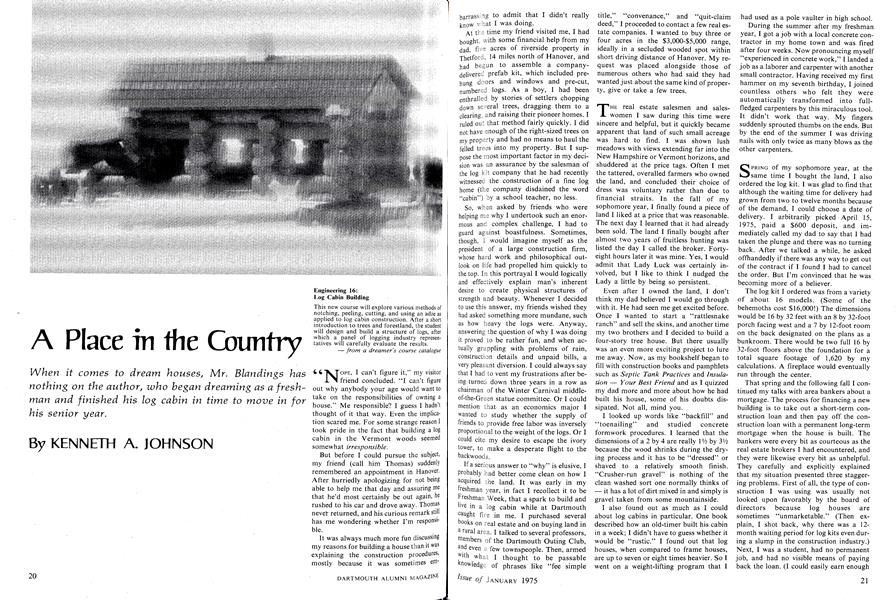
When it comes to dream houses, Mr. Blandings hasnothing on the author, who began dreaming as a freshman and finished his log cabin in time to move in forhis senior year.
Engineering 16: Log Cabin Building
This new course will explore various methods of notching, peeling, cutting, and using an adze as applied to log cabin construction. After a short introduction to trees and forestland, the student will design and build a structure of logs, after which a panel of logging industry representatives will carefully evaluate the results.
- from a dreamer's course catalogue
"NOPE, I can't figure it," my visitor friend concluded. "I can't figure out why anybody your age would want to take on the responsibilities of owning a house." Me responsible? I guess I hadn't thought of it that way. Even the implication scared me. For some strange reason I took pride in the fact that building a log cabin in the Vermont woods seemed somewhat irresponsible.
But before I could pursue the subject, my friend (call him Thomas) suddenly remembered an appointment in Hanover. After hurriedly apologizing for not being able to help me that day and assuring me that he'd most certainly be out again, he rushed to his car and drove away. Thomas neve'r returned, and his curious remark still has me wondering whether I'm responsible.
It was always much more fun discussing my reasons for building a house than it was explaining the construction procedures, mostly because it was sometimes embarrassing to admit that I didn't really know what I was doing.
At the time my friend visited me, I had bought, with some financial help from my dad, five acres of riverside property in Thetford, 14 miles north of Hanover, and had begun to assemble a company- delivered prefab kit, which included prehung doors and windows and pre-cut, numbered logs. As a boy, I had been enthralled by stories of settlers chopping down several trees, dragging them to a clearing, and raising their pioneer homes. I ruled out that method fairly quickly. I did not have enough of the right-sized trees on my property and had no means to haul the felled trees into my property. But I suppose the most important factor in my decision was an assurance by the salesman of the log kit company that he had recently witnessed the construction of a fine log home (the company disdained the word "cabin") by a school teacher, no less.
So, when asked by friends who were helping me why I undertook such an enormous and complex challenge, I had to guard against boastfulness. Sometimes, though, I would imagine myself as the president of a large construction firm, whose hard work and philosophical outlook on life had propelled him quickly to the top. In this portrayal I would logically and effectively explain man's inherent desire to create physical structures of strength and beauty. Whenever I decided to use this answer, my friends wished they had asked something more mundane, such as how heavy the logs were. Anyway, answering the question of why I was doing it proved to be rather fun, and when actually grappling with problems of rain, construction details and unpaid bills, a very pleasant diversion. I could always say that I had to vent my frustrations after being turned down three years in a row as chairman of the Winter Carnival middle- of-the-Green statue committee. Or I could mention that as an economics major I wanted to study whether the supply of friends to provide free labor was inversely proportional to the weight of the logs. Or I could cite my desire to escape the ivory tower, to make a desperate flight to the backwoods.
If a serious answer to "why" is elusive, I probably had better come clean on how I acquired the land. It was early in my freshman year, in fact I recollect it to be Freshman Week, that a spark to build and live in a log cabin while at Dartmouth caught fire in me. I purchased several books on real estate and on buying land in a rural area. I talked to several professors, members of the Dartmouth Outing Club, and even a few townspeople. Then, armed with what I thought to be passable knowledge of phrases like "fee simple title," "convenance," and "quit-claim deed," I proceeded to contact a few real estate companies. I wanted to buy three or four acres in the $3,000-$5,000 range, ideally in a secluded wooded spot within short driving distance of Hanover. My request was placed alongside those of numerous others who had said they had wanted just about the same kind of property, give or take a few trees.
THE real estate salesmen and saleswomen I saw during this time were sincere and helpful, but it quickly became apparent that land of such small acreage was hard to find. I was shown lush meadows with views extending far into the New Hampshire or Vermont horizons, and shuddered at the price tags. Often I met the tattered, overalled farmers who owned the land, and concluded their choice of dress was voluntary rather than due to financial straits. In the fall of my sophomore year, I finally found a piece of land I liked at a price that was reasonable. The next day I learned that it had already been sold. The land I finally bought after almost two years of fruitless hunting was listed the day I called the broker. Forty-eight hours later it was mine. Yes, I would admit that Lady Luck was certainly involved, but I like to think I nudged the Lady a little by being so persistent.
Even after I owned the land, I don't think my dad believed I would go through with it. He had seen me get excited before. Once I wanted to start a "rattlesnake ranch" and sell the skins, and another time my two brothers and I decided to build a four-story tree house. But there usually was an even more exciting project to lure me away. Now, as my bookshelf began to fill with construction books and pamphlets such as Septic Tank Practices and Insulation - Your Best Friend and as I quizzed my dad more and more about how he had built his house, some of his doubts dissipated. Not all, mind you.
I looked up words like "backfill" and "toenailing" and studied concrete formwork procedures. I learned that the dimensions of a2by 4 are really 1½ by 3½ because the wood shrinks during the drying process and it has to be "dressed" or shaved to a relatively smooth finish. "Crusher-run gravel" is nothing of the clean washed sort one normally thinks of - it has a lot of dirt mixed in and simply is gravel taken from some mountainside.
I also found out as much as I could about log cabins in particular. One book described how an old-timer built his cabin in a week; I didn't have to guess whether it would be "rustic." I found out that log houses, when compared to frame houses, are up to seven or eight times heavier. So I went on a weight-lifting program that I had used as a pole vaulter in high school.
During the summer after my freshman year, I got a job with a local concrete contractor in my home town and was fired after four weeks. Now pronouncing myself "experienced in concrete work," I landed a job as a laborer and carpenter with another small contractor. Having received my first hammer on my seventh birthday, I joined countless others who felt they were automatically transformed into fullfledged carpenters by this miraculous tool. It didn't work that way. My fingers suddenly sprouted thumbs on the ends. But by the end of the summer I was driving nails with only twice as many blows as the other carpenters.
SPRING of my sophomore year, at the same time I bought the land, I also ordered the log kit. I was glad to find that although the waiting time for delivery had grown from two to twelve months because of the demand, I could choose a date of delivery. I arbitrarily picked April 15, 1975, paid a $600 deposit, and immediately called my dad to say that I had taken the plunge and there was no turning back. After we talked a while, he asked offhandedly if there was any way to get out of the contract if I found I had to cancel the order. But I'm convinced that he was becoming more of a believer.
The log kit I ordered was from a variety of about 16 models. (Some of the behemoths cost $16,000!) The dimensions would be 16 by 32 feet with an 8 by 32-foot porch facing west and a 7 by 12-foot room on the back designated on the plans as a bunkroom. There would be two full 16 by 32-foot floors above the foundation for a total square footage of 1,620 by my calculations. A fireplace would eventually run through the center.
That spring and the following fall I continued my talks with area bankers about a mortgage. The process for financing a new building is to take out a short-term construction loan and then pay off the construction loan with a permanent long-term mortgage when the house is built. The bankers were every bit as courteous as the real estate brokers I had encountered, and they were likewise every bit as unhelpful. They carefully and explicitly explained that my situation presented three staggering problems. First of all, the type of construction I was using was usually not looked upon favorably by the board of directors because log houses are sometimes "unmarketable." (Then explain, I shot back, why there was a 12- month waiting period for log kits even during a slump in the construction industry.) Next, I was a student, had no permanent job, and had no visible means of paying back the loan. (I could easily earn enough during one month on a summer construction job to cover the $80 monthly payments.) Finally, the credit market was extremely "tight." (But my economics professors, who had admittedly not made a bundle in the stock market but still "knew their stuff' as far as I was concerned, had forecasted that the rates would go down.) Predictably, the bankers weren't very impressed by these arguments.
By fall of my junior year most of my planning was accomplished, with the exception of financing. I had worked that summer once again as a somewhat hapless, but constantly improving, carpenter and had decided to cash in some stocks I had received from my grandmother in order to start on the foundation in the fall. I would cover the foundation sides with hay to prevent them from heaving during the winter, and begin the cabin itself the following spring when the kit arrived.
When I spoke with a college official about changing my course scheduling (I am on the Dartmouth Plan) to an off-term in the spring and an on-term in the summer so that I could build a house (by now I was getting used to the questions), she said as I left that she doubted that I would be able to get it done by summer and that I should perhaps think about taking off six months. I guess I didn't want to tell her that when the logs have been pre-cut and when there are several experienced men working, some cabins have been put up in a space of less than a week. I had allowed about three months for putting up the shell, but I secretly thought she might be right.
So at the beginning of fall term (I was still taking classes but thought I'd still be able to get the foundation in), I filed my building permit. The permit issuer met me at my property one day and I vaguely waved my hand toward the place where the house would go. After talking for a few minutes he said everything was "in proper working order," except that I ought to include a garage in my plans, in case later I wanted to add one. After I had done that, he signed the permit I had hastily filled out shortly before he arrived, and bid me a good day.
RENTING the concrete forms .was in no way as simple as getting a building permit. Forms are used to make the heavily reinforced molds into which the concrete is poured. I looked up the names of all the area concrete contractors to see if I could rent their forms. Finally, I convinced the contractor who was graveling my road that I would take good care of his forms and would clean them thoroughly of concrete after use.
Concrete is measured in cubic yards, which means that the volume 3 feet by 3 feet by 3 feet or 27 square feet equals one yard. Figuring the number of yards to order for a full foundation seems to take experience at the very least and a mathematical mind coupled with an uncanny judgement in the most difficult circumstances. This was only one of the several minor jobs when I asked the contractor who rented me the forms for help
Pouring the concrete had to be done in three separate stages due to complications with "ledge" - an invidious continuous stone slab extending far into the hillside. Once, while I was working on the second stage to ready the formwork for the redimix truck, I imprudently decided to order the concrete before I was ready for it. Sure enough, Murphy's Law - in any given situation if something bad can go wrong, it probably will - came true. The concrete truck came rumbling onto my property three hours before I was ready. I anxiously told the driver my predicament and by using a shortwave radio to the main office he eventually located another customer who could take the concrete originally mixed for me. Visions of the driver refusing to listen to my problem and simply dumping several tons of concrete on the ground for me to shovel faded away.
The foundation was poured to specifications and shored up with hay; then I awaited spring. The winter of 1973-74 could not pass fast enough. I busied myself with extra courses and ski touring, but my mind often strayed to the image of my house as I hoped it would look when completed.
About the middle of April my brother, Mac ('70), arrived. He had just finished med school and had consented the fall before to help me for four weeks. We rented a large truck from Hertz and drove down to Massachusetts to pick up the cabin. A 40-foot tractor-trailer ("semi") rig would haul most of the logs. Our truck would bring the rafters, windows, and doors. In the yard we observed forklifts busily moving around with large loads of pre-cut and bundled logs and wondered if by the time the shell was complete we might wish that we had used a forklift instead of hefting each log into place manually.
Unloading the logs from the 40-foot trailer posed no problem for the mechanical hoist. Our truck had to be unloaded by hand, though, which we completed around midnight. I must sheepishly admit the job was exhausting and we slept late the next day, the first full day after the long-awaited arrival of the logs.
Mac and I spent about five days placing the first layer of logs. Although it was still' spring, I remember thinking that at that rate the following winter could be mighty long and cold. The difficulty was the flooring system, which had to be constructed before any more logs could be placed on the walls.
Each log is grooved lengthwise, top and bottom; into this groove we put a masonite "spline" to seal the joint between the logs. Spikes were used to secure the logs and prevent them from shifting. After the first layer and the floor had been completed, the remaining layers took an average of about .half a day apiece. Until we came to the windows, where the joints were broken and the logs were shorter, many of the logs measured up to 14 feet long and weighed as much as 150 pounds.
My brother and I decided to camp in a tent to avoid paying rent and to be close to the construction site. We cooked most of our evening meals over an open fire. In the mornings we were usually anxious to start building and by noon we were often engrossed in the problem of the day, so we ate many sandwiches, mostly peanut butter and jelly. Ask any of my friends even now and they will single me out as a zealot who is constantly extolling the virtues of peanut butter.
Slowly the logs crept higher. Some days I spent the entire morning recruiting helpers and spent the entire afternoon explaining the procedure to my recruits. Other times Mac and I decided to see how much we could do by ourselves. At the end of four weeks we were at the second floor level. Before my brother left, I took some zany pictures of him pretending he was falling off the walls. It was too bad that he had had only four weeks to help out.
By the time I had the rafters up, my younger brother Milo, 18, had finished school for the summer and came to help put on the roof. I had decided to use pine and had been warned that it was unwise to allow the pine to get wet, as it would stain badly. Unfortunately, the weather was uncommonly wet, and at night Milo and I often tried to decide whether we spent more time putting plastic over the pine boards or actually putting on the roof. We finished in late June, two weeks after the start of summer term, and I started drying out my class, notes.
Once the roof was complete, the house - and more importantly, myself - were finally spared the frequent drenchings we had sustained throughout the spring. A triumphant moment: Milo decorated one wall with a set of antlers taken from a deer he had shot and I put up a picture of Teddy Roosevelt. Below the picture I Scotchtaped the following lines: "Far better is it to take a chance to win glorious victory and triumph even though checked by defeat than to take rank with those who know neither success nor failure because they live in the grey twilight and have tried neither."
As I drank a beer on the porch (Bud seems to be most popular among construction workers), I surveyed the situation. I had a beautiful spot in the Vermont woods and had already been invited to the reunions of several classes to which I did not belong. I had worked harder than I had in my entire life. (As the author in one of my construction books found, "I learned long ago that I worked much harder at those things in which I had a personal interest at stake.") I seemed to be the envy of many adults who visited me and praised the initiative they said it took to undertake such a project. I had the satisfaction of knowing that my dad, who was to visit in the fall, wouldn't be the only one in the family who had built a house. I owned a piece of real estate which, according to my insurance agent, was worth twice the value of the material I had used, plus the original value of the land.
I just guess I'm idealistic enough and wet enough behind the ears to believe Thoreau when he said, "If one advances confidently in the direction of his dreams and endeavors to live the life he has imagined, he will meet with success unexpected in common hours."
But there is a financial headache. I still don't have a mortgage for the place. An $8,000 note, guiltily obtained by putting up as collateral shares of stock owned by my aunt and uncle, comes due in 15 months. And I have no indoor plumbing, which lessens my already slim chances with the bankers. My choice of work when I graduate this month is restricted very simply by the fact that I must find the highest-paying job I can - probably oil rigs.
As I sit here writing the conclusion and periodically stoking the wood stove with maple (it burns the warmest), I ponder the question of whether I would do it again. Well, let's see ... if I can save up the $8,000 in the next year or so to pay off my debt, I just might go see about a piece of land up the road that I remember one of my neighbors saying he wouldn't mind selling ....
During the construction of his cabin,Kenneth Johnson '75 somehow earnedenough credits to graduate at the end ofthe fall term - six months early. He isfrom Grand Junction, Colorado.
More From This Issue
-
 Feature
THE HUNTERS, OR THE SUFFERINGS OF HUGH AND FRANCIS, IN THE WILDERNESS.
January 1975 -
 Feature
A MEMORANDUM
January 1975 -
Feature
Jeffrey Hart Professor of English 20 million readers in a single column
January 1975 -
 Feature
Noel Perrin Professor of English 2 pigs on a single form
January 1975 -
 Feature
Carole Berger Professor of English 2 wolves in a single run
January 1975 -
Feature
Robert Huke Professor of Geography 150 catfish in a single dame
January 1975
Features
-
 Feature
Nine of Dartmouth's Distinguished Professors Retire on June 30
JUNE 1963 -
 Feature
The Widmayer Touch
OCTOBER, 1908 -
 Feature
"Mr. Hockey" By General Acclaim
FEBRUARY 1967 -
 Feature
Hanover Marks Its 200th Year
April 1961 -
 Feature
A Passion for Speed
March 1998 -
 Feature
Anti-Social Climbers
December 1994


