CLASS OF 1850
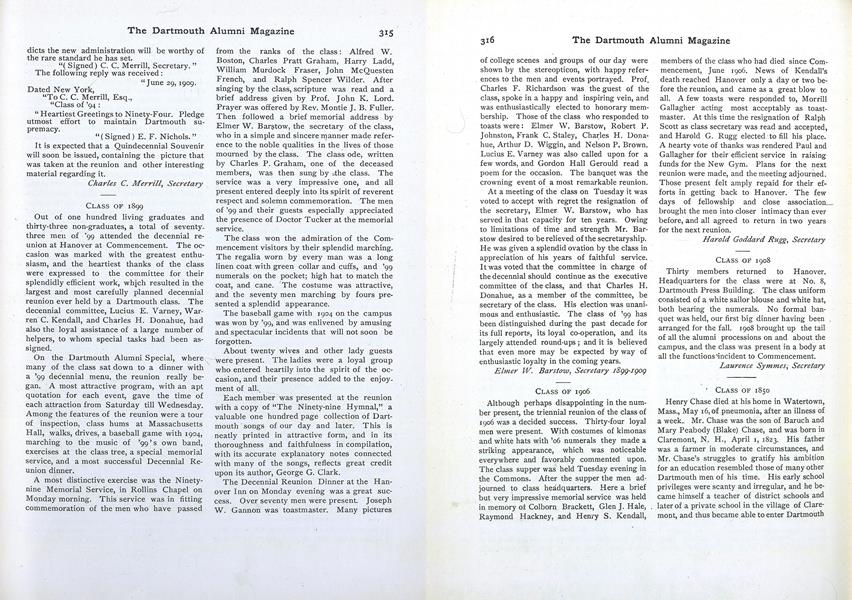
Henry Chase died at his home in Watertown, Mass., May 16, of pneumonia, after an illness of a week.. Mr. Chase was the son of Baruch and Mary Peabody (Blake) Chase, and was born in Claremont, N. H., April 1, 1823. His father was a farmer in moderate circumstances, and Mr. Chase's struggles to gratify his ambition for an education resembled those of many other Dartmouth men of his time. His early school privileges were scanty and irregular, and he became himself a teacher of district schools and later of a private school in the village of Claremont, and thus became able to enter Dartmouth at the age of twenty-three. He had taught in his school the mathematics of freshman year, and thus was able to give special attention to the study of Greek, in which he was imperfectly fitted. During his course he taught one term of each year in his native town, and graduated free of debt and with Phi Beta Kappa rank. After graduation he taught for a year in Claremont, and lived for three years in Washington, D. C., two years as assistant in Union Academy, and one year as assistant librarian in the Smithsonian Institution. He then taught again at Claremont for a year, and was in charge of the high school at Concord, Mass., for two years. In 1857, in collaboration with C. H. Sanborn, he published a volume of 191 pages entitled " The North and the South, " a statistical comparison of the two sections in the interest of the anti-slavery movement. In April, 1858, he became principal of the grammar school in Watertown, Mass., and so continued for ten years. In 1868 he represented the town in the legislature of Massachusetts. He afterward taught for about the same length of time in the grammar school of Medford, retaining his home in Watertown. As a teacher Mr. Chase was highly successful. In the fall of 1881 he was invited by the president of the New England Society for the Suppression of Vice (later known as the Watch and Ward Society) to become its general agent, and in January, 1882, he entered upon the duties of that position, to which he devoted nearly twenty-five years of tireless labor, retiring late in 1906. The object of the society is the removal by legal or moral means of those agencies which corrupt the morals of the young, such as im moral books and pictures, of gambling in all its forms, of fraudulent advertising, of immoral shows, and the protection of young women from the various devices to accomplish their ruin. In this work Mr. Chase was highly successful and accomplished an incalculable amount of good. To quote from a tribute to the man by one who knew him well: "It was his comfortable reflection in his last days that not one of all the host of malefactors whom he caused to be fined or imprisoned ever remained his personal enemy, and many a one of them came to look upon him as a friend and savior. He was the very impersonation of the New England conscience, with a warm and kindly New England heart close back of it." The funeral services were held in St. John's Methodist Episco pal church, of which Mr. Chase was the oldest member. He was married February 22, 1853, to Sarah Elizabeth, daughter of Erastus and Eliza ( Clement) Clark of Claremont, who survives him. Their two eldest daughters died in infancy; the third daughter is the wife of Dr. W. N. Emery of Waltham, Mass.
More From This Issue
-
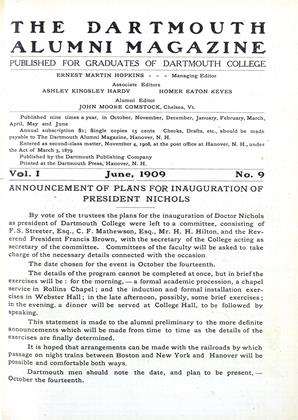 Article
ANNOUNCEMENT OF PLANS FOR INAUGURATION OF PRESIDENT NICHOLS
June 1909 -
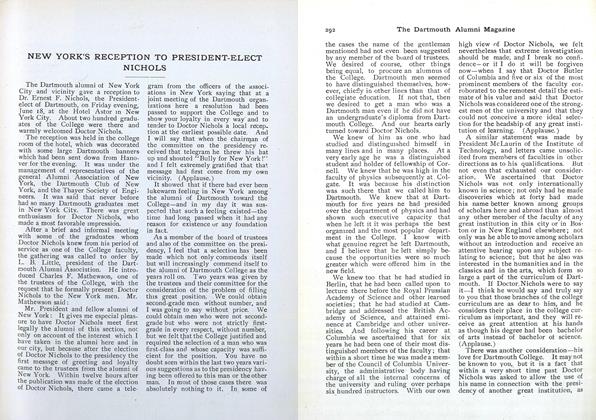 Article
NEW YORK'S RECEPTION TO PRESIDENT-ELECT NICHOLS
June 1909 -
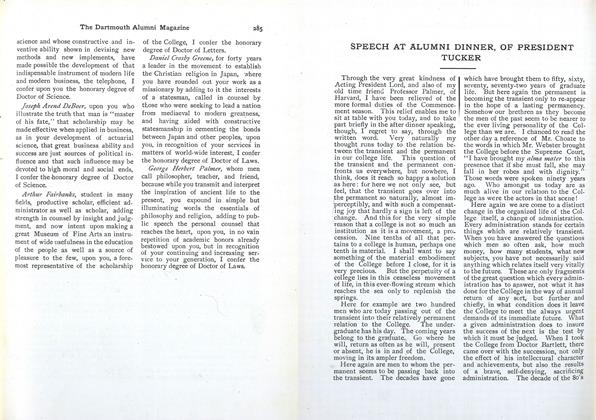 Article
SPEECH AT ALUMNI DINNER, OF PRESIDENT TUCKER
June 1909 -
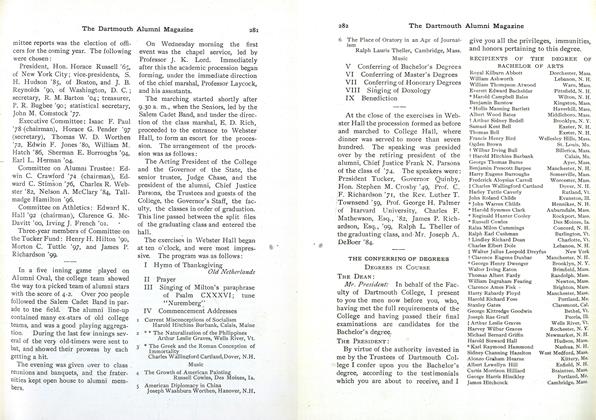 Article
THE CONFERRING OF DEGREES
June 1909 -
 Class Notes
REUNION OF 1859
June 1909 -
 Class Notes
LOCAL ASSOCIATIONS
June 1909