CLASS OF 1857
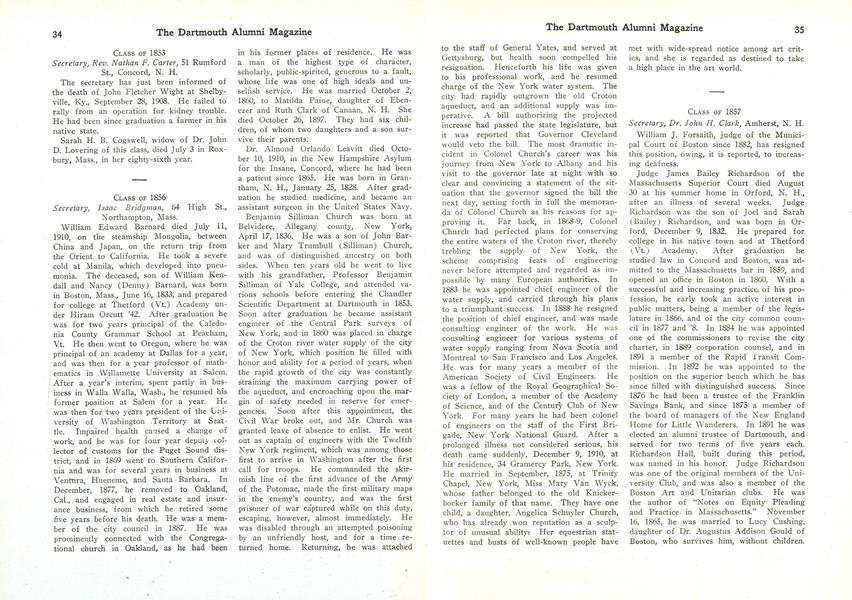
William J. Forsaith, judge of the Municipal Court of Boston since 1882, has resigned this position, owing, it is reported, to increasing deafness.
Judge James Bailey Richardson of the Massachusetts Superior Court died August 30 at his summer home in Orford, N. H., after an illness of several weeks. Judge Richardson was the son of Joel and Sarah (Bailey) Richardson, and was born in Orford, December 9, 1832. He prepared for college in his native town and at Thetford (Vt.) Academy. After graduation he studied law in Concord and Boston, was admitted to the Massachusetts bar in 1859, and opened an office in Boston in 1860. With a successful and increasing practice. of his profession, he early took an active interest in public matters, being a member of the legislature in 1866, and of the city common council in 1877 and '8. In 1884 he was appointed one of the commissioners to revise the city charter, in 1889 corporation counsel, and in 1891 a member of the Rapid Transit Commission. In 1892 he was appointed to the position on the superior bench which he has since filled with distinguished success. Since 1876 he had been a trustee of the Franklin Savings Bank, and since 1875 a member of the board of managers of the New England Home for Little Wanderers. In 1891 he was elected an alumni trustee of Dartmouth, and served for two terms of five years each. Richardson Hall, built during this period, was named in his honor. Judge Richardson was one of the original members of the University Club, and was also a member of the Boston Art and Unitarian clubs. He was the author of "Notes on Equity Pleading and Practice, in Massachusetts." November 16, 1865, he was married to Lucy Cushing, daughter of Dr. Augustus Addison Gould of Boston, who survives him, without children. An editorial notice in the Boston Transcript closes with these words:
"Severe as were his duties upon the bench he yet found time and strength to give a helping hand to fiduciary and philanthropic interests, whose reward was almost exclusively in the feeling of satisfaction that comes from contributing to worthy movements. His interest and his sympathies were much broader than his office or his profession. He loved his college and he loved his farm, and in his association and contact with both he found those distractions which helped him over many of the rough places in his life work, which, however, he never failed to make his first responsibility. The state of his birth and the state and city of his adoption all feel themselves poorer because of his loss."
Secretary, Dr. John H. Clark, Amherst, N. H.
More From This Issue
-
 Article
DARTMOUTH NIGHT
November 1911 -
 Article
With the beginning of a new college
November 1911 -
 Article
ADDRESS OF THE PRESIDENT AT THE OPENING OF COLLEGE
November 1911 -
 Article
THE TUCK SCHOOL CONFERENCE ON SCIENTIFIC MANAGEMENT
November 1911 -
 Article
JAMES BAILEY RICHARDSON 1832-1911
November 1911 -
 Class Notes
CLASS OF 1856
November 1911