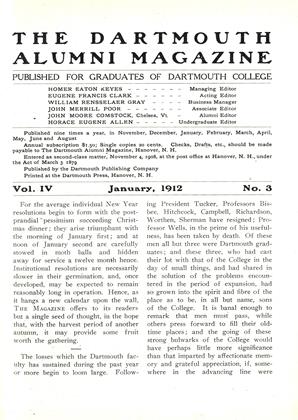
For the average individual New Year resolutions
begin to form with the postprandial pessimism succeeding Christmas dinner; they arise triumphant with the morning of January first; and at noon of January second are. carefully stowed in moth balls and hidden away for service a twelve month hence. Institutional resolutions are necessarily slower in their germination, and, once developed, may be expected to remain reasonably long in operation. Hence, as it hangs a new calendar upon the wall, THE MAGAZINE offers to its readers but a single seed of thought, in the hope that, with the harvest period of another autumn, it may provide some fruit worth the gathering.
The losses which the Dartmouth faculty has sustained during the past year or more begin to loom large. Following President Tucker, Professors Bisbee, Hitchcock, Campbell, Richardson, Worthen, Sherman have resigned; Professor Wells, in the prime of his usefulness, has been taken by death. Of these men all but three were Dartmouth graduates; and these three, who had cast their lot with that of the College in the day of small things, and had shared in the solution of the problems encountered in the period of expansion, had so grown into the spirit and fibre of the place as to be, in all but name, sons of the College. It is banal enough to remark that men must pass, while others press forward to fill their oldtime places; and the going of these strong bulwarks of the College would have perhaps little more significance than that imparted by affectionate memory and grateful appreciation, if, somewhere in the advancing line were enough other Dartmouth men to keep the balance true. But the fact is that there are not enough: the proportion of Dartmouth men in the faculty of Dartmouth College is a constantly decreasing one.
The situation thus plainly stated is one which may well cause serious uneasiness among all those who believe that Dartmouth College means something more than a label attached to a collection of very respectable educational machinery. In the last analysis, the chief asset of any of the older New England colleges is its individuality, which, in turn, amounts to the sum total of its traditions. In this sense, traditions become rather intangible things. They are not the transmitted outward forms of undergraduate life and fellowship, whose curatorship lies properly in the student body; they are rather to be considered as the accretion of traits and influences subtly operative through generations in the development of a point of view. If the statement is correct, it is needless to observe that traditions can never be learned, that they are, in truth, a blood inheritance, the vital nourishment drawn by her sons from the life principle of Alma Mater. Of them there can be but one guardian body, the one that directs the policy of the institution; in short, the faculty. And here, to pursue the figure one step further, if continued inbreeding weakens the native strain, sterile adoption in time annihilates it.
The discussion of what may become an acute situation properly implies some consideration of causes and some suggestion .of remedies.
Of causes three sufficient-ones may be cited. First; granting that Dartmouth, during the past fifteen years had grown in enrollment only, the percentage of first-rate teachers among an alumni list disproportionately small in comparison with the undergraduate body would have been insufficient to meet the increasing demand. But Dartmouth has been not only adding teachers in longestablished departments, but creating and upbuilding departments unknown to the days of the simple curriculum. The double process has, of necessity, entailed the calling of strong men from the universities. They have given loyal and devoted service and have added immeasurably to the vitality and prestige of the College. But the time has now come when, in further need, Dartmouth should be able to rely in larger measure upon the products of her own training. This forces into view the second of the two causes mentioned: few of the more vigorous and ambitious Dartmouth men are preparing themselves for advanced work as teachers, largely because the College has no adequate means of encouraging them to do so.
Fifty years since, a $500 fellowship afforded an attractive bait. Today for the young alumnus, without other means of support, it offers attic penury in a university. No wonder that men turn from such a prospect to the ambition-stirring opportunities of business. Five hundred dollars applied annually to the needs of a graduate student should, at the end of three years, produce a round shouldered, bespectacled, hollow-cheeked individual with chronic indigestion and a Ph.D. Contact with books he will no doubt have gained; but the wider contact with the life and activities of his time will have been denied him when he needed it most. It is strange that none of our American colleges has taken example of Cecil Rhodes and sought the best by offering the best.
In so far as Dartmouth is concerned, the remedy for this state of affairs lies in the hands of the alumni. At present the Tucker fund has the support of perhaps ten per cent of that body. The average subscription is satisfactory: the sum total is almost pitiful. Few are deeply interested in the movement because few can or will realize its object. The College needs whatever the fund will bring to help defray current expenses; yet the alumni might properly require that, when their contribution reaches a respectable figure, a part of it should be applied to the maintenance of one of more fellowships paying each not less than $1,000 per year; the final choice of candidates to be made on conditions similar to those in force for Rhodes scholarship awards. THE MAGAZINE believes that such an arrangement would add greatly to the appeal of the Tucker fund among the alumni; that it would help give, it a dignity commensurate with the name it bears and, in so doing would make it actually effective in correcting dangerous tendencies and in re-enforcing the Dartmouth ideal.
The third cause is . one operative not only at Dartmouth, but at many other institutions. Even where available material has existed among alumni of the College, it has not been used to full advantage. Slow promotion, or lack of opportunity for advancement, owing in part to insufficiency of funds applicable to salaries, has forced a number of the most promising Dartmouth men from junior positions on the home faculty to more important and better paid positions elsewhere. In further instances, the old adage that a prophet is not without honor save in his own country, has, seemingly, been substantiated in the preferment of the unknown . stranger over the better known, and hence less highly esteemed, member of the family circle. The remedy for this, of course, lies only in honest confession of an obvious human tendency, and an equally honest effort to overcome it. It is quite proper that the College should demand high qualities of her sons before she recalls them to enter her service. It is, however, equally proper that, other things being nearly equal, the balance of favor should incline to the men who, whatever their faults, still represent the ancient lineage of Dartmouth. Recognition of this principle has been apparent in some recent appointments where the hand of the Administration is directly traceable. The necessity, however, remains for its general application; and in this the intelligent cooperation of the alumni is of vital importance.