CLASS OF 1878
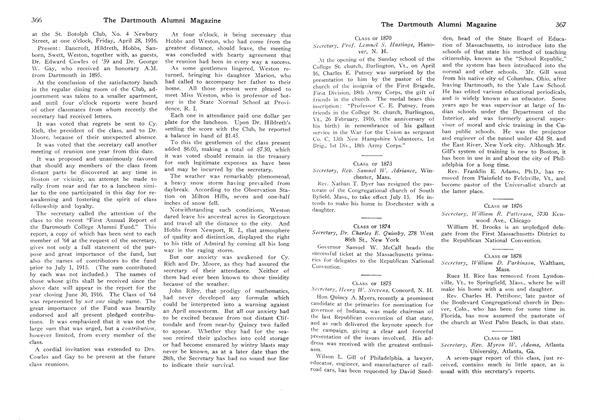
Frederick Douglass Lane, whose thirtieth year of service as teacher in Cushing Academy, Ashburnham, Mass., was made the occasion of especial honor to him by the students, faculty, and alumni of that institution, was further honored at Commencement in June of that year by the gift of a purse of gold from former students, with injunctions to use it for a European trip, which Mr. Lane accordingly enjoyed, visiting England, France, Germany, Italy, Austria, and, . what was an especial pleasure to Mr. Lane, witnessing the Passion Play at Oberammergau.
Mr. John Cotton Dana, librarian at Newark, enjoyed the unique distinction of having imparted a "notion" the the New York. SundaySun. In its issue of January 12, 1913, under the caption, "A Library That Does Things," that amiable journal declares that it has "got the notion that John Cotton Dana does a good many things for his city besides presiding adequately over a large collection of books. If there is any public or private enterprise in Newark that he does not make the institution he manages help along, it must be of no importance. If there is any intellectual appetite of the townsfolk that the library does not seek to appease, it is not worthy of encouragement."
François Joseph Gall Ladd died at Richmond Hill, New York, August 7, 1912. Mr. Ladd was born in Epping, N. H., March 24, 1851, prepared for college at New Hampshire Conference Seminary, and came to college from Derry, where his parents then resided. It was his intention to enter the ministry, and he was licensed to preach in the Methodist Episcopal church, but owing to limitation of health, he relinquished that purpose and turned to the profession of law, graduating from the law school of Columbia College in 1881, and entered upon practice in New York city. In 1889 he moved to Brooklyn, and had since pursued his profession in that borough, where he also became interested in real estate transactions. Although he gave up the ministry, he in no way lost his religious zeal. He was all his life active in the church and was much looked up to by those among whom he dwelt. He was married December 23, 1879, to Miss Ella M. Byrt of Chicopee, Mass., who survives him. So also do two sons and a daughter, all married and established in life.
Judge Charles Fremont Templeton, widely known throughout the Northwest, died at Grand Forks, N. D., January 3, 1913, after a long illness. Judge Templeton was born at Worcester, Vermont, June 21, .1856, and prepared for college at Barre Academy. Upon graduation, he entered upon the study of law at Montpelier, Vermont, and was admitted to the bar in December, 1880. He then emigrated to Dakota and entered upon practice at Fargo. In 1887 he was appointed attorney general for the (then) territory, which office he held until November, 1888, when, he was appointed by President Cleveland one of the associate justices of the supreme court of the territory. He then moved to Grand Forks, and had since resided there. Upon the admission of North Dakota as a state, he was elected judge of the first judicial district, and although elected as a Democrat in a Republican district, was re-elected for a second term without opposition. He returned to private practice in 1897, but ten years later again became judge of the first district, and held that position at the time of his death. He was. regarded as an upright, pure, and safe judge. He was also high in Masonry circles. He was married February 26, 1881, to Miss Edna C. Carleton of Williamstown, Vermont. Their eldest daughter died at an early age. Two others, and a son, with their mother, survive.
Secretary, William D. Parkinson, Waltham, Mass.