CLASS OF 1858
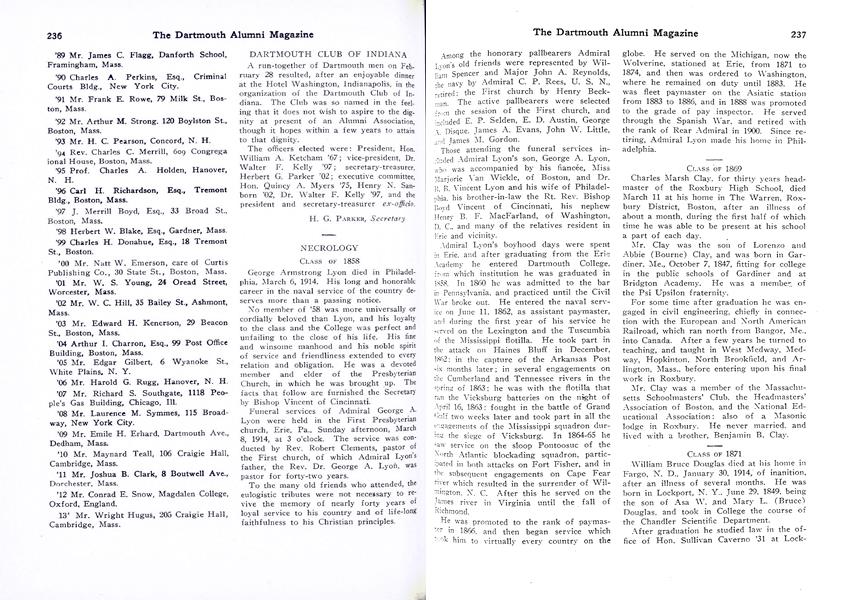
George Armstrong Lyon died in Philadelphia, March 6, 1914. His long and honorable career in the naval service of the country deserves more than a passing notice.
No member of '58 was more universally or cordially beloved than Lyon, and his loyalty to the class and the College was perfect and unfailing to the close of his life. His fine and winsome manhood and his noble spirit of service and friendliness extended to every relation and obligation. He was a devoted member and elder of the Presbyterian Church, in which he was brought up. The facts that follow are furnished the Secretary by Bishop Vincent of Cincinnati.
Funeral services of Admiral George A. Lyon were held in the First Presbyterian church, Erie, Pa., Sunday afternoon, March 8, 1914, at 3 o'clock. The service was conducted by Rev. Robert Clements, pastor of the First church, of which Admiral Lyon's father, the Rev. Dr. George A. Lyon, was pastor for forty-two years.
To the many old friends who attended, the eulogistic tributes were not necessary to revive the memory of nearly forty years of loyal service to his country and of life-long faithfulness to his Christian principles.
Among the honorary pallbearers Admiral Lyon's old friends were represented by William Spencer and Major John A. Reynolds, the navy by Admiral C. P. Rees, U. S. N., retired; the First church by Henry Beckman The active pallbearers were selected from the session of the First church, and included E. P. Selden, E. D. Austin, George Disque, James A. Evans, John W. Little, and James M. Gordon.
Those attending the funeral services included Admiral Lyon's son, George A. Lyon, who was accompanied by his fiancee, Miss Marjorie Van Wickle, of Boston, and Dr. B. B. Vincent Lyon and his wife of Philadelphia, his brother-in-law the Rt. Rev. Bishop Boyd Vincent of Cincinnati, his nephew Henry B. F. MacFarland, of Washington, D. C., and many of the relatives resident in Erie and vicinity.
Admiral Lyon's boyhood days were spent in Erie, and after graduating from the Erie Academy he entered Dartmouth College, from which institution he was graduated in 1858. In 1860 he was admitted to the bar in Pennsylvania, and practiced until the Civil War broke out. He entered the naval service on June 11, 1862, as assistant paymaster, and during the first year of his service he served on the Lexington and the Tuscumbia of the Mississippi flotilla. He took part in the attack on Haines Bluff in December, 1862; in the capture of the Arkansas Post six months later; in several engagements on the Cumberland and Tennessee rivers in the spring of 1863; he was with the flotilla that ran the Vicksburg batteries on the night of April 16, 1863; fought in the battle of Grand Gulf two weeks later and took part in all the engagements of the Mississippi squadron during the siege of Vicksburg. In 1864-65 he saw service on the sloop Pontoosuc of the Atlantic blockading squadron, participated in both attacks on Fort Fisher, and in the subsequent engagements on Cape Fear river which resulted in the surrender of Wilmington, N. C. After this he served on the James river in Virginia until the fall of Richmond.
He was promoted to the rank of paymaster in 1866, and then began service which took him to virtually every country on the globe. He served on the Michigan, now the Wolverine, stationed at Erie, from 1871 to 1874, and then was ordered to Washington, where he remained on duty until 1883. He was fleet paymaster on the Asiatic station from 1883 to 1886, and in 1888 was promoted to the grade of pay inspector. He served through the Spanish War, and retired with the rank of Rear Admiral in 1900. Since retiring, Admiral Lyon made his home in Philadelphia.
More From This Issue
-
 Article
MEETING OF DARTMOUTH SECRETARIES
April 1914 -
 Article
The New Hampshire State Superintendent of Public Instruction,
April 1914 -
 Article
IN MEMORY OF PROFESSOR CHARLES F. RICHARDSON
April 1914 -
 Class Notes
LOCAL ASSOCIATIONS
April 1914 -
 Article
NOMINATIONS FOR ALUMNI TRUSTEE
April 1914 -
 Article
DARTMOUTH THEN AND NOW
April 1914