CLASS OF 1865
Henry Eben Burnham, late United States senator from New Hampshire, died February 8 at his home in Manchester, N. H. He was born in Dunbarton, N. H., November 8, 1844, the son of Henry L. and Maria A. (Bailey) Burnham, and prepared for college at Kimball Union Academy. He was a member of Kappa Kappa Kappa and Phi Beta Kappa.
After graduation he studied law in Concord and Manchester, and was admitted to the bar in 1868. He began practice by himself in Manchester,: then was for a time in partnership with Judge David Cross '41, and later was associated with other firms.
He early entered upon political life, and was a member of the legislature in 1873, country treasurer in 1875-7, judge of probate in 1876-9, chairman of the Republican state convention in 1888, member of the constitutional convention of 1889, ballot law commissioner in 1893, and associate justice of the police court of Manchester. He was elected to the United States senate for the term beginning March 4, 1901, and was reelected, serving until 1913.
Judge Burnham had been president of the Mechanics' Savings Bank, and director of the Second National Bank and of the New Hampshire Fire Insurance Company. He was always active and liberal in the charitable work of his city, and served as a member of the advisory committee of the Children's Home. He also rendered valuable service on the school board.
He took a great interest in Masonry, and had served as master of the Grand Lodge of New Hampshire. He had also filled various offices in the order of Odd Fellows. He was commander of the Amoskeag Veterans of Manchester in 1892, and at a banquet in Worcester on Bunker Hill Day he gave an address that moved his Massachusetts hearers to call him "the silver-tongued orator from New Hampshire.
Judge Burnham was married October 22, 1874, to Elizabeth H. Patterson of Manchester, who survives him, with three daughters.
Says the Manchester Mirror: "Manchester has had no other citizen who equaled Henry E. Burnham in grace, beauty, and eloquence of utterance upon all kinds of public occasions. No lawyer of his time approached him in eloquence at the New Hampshire bar. His arguments were always, listened to with the deepest attention."
And the secretary of his class writes: "Henry E. Burnham was a rarely endowed man. In our college days he was handsome of face, dignified and graceful in bearing, with an all-around mind and a noble, heart. It seems to me. the most natural thing in the world that he should have been called to the Senate of the United States."
More From This Issue
-
 Article
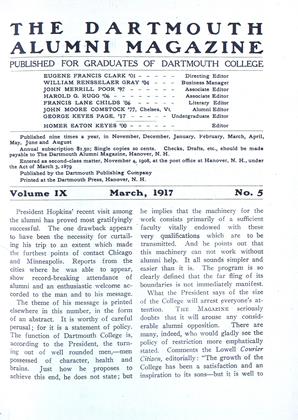
President Hopkins' recent visit among the alumni has proved most gratifyingly successful.
March 1917 -
 Article
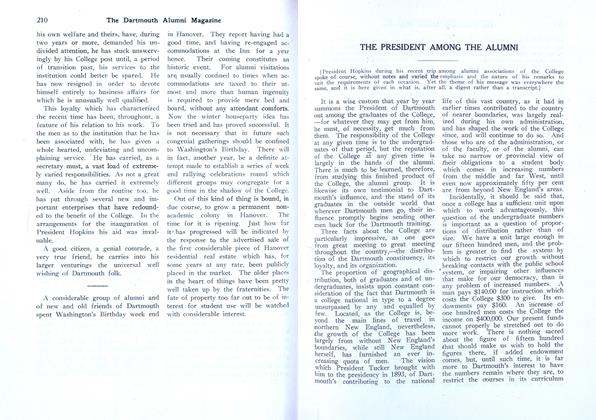
THE PRESIDENT AMONG THE ALUMNI
March 1917 -
 Article
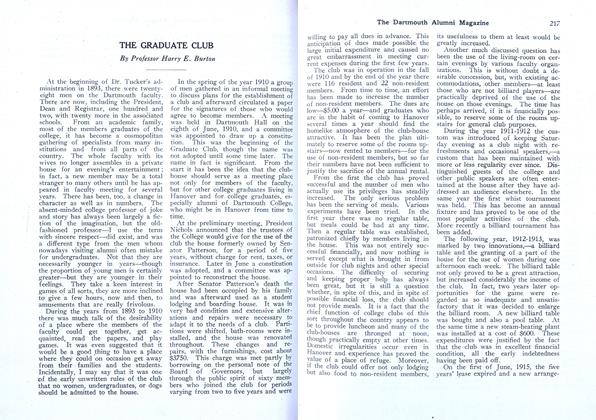
THE GRADUATE CLUB
March 1917 -
 Article
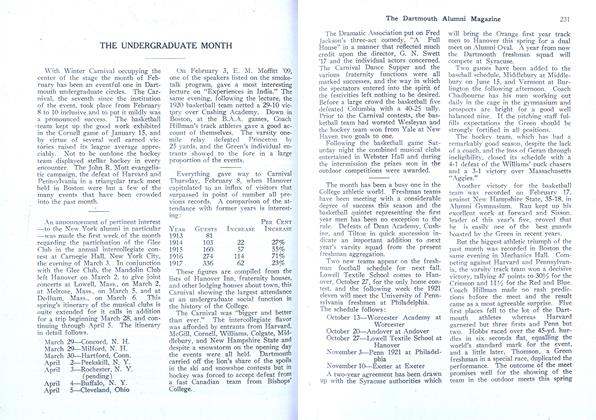
THE UNDERGRADUATE MONTH
March 1917 -
 Article
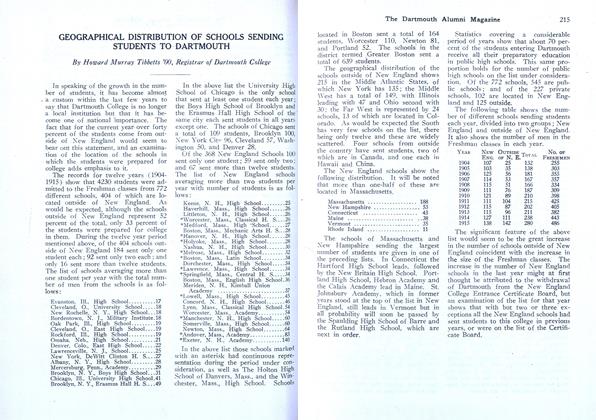
GEOGRAPHICAL DISTRIBUTION OF SCHOOLS SENDING STUDENTS TO DARTMOUTH
March 1917 -
 Books
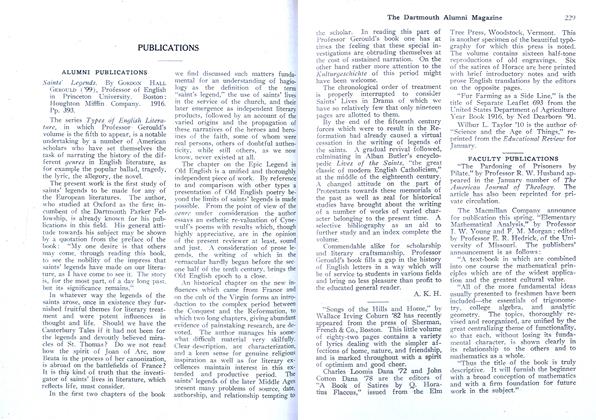
BooksSaints Legend
March 1917