FUNERAL OF HOWARD B. LINES '12
The following is an extract from a letter, writen by Paul B. Kurtz now serving in the American Ambulance Corps, that appeared recently in the Greenfield, Mass. Recorder:
"Christmas, 1916.
"There is to be be no Christmas for us this year. Not only on account of the fact that we are so far away from home, but, as if that were not enough, Howard Lines, who, as I wrote you, had been ill with pneumonia, died suddenly Saturday afternoon and was buried this morning. I knew Howard last year when he was with the section in Belgium and saw him and had him to lunch at the Club this Spring when he was in Cambridge finishing up at the Law School. He was as nice a boy as you could meet and was to be made 'sous-chef' in a few days. Luckily his family, who live in Paris, were able to get out here for the funeral, which was quite impressive. It was raining and blowing hard when we got up this morning, but towards nine o'clock it began to clear off and for a while we had a little sunshine. One of the cars was sent off to another camp for the Protestant minister an ordinary 'brancardier' who was to read the service. All the officers who are connected with our service and those who are quartered in the village were present, as well as a number of men from other sections of the Ambulance who were near enough to get there.
"With three others who were with the section last year I helped to carry the coffin, which was draped in the French colors and covered with flowers, from the mortuary to the doorway of the hospital where the simple services were held. We four, Dr. and Mrs. Lines and Miss Lines, stood just inside the doorway. On either side of the door were three soldiers, the guard of honor, who stood with rifles presented while the minister read the services and made a short and very appropriate speech. Outside were Mr. Andrew and former Ambassador Bacon, who had come up from Paris, all the officers and a number of soldiers, who stood with bared heads until it was over. Then we lifted the coffin and put it in the wagon which was waiting, while the body of a Russian soldier, who had died the same day, was placed in another. The guard of honor accompanied the wagons with rifles carried muzzles downward, while we followed behind.
"Everyone we passed on the way to the cemetery saluted or took off their hats, according to whether they were soldier or civilian, while each sentry presented arms until the procession had passed. The cemetery itself is not very large, merely a plot of ground enclosed by a rough fence and containing perhaps a hundred graves of soldiers, who have died here, each one with a black wooden cross with the name, regiment and date of death painted in white letters, and on each a 'couronne' of flowers. We four lifted the coffin from the wagon and carried it to the edge of the grave. There was another short address by the minister and it was all over.
"It was all so sudden and unexpected that I don't think any of us realize as yet just how much it means. We are so accustomed to seeing death in its worst forms and terrible suffering that it means, after a while, practically nothing to us. It is only when it is brought home to us in an affair like this that we realize that it is not the death which is so bad but the suffering that it causes others."
More From This Issue
-
 Article
President Hopkins' recent visit among the alumni has proved most gratifyingly successful.
March 1917 -
 Article
THE PRESIDENT AMONG THE ALUMNI
March 1917 -
 Article
THE GRADUATE CLUB
March 1917 -
 Article
THE UNDERGRADUATE MONTH
March 1917 -
 Article
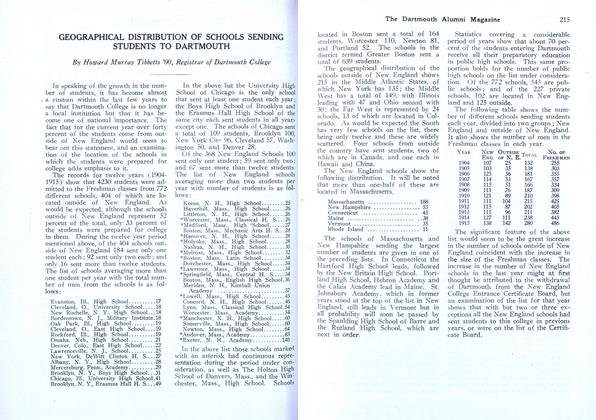
GEOGRAPHICAL DISTRIBUTION OF SCHOOLS SENDING STUDENTS TO DARTMOUTH
March 1917 -
 Books
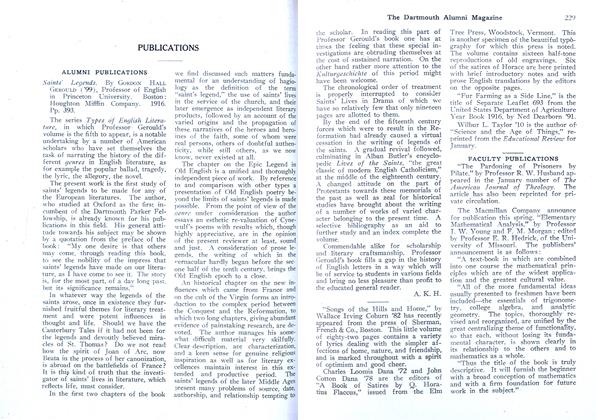
BooksSaints Legend
March 1917