NOT YET IN THE NAME OF RELIGION
The following article is the major part of a paper appearing in the Boston Transcript on the occasion of the intervention by the Pope in the interests of peace a few months ago. It is printed now, as it seems even amid the rapidly moving course of events still the best exposition that has appeared of the fundamental difficulties of attaining peace under present conditions.
To find the true and sufficient ground for the world's indictment of Germany we must go back to that ancient formula put forth in the name of religion, which the world has accepted in its inexorable simplicity as the code of national as well as individual righteousness: "It hath been showed thee, O Man, what is good, and what doth the Lord require of thee but to do justly, to love mercy and to walk humbly with thy God." This code antedates Christianity. What article of the code did Christ repeal, or under what circumstances was the suspension of it wholly or in part to be allowed, or the violation of it to be condoned?
Germany as the world knows, has persistently violated every article of the code. What is of greater significance, the German autocracy has openly repealed the code itself. It has set up the worship of a new God, the God of Power, in whose name and by whose authority the virtues of justice, mercy and humility are to be replaced by virtues better adapted to the exigencies of war. In the event of passing from war to diplomacy, we are asked to deal, on the ambiguous "principles of entire and reciprocal condonation with the mind of a nation indoctrinated in the new code of national righteousness. In view of this proposal, that requirement of the ancient code which had seemed least pertinent to present conditions is seen to be highly important. What is to be the nature of the diplomatic approach to a nation which has divested itself of humility and is allowed to remain of unhumbled mind? It becomes necessary to have a right understanding at this point of the national mind of Germany, lest we find that it offers a greater barrier to an honorable and lasting peace than German arms.
In the spring of 1913, as many will recall, a remarkable course of lectures was given by the professor of modern history in Queen's College, London, in which the professor sought to interpret to Englishmen the inner workings of the modern German mind, and to apprise them of certain results of its workings which he deemed to be inevitable, and apparently imminent. This was a year before the war. Within the. year the author died, but the lectures were published, though partly from notes, at the outbreak of the war.
Among the postulates which Professor Cramb laid down in his lectures was this: The world dominion of which Germany dreams is not simply a material dominion. "It is reserved for us," so he interprets the present mind of Germany, "to resume in thought that creative role in religion which the whole Teutonic race abandoned fourteen centuries-ago. Judea and Galilee cast their dreary spell over Greece and Rome when Greece and Rome were already sinking into decrepitude, and the creative power in them was exhausted. But Judea and Galilee struck Germany in the splendor and heroism of her prime. Germany and the whole Teutonic people in the fifth century made the great error. They conquered Rome but they adopted the religion of the vanquished. . . . . . . . . . . . The governing idea of the centuries from the fourteenth to the nineteenth is the wrestle of the German intellect not only against Rome, but against Christianism itself. Must Germany submit to the alien creed derived from an alien clime? Must she ever confront the ages the borrower of her religion, her own genius for religion numbed and paralyzed?" Thus, the author continues, while preparing to found a world empire, Germany is also preparing to create a world religion, which may be described as the religion of Valor, the glory of doing great things, its watchword, "Live dangerously." "Ye have heard how in old times it was said, Blessed are the meek, for they shall inherit the earth: but I say unto you, Blessed are the valiant, for they shall make the earth their throne. Ye have heard men say, Blessed are the peacemakers, but I say unto you, Blessed are the warmakers, for they shall be called if not the children of Jahve,. the children of Odin, who is greater than Jahve."
I read these warnings at the time with no little interest, but like many others dismissed them as too remote for serious consideration. The interpretation of this religious dream of empire seemed to be. a rhetorical exaggeration of the creed of a cult into which the writer had been initiated and from the fascination of which he had not altogether escaped. The dream could not come to reality. It was easy then to relegate everything pertaining to the war, including the war itself, to the category of the "unbelievable," the "unthinkable," the "impossible," just as it is not easy now to relegate anything pertaining to the war to that category. Who believed in Pan-Germanism three years ago, two years ago, one year ago? Who disbelieves in it now? Why should we longer disbelieve in a corresponding scheme of world religion fitted to support it, to justify its ambitions, to extenuate its crimes'? Certainly it cannot be for want of the official recognition of the "German God," or of the identification of the German Kultur with its official religion, or of the frank avowal of the practice of a religion whose creed from alpha to omega is the creed' of Power? "The French Ambassador in London," says Professor Deissmann, "is understood to have said at a banquet that so-called scholars and professors have preached the religion of barbarism. His words — I venture the paradox — pretty nearly express my thought. What people beyond the Channel call barbarism, history will some day call primitive strength. In this age which has witnessed the most gigantic mobilization of physical and mental forces which the world has ever seen, we certainly proclaim — no, it is not we who proclaim it, but it reveals itself — the religion of Power." With equal frankness Professor Oncken sets forth the superior rights of the strong nations. "The fate that Belgium has called down upon herself is hard for the individual but not too hard for this political structure, for the destinies of the immortal great nations stand so high that they cannot but have the right, in case of need, to stride over existences that cannot defend themselves, but live as parasites upon the rivalries of the great." And with more brutal frankness Pastor Baumgarten treats the sinking of the Lusitania. "Whoever cannot prevail upon himself to approve from the bottom of his heart the sinking of the Lusitania — whoever cannot conquer his sense of the gigantic cruelty to unnumbered perfectly innocent victims — and give himself up to honest delight at this victorious exploit of German defensive power — him we judge to be no true German." But the chief sign of this obsession of the German mind is the spiritual blindness which seems to have fallen upon it. On August sth, 1917, a pastoral letter was read at a Cathedral service attended by the Emperor and Empress from which the following is an abstract — "We will conduct ourselves as Christians toward our enemies, and conduct the war in the future as in the past with humility and chivalry." The Dutch newspapers of August 7th print in a parallel column with this extract the account of the murder of the crew of the British steamship Belgian Prince. "The British steamship Belgian Prince was sunk July 31 by a German submarine. According to survivors who reached a British port the Germans removed the lifebelts and outer clothing of all the members of the crew except eight, smashed the lifeboats with axes, and then re-entered the submarine and closed the hatches, leaving the men on deck. The submarine traveled on the surface for about two miles and then submerged. Thirty-eight of the crew were drowned. Three were rescued by a patrol boat."
There has been nothing in the intellectual history of mankind which can be compared with the present reversal of opinion throughout the civilized world regarding the German mind. From the religious point of view this reversal of opinion and of feeling is pathetic. That the people of the great protesting faith should subordinate their religious life to the creed of a ruling dynasty, that the home of the mystics should be transformed into the stronghold of a religious autocracy, this is the irony of religious freedom and faith. But the most serious aspect of the present situation is the confusing and disheartening fact that as the nations are beginning to turn from thoughts of war to thoughts of peace, and to the consideration of the terms of peace, they are confronted with the barrier of the German mind, now thoroughly divested, as I have said, of humility, and under present conditions unhumbled. No sane man desires the humiliation of Germany. That is a bad word to get into the vocabulary of nations. But an unhumbled mind is the greatest possible obstacle to peace. If it does not at once forbid approach, it quickly interrupts responsible intercourse. And this, according to the most intimate observers is, in its present state, the mind of Germany.
Two statements of exceptional importance bearing upon this point have recently been made; one by Mr. Otto H. Kahn, the New York banker, of German birth and business training and still in intimate relation with friends and men of affairs in Germany; the other by Professor Vernon Kellogg, the eminent biologist of Leland Stanford University, who as the chief representative of the American Relief Commission in northern France was stationed for several months, in charge of a German officer, at the headquarters of the German General Staff, where as a German scholar he had constant opportunity of conversing with the scientific men at the headquarters.
Mr. Kahn said, speaking as a German-American before the Liberty Loan meeting of the Merchants' Association of New York June 1, 1917: "Gentlemen, I measure my words. They are borne out all too emphatically by the hideous eloquence of deeds which have appalled the conscience of the civilized world. They are borne out by numberless expressions, written and spoken, of German professors employed by the State to teach its youth. The burden of that teaching is that might makes right, and that the German nation has been chosen to exercise morally, mentally and actually the overlordship of the world, and must and will accomplish that task and that destiny whatever the cost in bloodshed, misery, and ruin," to which should be added his further published statement. "The conviction that everything, literally everything, which tends to insure victory is permitted, and indeed called for, has now assumed the power of a national obsession."
Professor Kellogg, writing in the August Atlantic under the title, "Headquarters Nights," says in concluding his article, "I went into Northern France and Belgium to act as a neutral, and I did act as a neutral all the time that I was there. If I learned anything of military value which could be used against the Germans I shall not reveal it. But I came out no neutral. Also I went in an ardent hater of war, and I came out a more ardent one. I have seen that side of the horror and waste and outrage of war which is worse than the side revealed on the battlefield. How I hope for the end of all war! But I have come out believing that that cannot come until any people that has dedicated itself to the philosophy and practice of war as a means of human advancement is put into a position of impotence to indulge its belief at will. My conviction is that Germany is such a people, and that it can be put into this position only by the result of war itself: It knows no other argument, and it will accept no other decision."
It is with facts and testimonies like these in mind that we are obliged to consider the question of the timeliness of present intervention. There are three reasons for judging this untimely. Briefly stated they are, first the utter absence of any trustworthy evidence of a change of mind or of purpose on the part of Germany. The only change in evidence is a change of purpose regarding the means for reaching the end tenaciously held in view. As a German officer remarked to Frederic Vail: "In 1914 war was necessary to Germany; in 1917 peace is necessary." Peace, that is, if rightly managed is now better suited to her purposes than war. There always comes a stage in the relation of nations in conflict when it is opportune to relax the rigidity of military methods and try more elastic methods. Here is the opportunity of diplomacy. It was one of the fundamental tenets of Treitschke that "war is the mighty continuation of politics." With equal logic it may be affirmed that diplomacy is the mighty, at times the mightier, continuation of war. Suppose that in the present instance the term annexation, as a term of conquest, is dropped, and in its place the fact of incorporation is allowed. That might mean, as it probably would mean, the evacuation of Belgium and Northern France, but also the virtual incorporation of Austria, the Balkans, and Turkey into the German Empire. If the large end is domination, it is not so much a matter how it is accomplished as that it is. accomplished. The retreat from the Marne simply opens the route to Bagdad. Let us as advocates of peace, especially religious advocates, be wary at the present juncture of the venture into diplomacy.
Secondly, one looks in vain through the proposed terms of intervention for a clear, distinct and urgent insistence upon reparation, and reparation has become the moral issue of the war, the moral condition of peace. Territorial claims have no like significance. Nothing rests so heavily upon the conscience of the world as the studied cruelties of Germany in her treatment of the helpless communities in conquered territory — the deportations of peoples, the desolations of country, everywhere the wanton destruction of life and property. These atrocities have created a new moral issue. They require a new term to express the attitude of the civilized world toward those who perpetrate them. Reparation is the term required which if not new, is being charged with a new meaning. It rises above the traditions attaching to the terms "damages" and "indemnities" as applied to the settlement consequent upon war. It is coming to have something of the force of the religious conception of repentance and renunciation. It is not satisfied with disavowals, or extenuations, or even with such restitutions as are possible. It demands the open renunciation of the theory of war which supports the practices in question as having a legitimate place in modern warfare. It is in itself so vital a preliminary that its omission from any proposed basis of peace renders religious intervention morally inconsistent with its purpose.
The third reason for regarding present intervention as untimely appears in view of the greater timeliness of the movement for peace already under way through the entrance of the United States into the war. I refer to the contrast in no spirit of national pride. The origin, however, of the movement was so clear and open, and its object so well-defined that no candid observer can mistake its character. It has been from first to last a peace movement. It has no other object. By no possibility can it secure any other designed result. This is its definite though far-reaching purpose. The peace which it seeks must give the unmistakable promise of moral satisfaction, and therefore, of durability. For such a peace this country is willing to pay its part of the price. Whatever right of way it may have gained is due altogether to the unselfishness of its purpose, to the spirit of sacrifice which supports it, and to the recognized timeliness of its action. I believe that I am not mistaken in affirming that the growing consensus of opinion among the neutral nations is to the effect that the most direct road to peace lies through war. I respect and honor an endeavor after peace in the name of religion. But for the reasons given I question none the less its timeliness. When religion speaks its final word it must speak with what I have termed the inexorable simplicity of its ancient code of national righteousness. I do not believe that Germany is as yet prepared in the spirit and temper of its mind to listen to that word. Meanwhile I see no other possible course for us to follow as a nation than that which Lincoln .marked out for us in circumstances like those in which we are now placed, and in the following out of which we reached in due time the goal of peace — "With malice toward none, with charity for all; with firmness in the right, as God gives us to see the right, let us strive on to finish the work we are in, to do all which may achieve and cherish a just and lasting peace."
More From This Issue
-
 Article
COLLEGE NEWS
January 1918 -
 Article
DARTMOUTH'S PART IN UPBUILDING PHILLIPS ANDOVER ACADEMY
January 1918 -
 Books
BooksFACULTY PUBLICATIONS
January 1918 -
 Article
PROFESSOR GEORGE RAY WICKER
January 1918 -
 Article
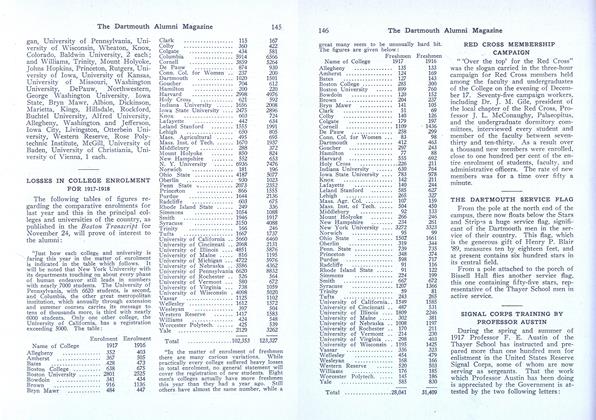
LOSSES IN COLLEGE ENROLMENT FOR 1917-1918
January 1918 -
 Article
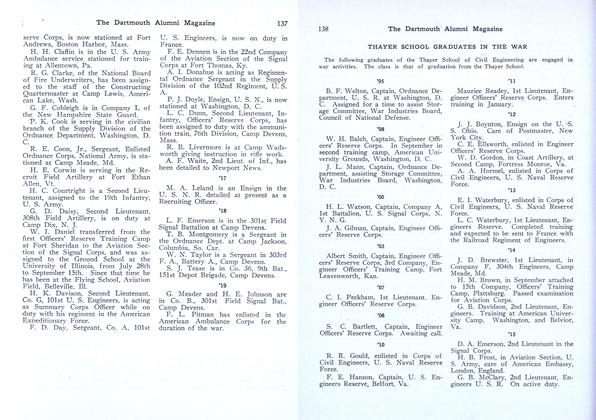
THAYER SCHOOL GRADUATES IN THE WAR
January 1918