REUNIONS CLASS OF 1870
(Mr. A. S. Abernethy prepared the following at the request of the class. This was Mr Abernethy's first visit to Hanover since his graduation.)
The semi-centennial reunion of the class of '70 was held in Hanover June 19 to 24.
Eleven of the sixteen surviving members were present all or some part of the time. Nine were on hand Saturday evening, and. the others came early in Commencement week.
Following were those in evidence:
Ira A. Abbott, Haverhill, Mass.; Alexander S. Abernethy, Seattle; John A. Bellows, Walpole, N. H. ; Irving W. Drew, Lancaster N. H. ; Channing Folsom, Newmarket, N. H.; Lemuel S. Hastings, Hanover; Hermon Holt, Claremont, N. H. ; Robert H. Parkinson, Chicago; Sanford H. Steele, New York; Ethelbert Talbot, Bethlehem, Pa. ; Charles E. Woodbury, Acworth, N. H.
Of the families, Mrs. Steele, Mrs. Hastings and daughter, Myra, and Mrs. E. K. Hall, daughter of Drew, were in Hanover and added much to the pleasure of the meeting.
The reunion began Saturday as soon as the first two men of the class got sight of each other, and was in session until the next Thursday morning, with short recesses for sleep when the Hanover Inn and Richardson Hall curfew rang for the last time.
The official timekeeper lost his job soon after the "chin music" began, so no record of the length of the session can be given but it was short enough, for when the last good-byes were spoken as the 'bus started for the train Thursday morning, there were still a lot of things left unsaid for lack of time.
Maybe we are getting into the "sere and yellow leaf" stage, but we have not come to the point where our grip on the present, the past, and the future things of the world about us is loosened, or the Dartmouth spirit within us dimmed, so our talk was less of things past than of those present or to come.
Sunday afternoon, after the baccalaureate services, we went with Drew and Steele in their autos to Woodstock, stopping awhile on the way to visit Col. Pingree and his wife (Steele's sister), and the library at Pomfret Abbott's timely gift to his boyhood home, that has done so much to lift the community life to higher planes of thought and action.
At Woodstock we found, gathered for the summer under the old home roof, the five sisters of Richmond, our classmate who long ago entered on the long trail that soon or late we all must tread, and spent a little time renewing old friendships, then went on tc find Dana '71, whom we all remembered as a promising young fellow in our time in college, and when we saw him and Mrs. Dana were sure he had made good his early promises. After our return we dined together at the Hanover ,Inn as Abbott's guests.
Monday morning we got together in good season, to speed Talbot on his journey to England, whither he went to attend the Lambeth Conference of bishops.
The current business of talking was then taken up in earnest, and carried on with zeal until Tuesday evening, with interruptions for a most enjoyable reception Monday afternoon in Robinson Hall, at which we met old-time associates of college days, of other classes many of whom were afterwards members of the faculty, with their wives and friends We were Steele's guests at the Inn Monday-evening.
Tuesday was somewhat broken by the baseball game in the morning, then the Alumni Association meeting, at which the '70 men were seated on the platform and held up as examples to the younger generation, Hastings and Steele acting as spokesmen for the class. The President's reception also came, but this was not much of an interruption, for the talk went on just the same.
In the evening the ten left after Talbot's departure gathered in College Hall for dinner, and then the real talk began.
Bellows' poem showed his pen had lost none of its old-time spell, and each of us felt for himself that fifty years is but a little time in the life of a man, and one looking for old age must look far beyond three score years and ten ere he comes across its threshold.
It is true we talked of those who are no more with us here, especially of the men who have gone from us since the meeting of five years ago—of Brown, leader and loved by us all, and Cheney and Colgate, at rest after a varied life, and Day and Edgell and Farnham and Hardy, and Sherman and Walker and Worcester, and last of all, of Putney, oldest of our number and last to go.
But we talked mostly of the work before us, for the College and the world, to make the one stronger and more useful and make the other safer and more fit to live in. It was a forward-looking talk, not backward.
On Commencement Day, we found ourselves among the first to rise as the classes were called in order of years, at the luncheon but did not find ourselves "passing up" any of the eatables for lack of appetite or digestion.
Nor did we find ourselves unable to "catch on" when the speechmaking began. Stephen Leacock got just as many laughs per capita from '70 as from any other class. On this occasion Drew was our spokesman.
After the exercises and the luncheon, Abbott came to the front with an auto, and gathering all of us who could go or stand the trip—four besides himself—took us for a ride to the Outing Club's Cube Mountain cabin.
This was a fitting end to the week's work and was most welcome to us all. Parkinson was host for a family dinner at the Inn.
Thursday morning brought the separation and we came back to earth again as the class scattered to the four winds, to take up again the threads of our busy lives.
Every one felt fully repaid for coming, and went away with the determination that 1925 would find him back again, if so be he had not been called to join the other and now far larger part of our class beyond the threshold of
"....the low green tent Whose curtain never outward swings."
More From This Issue
-
 Article
The congestion due to the great increase in the size of the undergraduate
November 1920 -
 Article
ADDRESS OF PRESIDENT ERNEST MARTIN HOPKINS AT THE OPENING OF DARTMOUTH COLLEGE, SEPTEMBER 23, 1920
November 1920 -
 Class Notes
CLASS OF 1910
November 1920 -
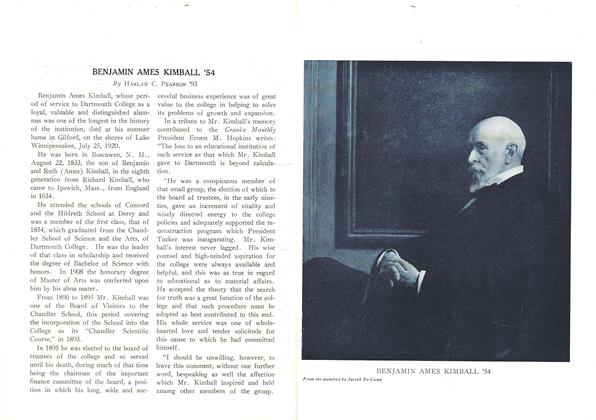 Article
BENJAMIN AMES KIMBALL '54
November 1920 -
 Class Notes
CLASS OF 1910
November 1920 -
 Class Notes
CLASS OF 1917
November 1920