The question raised by Mr. Keyes' recent article in the Boston
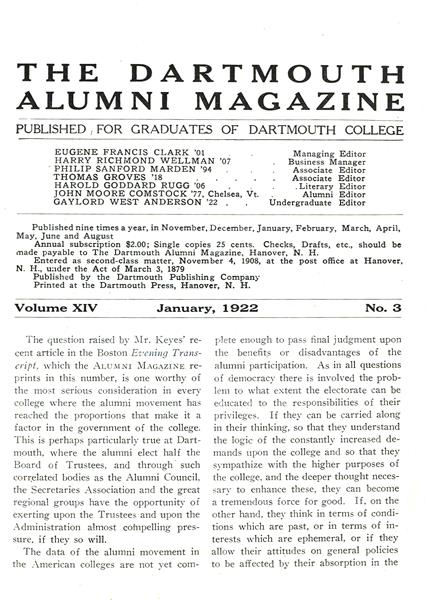
Evening Transcript, which the ALUMNI MAGAZINE reprints in this number, is one worthy of the most serious consideration in every college where the alumni movement has reached the proportions that make it a factor in the government of the college. This is perhaps particularly true at Dartmouth, where the alumni elect half the Board of Trustees, and through such correlated bodies as the Alumni Council, the Secretaries Association and the great regional groups have the opportunity of exerting upon the Trustees and upon the Administration almost compelling pressure, if they so will.
The data of the alumni movement in the American colleges are not yet complete enough to pass final judgment upon the benefits or disadvantages of the alumni participation. As in all questions of democracy there is involved the problem to what extent the electorate can be educated to the responsibilities of their privileges. If they can be carried along in their thinking, so that they understand the logic of the constantly increased demands upon the college and so that they sympathize with the higher purposes of the college, and the deeper thought necessary to enhance these, they can become a tremendous force for good. If, on the other hand, they think in terms of conditions which are past, or in terms of interests which are ephemeral, or if they allow their attitudes on general policies to be affected by their absorption in the extra-curriculum details of college life, the effect is almost certain to be harmful.
The fact is that the alumnus, unless called upon for particular thought upon the subject, inclines in his desires and. opinions towards policies and procedures in the college which will perpetuate his own type. Meanwhile busied with his own affairs, and involved within the scheme of circumstance of an oscillating present, he too often has neither time nor disposition for speculation about the future, and tends to be impatient with thinking, the results of which thought, if made operative, would further complicate and make difficult his own adjustments to life and to the affairs of the world about him.
The one sure thing is that the development of the alumni movement is an existent phenomenon and that it is tremendously big in possibilities for either good or harm, according to the intelligence which dominates its influence. Left to itself it may easily become a Frankenstein monster capable of strangling initiative in educational policy and of killing the disposition for constructive intellectual effort. On the other hand if nurtured and cultivated and given the basis for understanding of problems with which it must deal, this great force is applicable to the advancing of academic standards and to the stimulation of intellectual interest within the college to an extent impossible otherwise.
The possible magnitude of the force is unquestionable. The great need is that it shall become self-conscious to a degree which will make it recognize its own possibilities for either good or harm and that it shall allow itself to be made operative for no insufficient purpose.
It cannot be said that the football season just closed brought undying fame to Dartmouth, but it is fair to remember that not all OUT years can be good ones and that the real test is not "did you win" so much as "how did you fight?" One sympathizes especially with Coach Cannell, whose first year has not been one of triumph and who has to face the handicap of thoughtless criticism common to all new coaches whose teams have not covered themselves with glory. One may note in passing that two former Dartmouth coaches, Cavanaugh, now with Boston College, and Spears with the University of West Virginia have also had a year of slump, so far as the record of victories goes. The best test of coaching talent is not a single season, but three or four.
So far as" the undergraduate body is concerned, being on the ground and familiar at first hand with all the facts, sympathetic understanding rather than hasty criticism can always be counted on. The remote alumnus, recalling years of notable success and forgetful of the rest, is the one who usually rushes into hurried assumptions that something must be wrong with the generalship; and from such one has to fear the most in the way of the occasional injustice — not intentional, of course, but none the less real. Coach Cannell's own account of the recent season will be published elsewhere in due course and will speak for itself. For the moment, the MAGAZINE wishes to express its hearty appreciation of his effort to give Dartmouth a successful team against odds which were often discouraging. A crumb of comfort may be had from the successful closing of the year at Atlanta, Ga., where the winning score was made as the result of an unprecedented forward-pass play, magnificently achieved. This long and hazardous throw of an ungainly ball in extremely trying circumstances is most difficult to make—but once successfully made it is almost certain of results as the Georgia game proved. Captain Robertson had tried it several times before without the same success—but its triumph at the end of the season was timely proof that it was not so futile a play as many have insisted it must always be.
An echo of bygone days was heard at the recent meeting of the Council of the Alumni at New York, when a letter was read from Senator Spencer of Missouri calling attention to the fact that the grave of Hon. Salmon P. Chase, a Dartmouth alumnus of unusual prominence in the Civil war days, was in a dilapidated condition and was inadequately marked. The part taken by Judge Chase in a stirring period of this country's history was sufficiently notable to make this failure to mark his last resting place a deplorable circumstance, in which it is fitting the alumni should take interest.
Salmon P. Chase entered Dartmouth as a junior, having studied previously in the Middle West, and graduated in the class of 1826. He was an early convert to the anti-slavery cause,- and while in no sense an orator or a good speaker on the stump, he was gifted with amazing powers of lucid statement and was an adept at setting forth the case for th abolition and free-soil parties in "platforms" and otherwise. Elected to the United States Senate from Ohio, he relinquished his seat to become Lincoln's secretary of the treasury, with the colossal task before him of rehabilitating the demoralized financial system and making it adequate to meet the pressing needs of the Civil war, which broke out almost immediately after he assumed control.
Chase's chequered relations with Licoin — manifested by a curious series of offers to resign, which Lincoln for a long time would not accept—flowered into open political rivalry when it became time to seek a nominee at the close of Lincoln's first term. In this strained situation further differences developed which led to the final retirement of Chase from the cabinet; and to some extent this circumstance has been permitted to dim the reputation of a man who was of incalculable value to the Union during the stressful period of the war. Lincoln's persistent refusal to release Chase is in itself testimony to the estimation placed upon his abilities by the president. Further evidence of Lin coin's broad-minded regard for Chase's abilities was given when, against loud protest and in spite of past differences Lincoln named Chase for chief justice of the Supreme Court, succeeding Chief Justice Taney. In the chief justice's office Chase continued to reveal the remarkable lucidity of mind which had characterized him in law and politics, and he presided over the impeachment proceedings against Andrew Johnson with admirable impartiality, as well as rendered numerous decisions of great moment in causes growing directly out of the war situation.
It is notable that even the high dignity of the court did not satisfy Chase's ambition and he still yearned for the presidency — but in vain. One regrets this ineradicable longing—the one really weak spot in the character of a most remarkable and useful public servant. Hopefully some good may flow from the decision of the Alumni Council to investigate the matter of marking more worthily his grave.
The Alumni Council itself merits a word as the effective mouthpiece of the alumni of the college. Our concept of the college is tripartite, in that it sems to us to consist of the college officers (faculty and trustees), undergraduates and alumni. In other words it is an entity in which one usually perceives but two parts—the students and the college officers—but in which the alumni also figure as an essential component. The voice of the alumni can be made efficient only through some organization; and this element is supplied by the Alumni Council, which may be conceived as the entire alumni body constructively present by delegate representation.
Since on this body falls the highly important task of nominating the alumni trustees, as the occasions arise, and the further very important duty of raising the annual alumni fund to carry the college operations forward without deficit, it is desirable that alumni be constantly interested in, and conversant with, the deliberations of their delegates in this Council. Anything that suffices to make more intimate the relationship between alumni and Council is of service—thus will alumni come into more intimate relationship with the College as a whole, as they should.
At the New York meeting the deliberations included various suggestions, the most important of which seems to have related to the method of nominating trustees. In ordinary cases of regular election, the rule is for the Council to consider the names of at least three candidates for its final nomination—these being presented to it by a special committee of the council—and any other names which may be suggested from the floor, at a regular Council meeting. In extraordinary circumstances, however, it is now provided that a vote may be taken by mail, or telegraph, on nominations suggested by the special committee and mailed to the members. In this case, first, second and third choices are to be specified. If there is not a clear majority in such a case, the second choices are to be canvassed and a system of establishing the nominee in this way is provided.
Ordinarily, no doubt, the procedure would be the less complicated one of naming a trustee candidate by direct majority vote of those present at a regular or special meeting from among at least three suggested names. But as no one can foresee accurately all conditions, it is well to provide for the emergency of absentee voting , by adequate rules — which seems at last to have been done.
There is also to be noted a suggestion that the Council enroll among its membership more of the younger alumni. I his is not a matter over which the Council itself can well take jurisdiction, it being more properly the affair of the various regional associations in making their choice of delegations to the central body. That a representation of the younger men be included is doubtless desirable and to that end the scattered alumni organizations may well devote both thought and effort. It is both an honor and a privilege to serve the College in this way, and it entails some very real work which one accepting the honor and privilege should treat as a serious obligation. The duty involves actual presence at the Council meetings, which in many cases involves both the leisure and the means to make a journey to attend. No doubt the regional choice of Council members will be governed in the long run, independently of age, by the readiness of eligible alumni to assume whatever burdens the duty may entail.
We would fain stress the vital importance of the Council once again and urge a broader acquaintance with its nature and work on the part of those to whom it is, too probably, no more than a name. To regard one's obligations to Dartmouth College as fulfilled when one has sent a modest cheque to the alumni fund falls short of what we believe the College should command. Not alone the support in terms of money, but the support in terms of interest, is what the alma mater requires of her sons. This end the Council and this MAGAZINE aim to serve. To make of the graduates an integral part of the triune entity we call the College" is no easy task, and it is one to which the alumni may well give their cordial assistance.
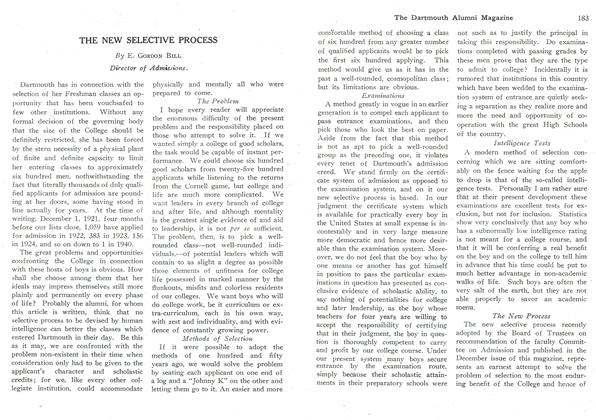
Detailed comment on the new system of selecting the members of future freshman classes at Dartmouth may best be reserved until alumni have had an opportunity to familiarize themselves with the idea. At the moment it is probably enough to say that the new plan contemplates the continued reception of applications to whatever number they may happen to reach, applying to the choice of the 500 or so who can be accommodated certain tests, which are partly scholastic and partly regional. The hard and fast limitations imposed by the present physical plant and by the desire to keep the size of the College within reasonably workable limits make it clear that in a very short time a class of 500 will be about as large as can be regularly received; but the trend of applications at the same time indicates the probability that the number from which this 500 must be chosen will vary between 3000 and 5000. It therefore becomes desirable, and indeed imperative, to devise some scheme for choosing the 500 from among so. many, with several objects in view. Promising abilities as a student, general high character and a fairly distributed national reputation in the student body may be set forth as the most important of these. Of the three, the last named is probably the least vital — but it is surely vital, even so.
In broad general terms it is reasonable to believe that a young man's revelation of capacity in his preparatory work is a fair criterion for judging his capacity to continue in college study with similar excellence. The scholarship test thus assumes the primary rank in the list of qualifications. Those who have shown to most advantage in preparatory study for college will naturally stand the best chance of acceptance. Since it is esirable that those be best educated who seem likely to make the best use of education when acquired, a demonstrated character and capacity for leadership will also receive due weight. As a matter of course, all properly qualified aplicants
from the State of New Hamphire will be received—a recognition of the state's important part in fostering and assisting the college within its borers. Sons of alumni and officers of instruction (if properly qualified otherwise) are also naturally in a position of preference. Beyond that an endeavor will be made to insure a proper distribution on geographical lines to make Dartmouth an all-American, rather than a purely parochial, institution. This, already true to a commendable degree, will be safeguarded and made more true than before—a most desirable thing, alike for college and country, since it is Important' to avoid overemphasis of the - purely sectional idea so easily fostered in American industry and politics.
To what extent applications will continue to come in on the present scale no one can say. The phenomenon may be sporadic and not capable of being long sustained. This, however, is not of vital bearing on the selective plan, which would apply quite as usefully to a number of applicants only a third as large as those now actually on file or in prospect for the present year. The main thing is to choose wisely the 500 or so who can be received as Dartmouth freshmen; and to this end the plan has been carefully worked out, as will be discovered by investigation detailed statements elsewhere published.
The announcement of the completion of the football schedule comes just as the MAGAZINE is going to press and extended comment will have to be deferred for another issue. One aspect of the schedule should, however, receive prompt, even though brief, mention. The reappearance in the list of games of two important rivals of past years is an unusual football event and the present schedule is made especially notable by that fact.
For ten years football relations with Harvard have been suspended, a source of constant regret to Dartmouth men in Boston and elsewhere. Our relations with Brown have been even more uncertain, a period of suspended activity alternating with closely contested games. But, whether these games appear on the schedule of any particular year or not, it seems to the ALUMNI MAGAZINE reasonable that they should and the logic of facts has again brought it to pass that in 1922 we will meet both Harvard and Brown on the football field.
The MAGAZINE is sure that it speaks for all Dartmouth men in welcoming a renewal of relations so close to the memory of generations of graduates of the College.
Article
-
 Article
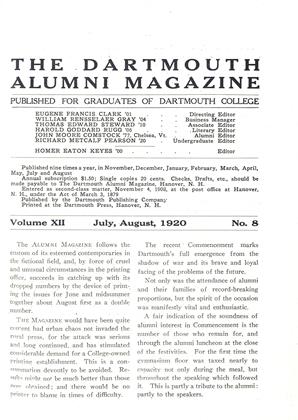
The ALUMNI MAGAZINE follows the custom of its esteemed contemporaries
July 1920 -
 Article
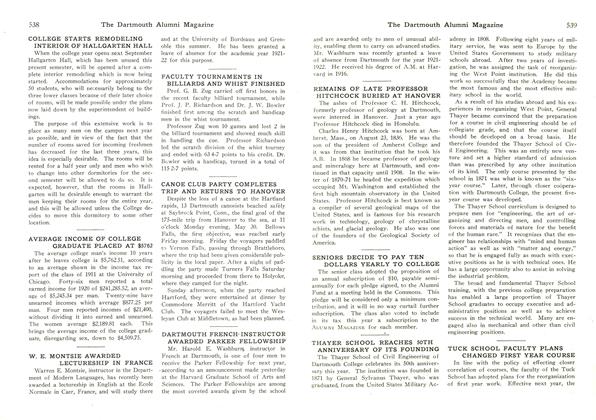
TWO PROFESSORS ADDED TO DARTMOUTH TEACHING CORPS
June 1921 -
 Article
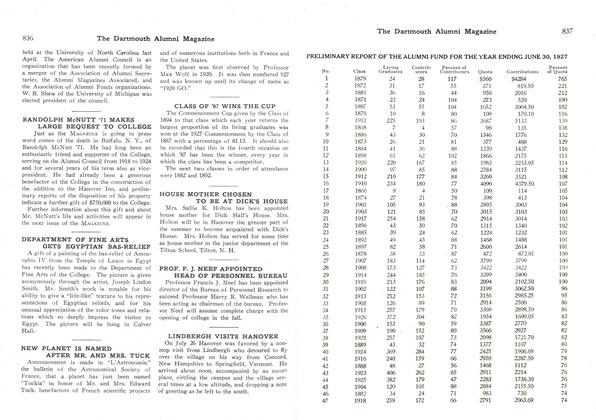
NEW PLANET IS NAMED AFTER MR. AND MRS. TUCK
AUGUST, 1927 -
 Article
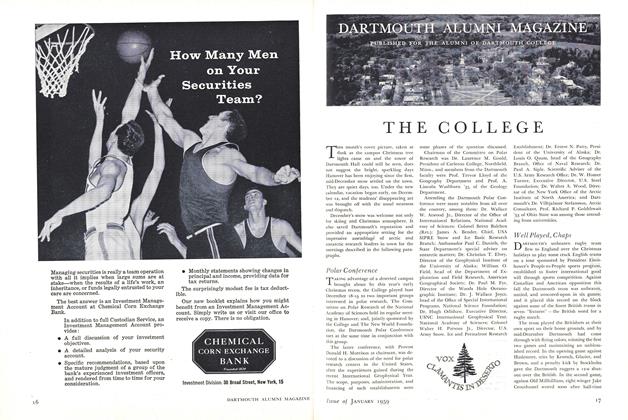
Polar Conference
JANUARY 1959 -
 Article
A new year begins
NOVEMBER • 1987 -
 Article
The Undergraduate Chair
FEBRUARY 1968


