Class of 1915
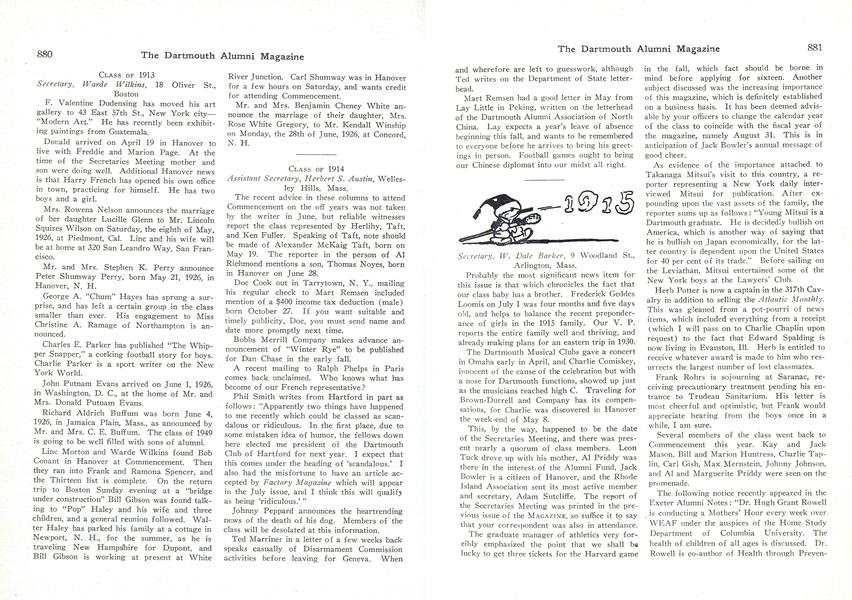
Probably the most, significant news item for this issue is that which chronicles the fact that our class baby has a brother. Frederick Geddes Loomis on July 1 was four months and five days old, and helps to balance the recent preponderance of girls in the 1915 family. Our V. P. reports the entire family well and thriving, and already making plans for an eastern trip in 1930.
The Dartmouth Musical Clubs gave a concert in Omaha early in April, and Charlie Comiskey, innocent of the cause of the celebration but with a nose for Dartmouth functions, showed up just as the musicians reached high C. Traveling for Brown-Durrell and Company has its compensations, for Charlie was discovered in Hanover the week-end of May 8.
This, by the way, happened to be the date of the Secretaries Meeting, and there was present nearly a quorum of class members. Leon Tuck drove up with his mother, A 1 Priddy was there in the interest, of the Alumni Fund, Jack Bowler is a citizen of Hanover, and the Rhode Island Association sent its most active member and secretary, Adam Sutcliffe. The report of the Secretaries Meeting was printed in the previousissue of the MAGAZINE, so suffice it to say that your correspondent was also in attendance.
The graduate manager of athletics very forcibly emphasized the point that we shall bg lucky to get three tickets for the Harvard game in the fall, which fact should be borne in mind before applying for sixteen. Another subject discussed was the increasing importance of this magazine, which is definitely established on a business basis. It has been deemed advisable by your officers to change the calendar year of the class to coincide with the fiscal year of the magazine, namely August 31. This is in anticipation of Jack Bowler's annual message of good cheer.
As evidence of the importance attached to Takanaga Mitsui's visit to this country, a reporter representing a New York daily interviewed Mitsui for publication. After expounding upon the vast assets of the family, the reporter sums up as follows: "Young Mitsui is a Dartmouth graduate. He is decidedly bullish on America, which is another way of saying that he is bullish on Japan economically, for the latter country is dependent upon the United States for 40 per cent of its trade." Before sailing on the Leviathan, Mitsui entertained some of the New York boys at the Lawyers' Club.
Herb Potter is now a captain in the 317 th Cavalry in addition to selling the Atlantic Monthly. This was gleaned from a pot-pourri of news items, which included everything from a receipt (which I will pass on to Charlie Chaplin upon request) to the fact that Edward Spalding is now living in Evanston, 111. Herb is entitled to receive whatever award is made to him who resurrects the largest number of lost classmates.
Frank Rohrs is sojourning at Saranac, receiving precautionary treatment pending his entrance to Trudeau Sanitarium. His letter is most cheerful and optimistic, but Frank would appreciate hearing from the boys once in a while, I am sure.
Several members of the class went back to Commencement this year. Kay and Jack Mason, Bill and Marion Huntress, Charlie Taplin, Carl Gish, Max Mernstein, Johnny Johnson, and A 1 and Marguerite Priddy were seen on the promenade.
The following notice recently appeared in the Exeter Alumni Notes : "Dr. Hugh Grant Rowell is conducting a Mothers' Hour every week over WE.AF under the auspices of the Home Study Department of Columbia University. The health of children of all ages is discussed. Dr. Rowell is co-author of Health through Prevention of Disease and of Health Supervision and Medical Inspection of Schools. He is a member of the Educational Clinic of the Institute of Child Welfare Research, Teachers College, New York city, and of the group committee on Child Welfare and- Parental Education at Teachers College." If sufficient interest was shown I believe Dr. Rowell would be glad to conduct a correspondence school on this subject for the benefit of class members, or better still, a portion of this column will be reserved for questions and answers on "Baby Hygiene."
Russ Durgin and family have returned to Japan for another five years' sojourn, which means that the Durgin family will be present for the Fifteenth.
Katherine and Freddie Childs and Jack Treasury Bowler were introduced to the pleasures of Cape Cod over the week-end of the Fourth, making their headquarters with Marguerite and A 1 Priddy at their Wind Mill Home, which is sufficient proof that they had a good time. According to the most reliable source of information, they indulged in all forms of sport from teaing to swimming. Jack and Fred did have the temerity to take on your president and secretary on their home course, the Bass River Golf Club, and I am sure that we shall be pardoned for remarking that Fred and Jack still sing beautifully. Parenthetically, classmates who might have difficulty in finding a course upon which to exercise their clubs while on Cape Cod will always find competition at Bass River if they will but ask for any or all of the following club officers: Priddy, Trowbridge 'l4, or Barker. This is undoubtedly contrary to the belief that such an admission of acquaintanceship might be a basis for exclusion. (Business Ad.)
Special wire just received : "Chairman Priddy again directed Alumni Fund Committee to the attainment of their goal." Fine work.
On board the S.S. Empress of Canada under the date of May 24, Charlie Griffith wrote a letter to the Secretary, which contains such an interesting description of his travels in countries bordering the Pacific that it would be unfortunate if only one person received its benefit. Therefore, it will be printed in installments in this column until completed.
"Dear Dale: The postcard I sent you from Japan in February was only a reminder that I had not forgotten you despite a long hiatus in letters. Then your letter came asking for information about Fifteeners I might have seen, and other Dartmouth men (who did not have the good fortune to belong to our class), and I decided to wait until I had doubled back on the return journey for the sake of a better and more complete travelogue.
"Los Angeles, in mid-January, was the first concrete evidence that, for a time at least, we could forget extreme cold, coal strikes, and smoky furnaces. The native sons of California do a great deal of talking about climate, and now I can see the reason for their enthusiasm. When I could snatch a little time from business routine, I went out of my way to marvel at the real estate development, and to see the conventional sights of Hollywood. Lunch at Montmartre gave me a chance to see movie stars off location in their make-up. Many seemed like normal human beings which we wish all were, whi e others displayed that assumed self-forgetfulness which attracts the gaping populace, and even caused a stampede at Barbara La Marr's funeral!
We sailed from Los Angeles harbor (a sec-et: it is twenty-eight miles from the city itself) Saturday morning, January 16. Once upon a time the S.S. Calawaii was a sister ship of the army transport Thomas, which is duly famous in Philippine history. The passenger ship connects California and Hawaii, hence the name, and too leisurely occupies a whole week for the journey. The last glimpse of California reminded me of pictures of Naples with Vesuvius in eruption; the long curve of the ccast blue, brown parched uplands merging into tawny mountains, and a column of yellowish smo .e spreading out into a gray pall from a burning oil well.
"The first view of the Hawaiian Islands amply justifies their description as the loveliest fleet of islands which lie anchored in any sea. The mountains are covered with green vegetation, which on closer inspection proves to be ferns, tropical plants, and luxuriant undergrowth. Cotton wadding clouds float majestically over the blue sea and the emeraled green shallows formed within the coral reefs.
"Part of Mrs. Griffith's and my pleasure at Waikiki Beach came from our meeting with Mr. and Mrs. C. A. Fifer of Quincy, 111.,—in other words "Pop" Fifer 'O6. Surf riding and bathing are all they are advertised to be, especially when the water is 70 and the month January. It is appropriate for any one of us in our college generation to enjoy Waikiki. Do you remember the proms when the orchestra from Concord used to play On the Beach at Waikiki sung by Ernest Truex in Very Good Eddie?
"First in Boston and then in New York you will remember the class dinner programs when men took turns in giving 'shop-talks' about their businesses. In this letter I can hardly take time to go into the details of my work, but visiting schools and seeing their great contribution to better citizenship are experiences long to be remembered and a rare privilege, perhaps to recount later and elsewhere. Our jingo newspapers at home are continually running scareheads about the dangers from the growth of the Japanese population in Hawaii. To be sure the problem is a perplexing one, and has many angles to be smoothed down tactfully and with real statesmanship. However, if the American people will trust and support to the limit the magnificent work of the public schools, and those private schools inculcating American educational ideals, the final outcome will be loyalty where loyalty is due.
"Music plays a large part in the life of Honolulu. The Hawaiians have an harmonic sense which enriches their part-singing wonderfully and makes our best 'swipes' and 'barber shop chords' sound tame and stilted. Under the big banyan tree at Waikiki every Sunday night the beach boys sing Hawaiian folk songs to the accompaniment of a steel guitar. It isn't only the setting, the dim lights, the scented air, the moonlight, the pervasive magic of the tropics, which makes this music memorable. It is really good music, typical of the life of a people, wistful for vanishing pomps, rhythmic with the long sinuous sweep of the Orient, melodic from socializing contacts and the encompassing beauties of nature.
"The storm on the Atlantic in which the S. S. Roosevelt made a gallant rescue of an English freighter so monopolized news that you probably did not know of our eight days' blow on the Pacific. Usually the winds veer after a day or so of terrific violence. Our ship from Honolulu bucked a headwind, which blew from the same direction for over a week. While the S.S. President Taft pitched up and down, one day covering only one hundred miles, the effects of the storm on land were felt five thousand miles away, where giant breakers furiously lashed the California coast. Therefore, Yokohama was a most welcome sight, and most of all Dan Waugh standing on the dock."
[The entertainment supplied by Oriental Dan will be described in the November issue. Imagine Susan and Charlie chopsticking "sukiyaki," —impossible, you will have to read about it.]
Secretary, 9 "Woodland St., Arlington, Mass.
More From This Issue
-
 Article
DARTMOUTH COLLEGE MEMORIAL FIELD FUND CONTRIBUTORS BY CLASSES
August 1926 -
 Article
THE ONE HUNDRED AND FIFTY-SEVENTH COMMENCEMENT
August 1926 -
 Article
WITH THE FORMAL
August 1926 -
 Class Notes
Class of 1916
August 1926 -
 Article
JUNE MEETING OF THE ALUMNI COUNCIL
August 1926 -
 Sports
THE DISTRIBUTION OF FOOTBALL TICKETS
August 1926