Class of 1915
Unknown to most of us one member of the class is in the Movies. His name does not blaze forth on Broadway after dark, and as a matter of fact, he does not appear on the screen doing harold-lloyds or tom-mix's, so probably it should be said more properly that he is associated with the cinemas. On the letterheads of First National Pictures, Inc., there appears the name of Ralph Brown, assistant general counsel, with headquarters in New York, not Hollywood. It would seem that attempting to settle the trials and tribulations of moving picture heroes and heroines would be more hazardous but vastly more interesting than maritime disputes. But the most important news about Brownie is now about to be written. For some unaccountable reason for which I assume the responsibility, the announcement of his marriage to Esther Fisher Davis has not previously been made in this column. This occurred at Hopkinton, Mass., last August and just to show their disbelief in superstition the Quaker service was performed in a thunderstorm. There followed a month's cruise in Long Island Sound and southern Massachusetts' waters. Brownie reports that his first mate (or is it captain) is a first-class sailor.
Following the plea for correct addresses which appeared in the December issue, Larry Edgerton sent in his from St. Petersburg, F1a.—903 West Coast Title Building. Larry doesn't say just what is the nature of his work, but the company trade-mark is a corker, depicting the Spanish Armada under full sail. Larry, Jr., was born just a year ago.
Prognostications are tricky items to print because of the danger of their failure to materialize. However, two of our recent ones have been justified. In the Boston Sunday Heraldof January 30 the political editor wrote some- what at length about the New Hampshire legislature, the largest legislative body of its kind in the country. No small amount of praise did he give to the speaker, Hal Davidson, who is considered in high regard for his political abilities. The Boston Transcript of January 22 carried a picture of Dick Merrill's new church— the Second Church of Newton, and also a complimentary resume of Dick's career to date.
After the first five minutes of play the hockey game between Dartmouth and Harvard became most interesting, with the final score 4-2 in favor of Harvard. Eddie Shea, John Healy, and Johnny Mullin were there lending their moral support, and although Leon Tuck sat beside me during the entire game he did not even hint that he was going to get married. But future events proved that he must have been thinking about it at least, for on January 24 he was married to Joyeuse Gray Ellms. Just to make the job complete, Dick Merrill did the marrying.
Dick Clarke writes that at the recent New York alumni dinner 1915 accounted for two tables. Fred Child and Charlie Griffith, according to their respective abilities, contributed to the success of the affair, which was pronounced the best yet. It is. not amiss at this point to recall to your mind that the New York crowd holds regular monthly dinners at the new Dartmouth Club, so if you are uncertain about the time, get in touch with Dick Clarke at 80 Maiden Lane, and he will give you the dates. Ray Perry is now with the Wilcolator Company, 17 Nevada St., Newark, N. J. What is the line, Ray—refrigerators or coffee cookers ?
While we are on the subject of dinners, the largest Boston alumni dinner since the War deserves mention. Our attendance percentage was 2 4-5% of the total (which can be determined after counting the following list and applying a Tuck School formula). Joe Fawcett and George Simpson made their annual pilgrimage from Maiden and Melrose, and then there were Doc O'Hara, Ray Humphrey, Russ Rice, Henry Marcy, Eddie Shea, John Healy. Norvie Milmore, Shrimp Williams, Adam Sutcliffe, Red Folan, Earl Clough, Jack Mascn, Stu Hill, Dooze Lounsberry, Al Priddy, Kike Richardson, and Johnnie Johnson, who was with us when he wasn't obliged to sing with the double quartette. Perhaps his most spectacular contribution to the program was when he, as one of a band of 12 hikers, depicting the arrival at an Outing Club cabin, marched across the darkened floor in the glare of a spotlight, bedecked with an Indian blanket and with skis and pack on his back. He surely represented the spirit of the North Country.
For the first time in several years the ladies were admitted to the gallery to watch the performance, and perhaps their husbands. There might have been more there, but I'm sure I saw Margaret Hill and Helen Lounsberry. Notes from the 1915 auxiliary are scarce. Haven't they anything to report?
At their annual meeting in January the board of directors of the Atlantic National Bank of Boston elected Al Priddy to their directorate. This is a distinctive honor, as this bank is reckoned as one of the most progressive in the city. In the same breath we hasten to express our belief that the bank justified its reputation by making such an able addition to its board.
With so many members of the class holding bank jobs and titles it would seem as though money shouldn't be so scarce. Out in Les Castle's bank—the Austin State Bank— money is coming in so fast that they have had to build an addition to the main bank building. Les eases his conscience a little by working for the Y. M. C. A.
Harold E. Corwin has resigned his position at Exeter and become cashier of a bank in Hopkinton, Mass.
John Macintosh was recently seen within the confines of West Medford, Mass., dancing the black-bottom. This happened at night, but during the day John says that he will sell wool to anyone with the proper credit.
The February issue of the ALUMNI MAGAZINE has just been received, and I hope you read it carefully enough to note that J. P. Bowler is one of the enthusiastic members of the Hanover curling team. The uniform I believe consists of a tam-o-shanter, pipe, woolen scarf, kilts, and a broom, so under the circumstances it would be well to form a cheering section for the premier curler of the class and give him "a hearty round of applause," as that eminent Sunday radio preacher is wont to say. Curling has one advantage at least over golfing, Jack—there are no hay fever stimuli on the ice.
Secretary, 9 Woodland St., Arlington, Mass.
More From This Issue
-
 Lettter from the Editor
Editorial Comment
March 1927 -
 Article
THE DARTMOUTH COLLEGE BUREAU OF PERSONNEL RESEARCH
March 1927 -
 Article
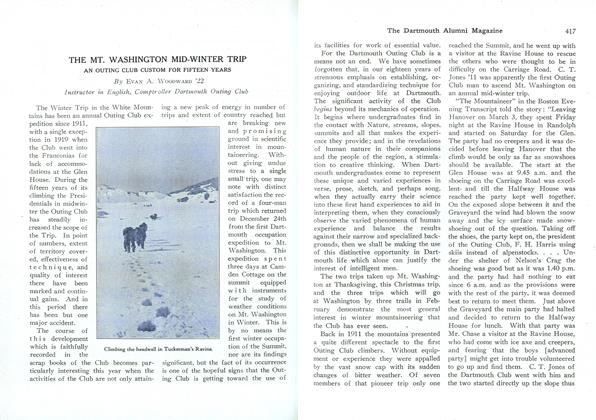
THE MT. WASHINGTON MID-WINTER TRIP
March 1927 -
 Article
JOHN LEDYARD AND HIS RUSSIAN JOURNAL
March 1927 -
 Article
A Bigger and Better Carnival
March 1927 -
 Class Notes
Class of 1899
March 1927