WELL-KNOWN SPORT WRITER PRAISES WINTER CARNIVAL
Among the many glowing tributes, as one calls them, paid to Dartmouth's Winter Carnival, one of the most ruddy was undoubtedly that of Fred Hawthorne, the New York Herald-Tribune's well known sport writer, who, in an article in The Dartmouth wrote February 11 as follows:
The Winter Carnival of the Dartmouth Outing Club has been conducted among what we, of the more effete and coddled city of New York, like to refer to as the "great white spaces of the frozen North," for the last 17 years, and for the last six of these years I have been making my annual pilgrimage up here, in the attempt to set down for Herald Tribune readers some of the things I see at the Carnival.
The first year I came to Hanover, in 1922, it was as a part of my duty as a newspaperman. At that time I looked forward to the long overnight trip to the frigidity of New Hampshire with considerable misgiving, and I am afraid, a spirit of rebellion. But ever since that time I have looked forward eagerly to the annual Dartmouth week-end and the opportunity to meet again with the men of Dartmouth.
In the course of a long and varied newspaper career, .it has been my lot to look upon many variations of sport, amateur and professional, from the Florida Keys to the Canadian Border, and hundreds of Carnival visitors who gather at Hanover from all parts of the compass. The ski-joring, the snowshoe and ski races, the skating and tobogganing, not to mention the specialties for the still so-called "gentler" sex, such as the fraternity and Musical Club dances, the Carnival Ball and the dramatic offerings of the Dartmouth Players, all these combine to make up a memorable three days and nights for the pilgrims to Hanover.
My first impression of Dartmouth and Dartmouth men, gained on that first visit here, was one of wholesomeness, and that impression has deepened with each passing year. There is something in the hardihood bred in your rigorous winters, perhaps, that gets into the blood of sons of Dartmouth, and gives them healthy comradeship with the out-of-doors, a sane outlook upon Life, and a certain ruggedness of character that are refreshing to meet with in this considerably upset age.
And with these sterling qualities I have found that Dartmouth men are all primarily and instinctively gentlemen. In all the years I have been coming to Hanover, I have yet to observe a disagreeable incident connected with Dartmouth from the Atlantic Seaboard to the Far West. In no one instance can I recall any specific sporting event that holds the thrill for me that your Dartmouth ski-jump does, and in saying that I am not forgetting flights in racing aeroplanes and 60 mile an hour seasleds—or the Dempsey-Carpentier "Battle of a Century."
No one of the three latter forms of sport require daring equal to that vital in the ski-jump. The arctic gale blowing in the teeth of the jumper, the dash at railroad speed down the frozen incline, followed by the eagle-flight through the air from the take-off and the swift descent into the valley far below; nothing but nerves of steel and unfaltering courage, coupled with the spirit of the great adventure, are sufficient to insure success.
While the ski-jump, of course, is the spectacular feature of the Dartmouth Outing Club's Carnival, the entire programme of the three day meet is admirably planned to hold the interest of the student life, and that is saying considerable in a college as big as this.
It all goes to prove, I think, that boys can be raised in an atmosphere as far removed from the centres of civilization as Hanover and still grow into polished gentlemen, as well as inheriting that priceless love of nature and clean living that nothing else can quite compensate for.
An ancestor of mine used to roam these mountains, long years ago, and sit in solitude for hours, drinking in the beauty and the majesty of these snow-covered heights, and one of his favorite haunts was the giant rocky eminence, known, if memory does not fail me, as ''The Old of the Mountain." One of his stories, entitled "The Great Stone Face." was written about that particular bit of granite. Could he return to those mountains today, I believe he would find Dartmouth men fitting descendants of the days when Dartmouth College was but a school in respect to the size of the student body.
I have spoken a lot about "atmosphere," it seems, but I might add in closing that I believe President Hopkins has had a deal to do with the atmosphere" at Dartmouth, and that largely because of his broad-minded and progressive attitude as respects the students, Dartmouth is turning out into the world the splendid types of men she is sending forth today.
More From This Issue
-
 Lettter from the Editor
Editorial Comment
March 1927 -
 Article
THE DARTMOUTH COLLEGE BUREAU OF PERSONNEL RESEARCH
March 1927 -
 Article
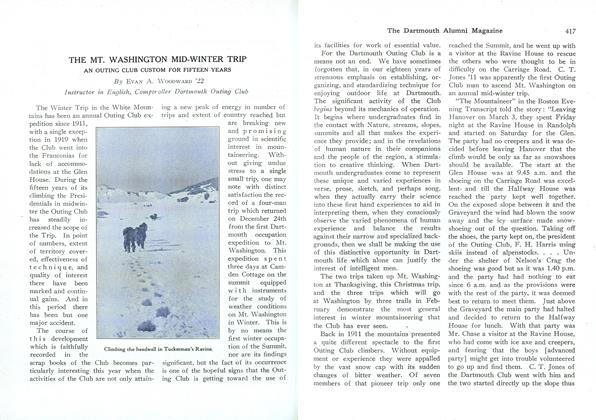
THE MT. WASHINGTON MID-WINTER TRIP
March 1927 -
 Article
JOHN LEDYARD AND HIS RUSSIAN JOURNAL
March 1927 -
 Article
A Bigger and Better Carnival
March 1927 -
 Class Notes
Class of 1899
March 1927