Set-Back, or Stimulus?
Professor Gilbert Murray, the famous Oxford Greek scholar recently visiting this country, has been quoted as saving that in his judgment the so-called "monkey law" trials in Tennessee two years ago marked the most serious set-back to intellectual civilization in many a longyear—or words to that general effect. There seems room for some difference of opinion here. The tendency of some more primitive minds to fetter the search for truth by repressive statutes designed to bolster ancient concepts of creation and the universe, would indeed be a serious set-back if it were likely to work out as its promoters design; but the fact seems to be that the ultimate effect is merely going to be to produce an intensification of the knowledge that such repression is ridiculously out of tune with the Twentieth century and much more in character with the Thirteenth.
Observation indicates that the great result from the Tennessee business has been a general awakening of curiosity touching matters formerly ignored by the rank and file of mankind. To be sure there remain several jurisdictions in which the lagging intelligence of the public inclines to perpetuate the same kind of spirit that met the first revelations of Copernicus and Galileo. Indeed one state legislature has gone farther, if the reports are true, and has proposed to simplify mathemat- ics by a decree that in its jurisdiction the value of "Pi" shall be a flat 3 instead of 3.1416 plus! Nevertheless the efforts of bucolic senators and representatives to save God's truth from destruction by dint of legislative prohibitions merit far more of amusement than alarm; and we cannot avoid feeling that Professor Murray exaggerates the injury done by the Scopes trial. The gaiety of nations was clearly promoted, and an index was afforded which shows a more general obduracy of intellect in some quarters than one might have expected in this late age of the world; but really the effect will be found to be to have opened the general mind to the consideration of problems hitherto treated as too abstruse and too dull for common folk to weary their heads over.
It is entirely probable that some parents anxious to keep their children from contamination will react unfavorably against colleges which not only otter courses in evolution, but even require them to be taken very early in the curriculum ; but the absence of such as regard the study of such sciences as impious will hardly damage the colleges.
The extraordinary thing will remain the amazing reluctance of human beings to recognize the fact that what they are dreading is merely the decay of their own misconceptions, and not at all the prospect that God will be mocked by discovering the actual methods by which the universe and the life which it supports came into being. Religion seems to have weathered the revelations of the older astronomers and geographers, despite the frantic endeavor of the early churchmen to repress such knowledge by every artifice known to a dogmatic age. It will inevitably continue to survive, if God is what devout persons assert Him to be. Meanwhile in some backward states it may be necessary for some years to come "to bootleg your biology," as it has been irreverently put. Mr. Mencken and other scornful critics of herd morality will run no risk of perishing from sheer ennui for some time yet.
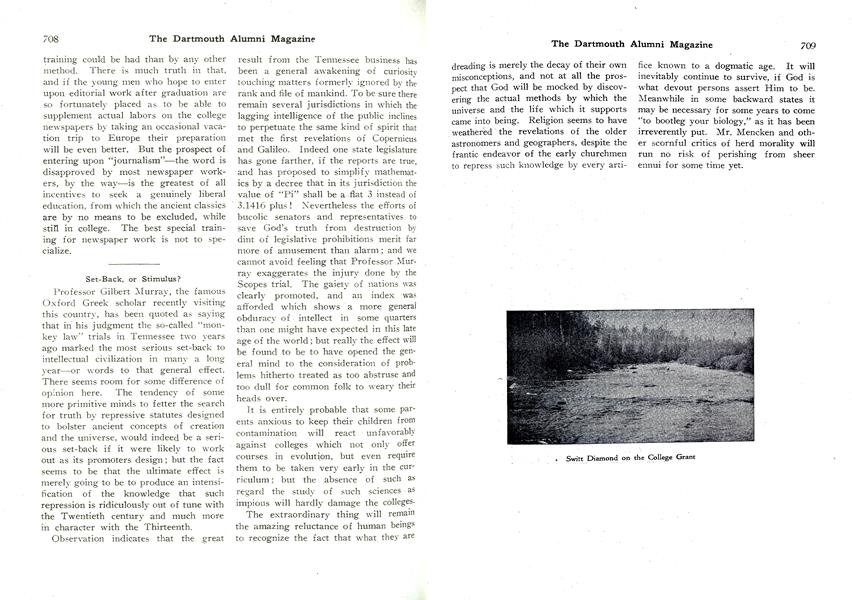
Switt Diamond on the College Grant
More From This Issue
-
 Article
THE UNDERGRADUATE CHAIR
June 1927 -
 Article
WHAT THE COLLEGE MAN EXPECTS IN BUSINESS
June 1927 -
 Article
ATHLETIC COUNCIL REPLIES TO PRESIDENT HOPKINS
June 1927 -
 Article
SECRETARIES ASSOCIATION MEETS IN HANOVER
June 1927 -
 Article
DARTMOUTH CAVALRY IN THE CIVIL WAR
June 1927 -
 Article
CAN CHINA SURVIVE
June 1927