Praises Pres. Hopkins' Address
The following letter from William Stearns Davis, the well-known historian and novelist, appeared in the Boston Herald on January 12: To the Editor of The Herald:
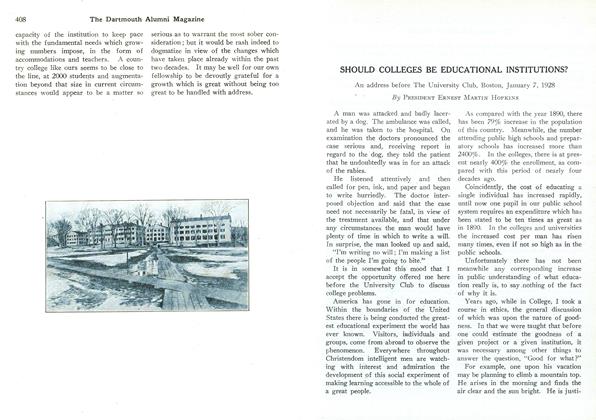
Allow me to thank The Herald for publishing in full the address of President Hopkins of Dartmouth upon the 7th before the Boston University Club. His dismissal of the idea that colleges fail in their purpose if they refuse to be turned into a kind of sublimated business school deserves the applause and approval of every educated man in the land.
I well recall how some years ago Dr. George Edgar Vincent, now head of the Rockefeller Foundation, and then president of the University of Minnesota, poured out his contempt for that type of student whose prime object in going to college seemed to be "to learn how to extract more money from his fellow men." Apparently however, there are certain gentlemen in business circles who have corresponding contempt for any young man spending four years in any less sordid object. These gentlemen seem to know very little of the purposes for which great institutions of learning have been founded, and to which many thousands of persons reckoned among the wise and good have devoted their lives.
There are noble traditions not to be sent to the scrap heap, even though the priests of that new Baal called "Efficiency" cry aloud and cut themselves with knives. There are things of the spirit not to be sacrificed, even for the sake of enabling graduates to increase the profits of the corporations which condescend to employ them. There are those who believe that colleges and universities primarily exist not for teaching how to get bigger incomes, but how (in the worthiest and truest sense) to get the most out of life; who believe that truth is worth seeking for its own sake irrespective of dividends; and who, finally, are fearful lest the crass materialism of certain business tendencies represents a greater national menace than all the wrong thinking of avowed revolutionists.
Possibly for argument's sake let it be granted that a college man cannot hope to win a larger income than a non-college man (I am confident that this is not true), even then the question comes down to this—are there no higher values in life? Do our colleges provide the means to attain them? Is there anything much more pitiful than your wealthy and "successful" man, approaching his three score and ten, and yet wholly unable to appreciate and enjoy that great treasure of the "true, the beautiful and the good," accumulated across the ages, and the chance to possess which is apart from deeds of lavish philanthropy almost the only justification for amassing dollars?
To give this power to grasp the higher values is the thing for which colleges today exist. If they fail to give this they are rightly criticized. If they fail to teach how to add to these higher values they are rightly criticized. But it is to their praise if they decline to run their curricula so that their alumni may simply become more efficient employees around the office.
According to some modern standards Socrates was a great fool to drink the hemlock. What increased production did he get out of it? Dr. Hopkins's address constitutes a very rare thing in these days; it is a real contribution to the understanding of an enormously important subject.
Exeter, N. H., Jan, 9.