Managing a Football Team
Dartmouth undergraduate athletic managers have theentire responsibility of transporting, equipping, and takingcare of their teams. The "D" which these young businessmen are awarded is as well earned as are the letters givento the athletes under their supervision. In view of the re-sponsibilities and the efficiency with which they meet theirduties the managers are entitled to their own bit of "glory."This article, written by the 1928 manager of football, ex-plains the careful preparation and execution of planswhich involved expenditures of $13,000 for trips of theteam and $8,500 for its equipment this season.
DARTMOUTH men like to reminisce on only those happenings that are pleasant to them. Like all human beings all of us talk about our triumphs and let the less successful features of our pasts slide silently into the dark corners of our memories. Rather therefore than going through the very uncomfortable process of re-narrating all the defeats of the ill-fortuned team which seemed to run into one jinx after another in the form of injuries all season, I will speak of the pleas- ant things that happened in writing of the season from the managerial point of view.
There are few people that are acquainted with the work of the undergraduate athletic manager. Like the scrubs on the bench his is the lot of doing a great deal of work and receiving little credit, so that while the players and trainers and coaches occupy headlines in the daily papers, the managers go about their work un- heralded. At Dartmouth a manager must first go through two years of rigorous training in which he be- comes acquainted with the entire athletic machine and with this knowledge is well equipped to enter upon his managerial duties. He arranges his own schedule, draws up his equipment and trip budgets before the season opens, and is personally responsible for his team throughout the season. He must, of course, work under the constant approval of the athletic council, but on the whole he is allowed to use his own judgment and make his own decisions unmolested.
In the case of football, the schedules are made out some years in advance by the athletic council. The handling of the equipment however presents a real problem to the manager. The full equipment for a player for a season costs approximately a hundred dollars and as Dartmouth usually carries a squad of about seventy-five men through the season this item alone assumes tremendous proportions. In addition to this, there is a host of accompanying equipment such as balls, blankets, medical equipment and field equip- ment. During the past season the cost of footballs alone amounted to about eight hundred dollars.
In arranging his trips the football manager must travel to the different camps of opponents, choose a suitable place to stay, and make the necessary arrange- ments in the spring before the fall season. In doing this there are a thousand details th at must te attended to, which if left undone are apt to throw tie -whole team out of sorts during the trip. Thus we have to carry our own drinking water and send special menus ahead for each meal. The task of handling the equip- ment while away from home is such a great one that a special man has to be appointed for the management of that end. After making sure that each man has packed every part of his uniform, the equipment manager ac- companies the trunks to the field, assigns each man a locker, and hangs the uniforms in their respective lockers. Before the game every pair of shoes is shined and the green helmets are thoroughly gone over, and after every game the jerseys are dry cleaned, account- ing for the favorable comment that the appearance of Dartmouth football teams has always caused.
The Cornell trip of the past season affords an excel- lent example of the work of the equipment manager. We arrived in Geneva, New York, Friday morning be- fore the game and were scheduled to practice at Hobart College Friday afternoon. Bill Henretta, the equip- ment manager, and his three assistants had just barely enough time to rush the eight large trunks from the station to the Hobart Field and have the equipment unpacked in time for the team to practice in the after- noon. Immediately after practice the uniforms were packed in the individual dunnage bags and placed in the trunks with the rest of the equipment. It was now necessary to accompany the trunks to Ithaca Friday night while the team stayed in Geneva. So while one set of managers was conducting the team from Geneva to Ithaca Saturday morning, the other set was unpack- ing the trunks at the field house at Cornell. The players had only to walk into their locker room and find every article of their equipment labeled, and in its proper place. After the game it was again necessary for the managers to pack very quickly in order to get the trunks safely on the six o'clock train out of Ithaca. Of course in order to conduct these trips the manager must handle thousands of dollars, and in using these funds he must exercise his judgment and business ability by keeping close track of his money, balancing each day, and turning in a very detailed expense report upon his arrival in Hanover.
As we go back and examine the records of the foot- ball teams of the past we cannot help but be amazed at the tremendous growth of the sport. We find in an issue of the Dartmouth dated Nov. 10, 1882, the follow- ing news item:—"The Rugby team left here Wednesday afternoon for Cambridge, Mass., where they were to play the Harvard eleven on Thursday.•••The following men went: Drew, Oakes, Brown, Cushman, Howland, Rolfe, Nettleton, G. 0., Brooks, Towle, Weeks, Gove, Bennett, Marston, and Niles, Manager." This adven- turous little band, which was the first Dartmouth foot- ball team to play Harvard, consisted of one full eleven, two substitutes, and a manager. Constrast this with the football party that travelled to Cambridge in 1928. Besides the thirty-six players, there were five coaches, four men of the training staff, three managers, and four "athletic competitors" (men competing for mana- gerships)—a total of fifty-two men. Later in the season, when the team went to Chicago to play its unhappy game with Northwestern, there was added the Dart- mouth band and the freshman team, so that the offi- cial party commanded a special train of a dozen cars and numbered 140 men.
These trips usually go very smoothly but the man- ager must be constantly on his guard against the un- expected. One of the most striking examples of this occurred during the 1927 season when Larry Martin was managing the team. He awoke on the Friday morning before the Brown game to find that the great flood had ravaged New England and completely wiped out every railroad connection out of White River Junc- tion. The team was scheduled to leave for Providence at noon that day and to play the game at two o'clock the next day. The managers realized that something had to be done and done quickly. They knew that if the team did not arrive in Providence in time for that game there would be thousands of dollars lost. They accord- ingly gave orders to the whole party to eat dinner and meet in front of Commons at noon. Then they began a long series of phone-calls over those lines that still re- mained. The Boston & Maine agreed to hold a train in Concord, and in order to supply the transportation to that point the managers finally succeeded in gather- ing a squad of fifteen taxicabs from neighboring towns. Promptly at noon fifty men left Hanover in an imposing cavalcade consisting of the fifteen taxicabs followed by two light trucks with the equipment and a wrecking car to use in case of disaster.
The story of the ride through the flood is one which will long be remembered by every man in the party. As we passed White River Junction and saw the bridge across the White River under about three feet of water we realized that the flood was no idle rumor as some had previously thought. We went by the road to Newport and were parallelled by a rushing torrent which took with it everything in its path. At times houses were literally washed away beneath our eyes and the road was constantly below water from six inches to a foot and a half. Finally we came to a place where the road was no longer passable and many advised us to go back, thinking it impossible to get through. However, we were not to yield so easily and after a short search found a slippery wagon road over a mountain. The game would never have been played had we not at- tempted this doubtful road and finally slipped through after the last of the cabs had been pulled out of the mud. After this, the road was better and we finally caught our train in Concord after the wrecking car had suc- cessfully brought in those which had broken down on the way. We reached Boston where we stayed that night and went to Providence the morning of the game. Incidentally in spite of the excitement of the very hard trip the team played one of the best games of the season against Brown. The next week the Cornell manager ran into the flood on his way to Hanover and finally arrived in time for the game after having travelled over a thou- sand miles by rail by a most roundabout route. These are only examples of many cases in which the under- graduate managers have had to overcome the un- expected.
However, one must not think that a manager is con- stantly running into such serious situations. On the contrary, he often finds himself engulfed with the ridic- ulous. This happened to me during the early part of the preliminary training, this fall. Pat Kaney was accus- tomed to lead the squad in calisthenics daily before regular practice began and as the tension was becoming severe at this particular time, Pat suggested that it would put zest into the men if they were allowed to go through their paces to music. We thought this propo- sition over and believed it to be a good one but as the Barbary Coast Orchestra was not available, the best that could be procured in the line of music were my own efforts on the harmonica. Certainly no one denied that the tension was relieved! Furthermore, the news- papers were quick to recognize the news value of this most unorthodox procedure and published stories the point of which was the fact that Jess Hawley was rounding his men into shape by Russian dances to the tune of the manager's mouth organ. The climax came when practice was interrupted one day by the arrival of the Fox Movietone people with a truck load of re- cording apparatus. Practice had to be stopped while the team once more went through their paces and I stood by tooting the harmonica in a not altogether dignified manner. Later, however, I received some con- solation when Harry Hillman performed before the camera and convinced us all that he missed his calling when he became a track man. (He made his exit be- neath a shower of apple cores.)
When I spoke of equipment I omitted one of our most important items—the Hawley twins. To speak of the football season without reference to the two little two- year-olds would be like telling the story of Dartmouth College and neglecting Eleazar Wheelock. For two years they have watched the football practices and ac- companied us to our out-of-town games and on many occasions have been the life of the party. Whether at New Haven or at Ithaca, the twins were present, and it was no uncommon sight to see Captain Black and myself marching serenely down the station platform, each of us with one of these famous twins under an arm. Although she admitted that we were a little clumsy at it, Mrs. Hawley declared that we had the potentiality of becoming quite proficient.
One of the unique features of the Dartmouth athletic managerships is the method of selection. Before a man may compete for the managerships he must achieve a certain scholastic average and be one of the thirty men elected by his class to the athletic competition. The thirty men who comprise this competition begin work at the beginning of their sophomore year when they are assigned to different sports. By means of a system of apportioning the work, each man is enabled to become thoroughly acquainted with both the office and field aspects of every sport. After a year of experience on the different sports where he is graded by all with whom he comes in contact, and after several examinations and a personal interview with the athletic council, the latter body apportions the assistant managerships to the ranking men.
Without this very thorough and intense training it would be impossible for Dartmouth to be so successful with her system of undergraduate managers. In most colleges, in the case of football especially, the under- graduate managers have been reduced to nothing more than labeled "handy men" whose duties consist mainly of attending the water buckets, while salaried graduate managers conduct the teams. Nevertheless, I believe that I can say that at very few places have we seen teams handled as smoothly and efficiently as the Dart- mouth teams are under our undergraduate system. At many colleges it is the case of a paid man mechanically handling the team's business, while at Dartmouth it is an enthusiastic undergraduate eager to introduce im- provements into the system and intent on living up to the demands made of him by the use of his own qualities of leadership and business ability.
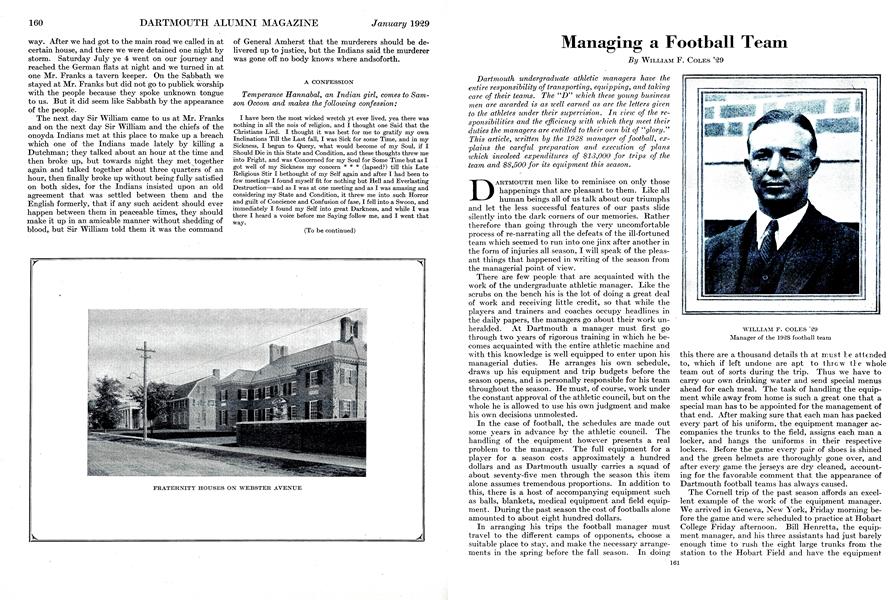
WILLIAM F. COLES '29 Manager of the 1928 football team
HEELERS RECEIVE THEIR INSTRUCTIONS From Manager Coles just before the Brown game. The full equipment which the athletic competitors use at football games, both in Hanover and abroad, is shown. Herman T. Schneebeli '30, assistant manager, is standing at the extreme right and beside him is William Henretta '29, equipment manager.