Indian Oratory
In this article Mr. Russell, a student of the ways of theredmen, has presented much material of value in the studyof Indian Culture. It all has a Dartmouth significanceparticularly the portion dealing with Samson Occom andthe Indian reply to Ralph Wheelock.
"And all her thoughts are with the days gone by, Ere might's injustice banished from their lands Her people, that today unheeded lie, Like the dead husks that rustle through her hands."
IN these pathetic lines from The Corn Husker did Pauline Johnson, the Indian poetess, draw a sad and vivid picture of one of her unfortunate kinswomen, which is typical of a fast vanishing race. The American Indian is peculiar among the nations of the past in that he left no written records concerning his people if we except the wampum belts, his only archives, from which the orators took their "leads" and recalled former events. It would be of the greatest value to historians if some person in the early colonial period could have sufficiently secured the confidence of the recorders of the aborigines, and learned the secrets which their predecessors "talked into the sacred wampum records" for the benefit of their own posterity.
All of the history of the peacetime and military events in which the red man had a part has been written by the civilized" European or his descendants; this, almost without exception, has been biased in order to justify the white man's cruel treatment of the aborigene; only by the most painstaking study can the historian do justice to the noble savage, too often pictured as cruel, ignorant, and ignoble by the greedy colonist.
Fortunately for us the Indian had the rare gift of eloquence; and from his recorded speeches and "talks" granted that they are often poorly translated we have a reliable guide to comprehend his conduct, as well as the motives and inspirations which shaped it. He developed a reason and judgment which made him susceptible to refining influences, even though he was incapable of grasping more than one idea at a time.
The language consisted of various dialects and was largely guttural. Its very poverty developed a highly figurative style, where metaphor shouldered metaphor, full of beauty and poetry, yet eloquent and forceful. It was the oratory of woods and prairies, not of schools.
ORATORY IS DRAMATIC
During the councils, when treaties were made and covenants renewed, gifts and tokens were given and received: perhaps a buffalo robe stained with red to show that the tribe remembered the men lost in battle by their white brethren; perhaps a red marble was presented to represent the sun; or chains of wampum were handed over to the military leaders: red for war, white for peace, black for mourning. These reciprocal presents were accompanied by the most solemn speeches.
Indian oratory is peculiarly impressive in the manner of the orator's delivery: forcible in the expression of his countenance, and in the brilliant flashes of irony, humor and pathos with which he embellishes his subject. The Red man is remarkable for allegorical apostrophes, highwrought and original comparisons, high principles, and logical reasoning. All interpretations are said to fall far short of the originals in every case, for the Indian needs to be seen as well as heard in order to have the auditor get the full effect of his words. In the absence of an adequate written history the utterances of the Red man, in the best translations available, will remain his most permanent and lasting record.
"The beauty of their imagination," said the historian Charlevois, "equals its vivacity, which appears in all their discourse: they are very quick at repartee, and their harangues are full of shining passages, which would have beeri applauded at Rome or Athens. Their eloquence has a strength, nature, and pathos, which no art can give, and which the Greeks admired in the barbarians."
OCCOM'S FAMOUS SPEECH
In 1772 Moses Paul, an Indian, while under the influence of liquor, killed Moses Cook. At Paul's request Samson Occom, an early pupil of Eleazar Wheelock's at his Indian School in Lebanon, Connecticut, gave an address, which I quote in part. It must be remembered that Occom was one of the first Red men educated in this missionary school and that his sermon is not typical of the unlearned savage.
"As it was your own desire that I should preach to you this last discourse, so I shall speak plainly to you.
. . .You are the bone of my bone and flesh of my flesh. You are an Indian, a despised creature; yea, you have despised God more; you have trodden under foot his authority; and now, as God says, be sure your sins will find you out. And now, poor Moses, your sins have found you out, and they have overtaken you this day; the day of your death is now come; the king of terrors is at hand; you have but a very few minutes to breathe in this world. . . . The just laws of man, and the holy laws of Jehovah, call aloud for the destruction of your mortal life. God says, 'Whoso sheddeth man's blood, by man shall his blood be shed.'
The interpreted speeches fall far short of the originalsin grace, power, and effect, but they throw much light on the courtesy, the high-souled honor, the indomitable wisdom, and untiring courage of statesmen, such as Dekanissora (Hiawatha), to whom the Onondagas give the credit of suggesting the formation of the League ofthe Ho-De-No-Sau-Nee- (or Iroquois). His was one of the greatest minds which the American Indian has ever produced; by several hundred years he anticipated TheLeague of Nations; it is probable that the coming of the European was responsible for limiting the extension of this American League and the collapse of its power. . . Here is a speech of Hiawatha:
"Friends and Brothers:—You are members of many tribes and nations. You have come here, many of you, a great distance from your homes. We have convened for one common purpose, to promote one common interest, and that is to provide for our mutual safety, and how it shall best be accomplished. To oppose these hordes of northern foes by tribes, singly and alone, would prove our certain destruction. We can make no progress in that way; we must unite ourselves into one common band of brothers. Our warriors united would surely repel these rude invaders, and drive them from our borders. This must be done and we shall be safe.
"You—the Mohawks, sitting under the shadow of the Great Tree, whose roots sink deep into the earth and whose branches spread over a vast country, shall be the first nation, because you are warlike and mighty.
"And you—Oneidas, a people who recline your bodies against the Everlasting Stone that cannot be moved, shall be the second nation, because you give wise counsel. "And you—Onondagas, who have your habitation at the Great Mountain and are overshadowed by its crags, shall be the third nation, because you are greatly gifted in speech, and mighty in war.
"And you—Cayugas, a people whose habitation is the Dark Forest and whose home is everywhere, shall be the fourth nation; because of your superior cunning in hunting.
"And you—Senecas, a people who live in the OpenCountry and possess much wisdom, shall be the fifth nation; because you understand better the art of raising corn and beans, and making cabins.
"You five great and powerful nations must unite and have but one common interest, and no foe shall be able to disturb or subdue you.
"And you—Manhattoes, Nyacks, Montauks, and others, who are as the feeble Bushes , and you, Nara gansets, Mohegans, Wampanoags, and your neighbors who are a, fishing people, may place yourselves under our protection. Be with us and we will defend you. You of the South, and you of the West may do the same, and we will protect you. We earnestly desire your alliance and friendship.
"Brothers—if we unite in this bond, the Great Spirit will smile upon us, and we shall be free, prosperous, and happy. But if we remain as we are, we shall be subject to his frown; we shall be enslaved, ruined, perhaps annihilated forever. We shall perish and our names be blotted out from among the nations of men. Brothers; these are the words of Hi-a-wat-halet them sink deep into your hearts I have said it."
CAPTAIN PIPE'S SPEECH
Mr. Willard Yager, eminent Indian authority, calls Heckewelder the most accurate translator of all, and refers in particular to Captain Pipe's Speech. In his foreword the Moravian missionaryjsaidthat the eloquence of the Indians was natural and simple; they spoke what their feelings dictated without art and without rule; their speeches were forcible and impressive; their arguments were few and pointed, reaching the heart in the shortest possible time. He characterized this speech of Pipe's as possessing most of the elements of school oratory. He maintained that it possessed boldness, frankness, dignity, and humanity, blended together and most eloquently displayed.
This speech was delivered at Detroit on the 9th of December, 1801, by Captain Pipe, a chief of the Delaware Nation, and was addressed to the commanding officer of that post, then in the possession of the British. The English had been forcing the Indians to subdue their revolting subjects—the Americans. The Delawares, after trying to remain neutral, took part with the Americans; but Pipe, with a party of the Wolf Tribe, joined the English at the beginning of the war, and was soon sorry for his hasty aption. Heckewelder was present when the address was given. He states that in the original Indian tongue it had much strength and spirit which the translation loses:
"Father! At the time when you gave me this weapon, I had neither cause nor inclination to go to war against a people who had done me no injury; yet, in obedience to you, who say you are my father and call me your child, I received the hatchet; well-knowing that if I did not obey, you withhold from me (meaning his nation and his tribe) the necessaries of life, without which I could not subsist, and which are not elsewhere to be procured but at the house of my father.
"Father! You may, perhaps, think me a fool for risking my life at your bidding, in a cause, too, by which I have no prospect of gaining anything; for it is yourcause and not mine. It is your concern to fight the longknives; you have raised a quarrel amongst yourselves, and you yourselves to fight it out. You should not compel your children, the Indians, to expose themselves to danger for your salces.
"Father! You say you love your children, the Indians —This you have often told them; and indeed it is your interest to say so to them, that you may have them at your service.
"But, Father! Who of us can believe that you can love a people of different color from your own, better than those who have a white skin like yourselves?
"Now, Father! Here is what has been done with the hatchet you gave me. (Handing him the stick with the scalp on it.) I have done with the hatchet what you ordered me to do, and found it sharp. Nevertheless, I did not do all that I might have done. No, I did not. My heart failed within me. I felt compassion for your enemy. Innocence (women and children) had no part in your quarrel; therefore I distinguished—I spared. I took some live flesh (prisoners), which, while I was bringing to you, I spied one of your large canoes, on which I put it for you. In a few days you will receive this flesh, and find that the shin is of the same colour withyour own.
"Father! I hope you will not destroy what (prisoners) I have saved. You, Father! have the means of preserving that which with me would perish for want. The warrior is poor and his cabin is always empty; but your house, Father! is always full."
RED JACKET HATED MISSIONARIES
Red-Jacket, a Seneca, was the great orator of the Six Nations, born near the present site of Geneva, New York, about 1750. His hostility to Christianity was implacable and broke forth on every possible occasion. It is probable that his indignation was just and righteous and that he had reason to be bitter against the White man for his many greedy and dishonest actions toward a weaker race. This was his reply in 1824 to a gentleman who asked him why he was so opposed to missionaries:
"Because they do us no good. If they are not useful to the White people, and do them no good, why do they send them among the Indians? If they are useful to the White people, and do them good, why do they not keep them at home? They are surely bad enough to need the labor of everyone who can make them better. These men know we do not understand their religion. We cannot read their book they tell us different stories about what it contains, and we believe they make the book talk to suit themselves. If we had no money, no land, and no country to be cheated out of, these black coats would not trouble themselves about our good hereafter.
The Great Spirit will not punish us for what we do not know. He will do justice to his red children. These black coats talk to the Great Spirit, and ask for light that we may see as they do, when they are blind themselves, and quarrel about the light which guides them. These things we do not understand, and the light which they give us makes the straight and plain path trod by our fathers dark and dreary. The black coats tell us to work and raise corn; they do nothing themselves, and would starve to death if somebody did not feed them. All they do is to pray to the Great Spirit; but that will not make corn or potatoes grow; if it will why do they beg from us and from the white people? The red men knew nothing of trouble until it came from the white men; as soon as they crossed the great waters they wanted our country, and in return have always been ready to teach us to quarrel about their religion. RedJacket can never be the friend of such men. The Indians can never be civilized they are not like white men. If they were raised among the white people, and learned to work, and read, as they do, it would only make their situation worse. They would be treated no better than negroes. We are few and weak, but may for a long time be happy if we hold fast to our country, and the religion of our fathers!"
BLACK HAWK'S FAREWELL
In 1832 the Indians, headed by Black Hawk, resisted an attempt of the white settlers to appropriate their lands. A battle occurred in which the Indians were defeated. The chief avoided capture, but surrendered at Prairie du Chien. I quote about the last third of his Farewell:
"Black Hawk is a true Indian, and disdains to cry like a woman. He feels for his wife, his children, and his friends, but he does not care for himself. He cares for the nation and the Indians. They will suffer. He laments their fate. The white men do not scalp the heads, but they do worse, they poison the heart. It is not pure with them. His countrymen will not be scalped, but they will in a few years become like the white man, so that you cannot trust them. There must be, as in the white settlements, nearly as many officers as men, to take care of them and keep them in order. Farewell, my nation! Black Hawk tried to save you and avenge your wrongs. He drank the blood of some of the whites. He has been taken prisoner, and his plans stopped. He can do no more! He is near his end. His sun is setting and he will rise no more. Farewell to Black Hawk!"
ANSWERING RALPH WHEELOCK
In 1768 Ralph Wheelock, son of President Wheelock of Dartmouth College, called together the Indians at Canajoharie, New York, telling them, in substance, that he had come on business of importance and insinuating that the sick missionary, Kirkland, had run away from the Red men instead of giving Wheelock his assistance.
"I am bound to Onondaga to know their minds re- specting my father's school. You see, my brethren, my situation. You see your father (Kirkland) has run off in this manner and left me, and it seems that instead of helping, he is counteracting my father."
The Indians defended the motives of Kirkland; Wheelock remained obstinate and insisted that he should go and confer with the Onondagas. When Ralph arrived with his Indian companions, furnished by Kirkland's Indians, a council was summoned, and he communicated his errand.
In the following sharp, pointed, but courteous speech the Indians answered Ralph Wheelock: "Brother, we heartily thank you that we now understand the whole of your messages, as you are come with the word of God. You have spoken exceedingly well, very sweet words indeed, as coming from the tongue, from whence we perceive you have spoken.
"But, brother, do you think we are altogether ignorant of your methods of instruction? (Then taking and shaking him by the shoulder) Why brother, you are deceiving yourself! We understand not only your speech, but your manner of teaching Indians. We understand affairs that are transacted at a great distance to the westward; they are all brought here: this is our centering council-house. Just so well am I acquainted with your deportment. I view all your conduct as just by (sic) under my eyes. Take care, brother! In the first place, correct yourself. Learn yourself to understand the word of God before you undertake to teach and govern others; for when you have come to understand it yourself, perhaps some of our children will like to make a trial of your instructions. For the present, brother, I shall watch your future conduct. You have spoken exceedingly well, even to our surprise, that our children should become wise in all things by your instructions, and treated as children at your house, and not as servants. Brother, take care; you were too hasty and strong in your manner of speaking, before the children and boys have any knowledge of your language. Why, brother, if another hears my dog barking or having hold of a creature and bids him get out, and perhaps he don't obey immediately, not understanding the voice. Upon which the stranger catches up a club and mauls my dog. I shall resent it because he is my dog. Brother, I love my dog. What do you think of children, then, in like case?"
PRIMITIVE POETRY
In conclusion, I am inserting the Song of the WarChief never before published, transcribed and translated by Dr. Earl Bates as he listened to the primitive singer in 1915 at the Six Nations' Council:
"Now I am greatly surprised And therefore I shall use it The power of my War Song. I am of the Five Nations And shall make supplication To the Almighty Great Spirit. He has furnished this army, My warriors shall be mighty In the strength of the Master of Life."
Down through the centuries is heard the voice of the Indian, the plea of the aborigine, the shout of the Red man, raised in eloquent speech in the forest forum, around the council fire. Again, in imagination, we hear Cannassateego, at the Treaty of Lancaster, urging his white brethren to unite in order that through union they might acquire fresh strength and power. Again Occom preaches his funeral oration on the evils of drunkenness; Logan upbraids the white man for murdering his family in cold blood; and Passaconaway, in hoary old age, urges his people to pursue a peaceful policy with the English. Again we listen to Hiawatha, as in eloquent discourse hefounds the Leagueof the Five Nations; we listen to Farmer's brother's demand for land for his tribe's adopted white children; we hear Chocorua pronouncing his curse on the European. Once more the Cayuga Chief reminds the greedy New Yorkers that the Iroquois alone by "holding the key of the continent," kept the English from being swept into the ocean by the French.
Truly in the oratory of the aborigine, the soul of the Red man is revealed.
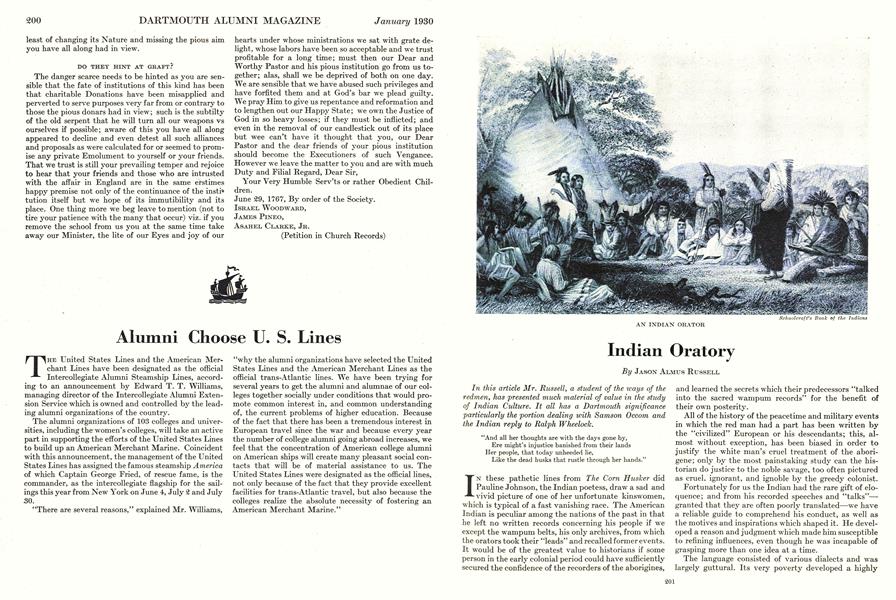
AN INDIAN ORATOR
DOG DANCE OF THE DAHCOTAS
INDIAN WOMAN AND PAPOOSE