Tradition Becomes Memory: A Tribute to Lon Gove
The captains and the kings depart. Men made weighty with crowns and epaulets, gaudy with plumes and braid and the ribbons of orders, and owning keys to the great cities of the world, leaving this gear behind them set out upon a path we cannot see behind the curtains of life. Lon Gove wore no decorations. He had no gilt ornaments or badges, or any emblems of power or wealth to cast aside. Up in the top floor room of his "farm" at the corner of College and Lebanon Streets in Hanover are only a few cheap and tarnished loving cups left, and a couple of old baseballs, to show that he had won a little fame and recognition. All else he carried with him and taking it took more than most who go beyond our call; a wealth of affectionate friendship that few of us can ever gather, a treasure in good deeds and noble thoughts that few of us will ever amass,—and the keys to the innermost depths of many a man's heart. Lon was no king or captain. Lon was just a prince of good fellows and the best friend in the world.
The span of Lon Gove's life we cannot measure by dates or figures. He was as old and as young as each of us who knew him, as old and as young at the same time as the joy or grief, experience or incident of the moment. He was a boy with them when his companions were boyish, and he was a man when they were men. No boy upon the playing fields of Dartmouth ever gave more in a game of his zest and heart than Lon Gove watching him, and in his own mind playing beside him, gave too. No man within the fastness or mansions of his self ever felt the pangs or the elations of his life more vibrantly or keenly than, when he knew and shared them, Lon did too. To those of us who knew him best and loved him there was no age or time for Lon. He was a part of us however old or young we were, and now in our hearts and memories he is immortal.
He has left some parts of himself with us: not merely the memories of the many little kind deeds that he did impulsively, almost instinctively it seems, but the desire to do such things ourselves as he did; not only recollections of his geniality and merriness, but an appreciation of the happiness those traits of his awakened and made live; not just the knowledge that he grinned the while he bore misfortunes, but, too, the hope that we may bear misfortunes likewise. Lon was a fountain of helpfulness. Things he had heard you say you liked or wanted he brought to you; little contrivances that simplified the items and the processes of daily life and work he got or made for you; and always he did things with a sincere cordiality and courtesy that made them memorable.
Cordiality and courtesy, honesty and good-sportsmanship were essential in Lon Gove. He was four-square as his jaw and his room and his house. If he liked you he told you so, sincerely and without circuitous approach. And if he did not like you he told you that too, without evasion or caution. Honesty was the grain of his character and there was no knot of deceitfulness in him. But cheer and gayety was in him too, in broad long streaks that all could see. In jest and jocularity he conforted or chided you. There was no rasping harshness in him even when he was stern. Yet always on his square broad shoulders he bore fardels that only those who knew him best could see behind his smiles.
If you knew Lon you cannot help but hope that somewhere, with a funny, round fiat hat on, or a pair of scarecrowish white gloves, he walks down some Main Street with solemn clownishness and mock severity. Or you can see him scampering over a whole outfield making miraculous shoestring or gloved hand catches of fly balls; or with abandoned ease catching some speed ball pitcher and at the same time teasing a batter into self-conscious impotence; or making at a first base stops and put outs you would not expect from one of twice his weight. Or in imagination you will watch him smite a golf ball straight and far down a green fairway. Again you will hear him thumping his deep chest under a shower bath and bellowing " 'Twas off the blue Canary Isles." And yet again you'll watch him sink back and relax in a big chair, and sip a long cool drink, and listen to him start a story that begins "Up where I come from." For Lon knew the joy of living. Lon gave in his living joy to others. And wherever in the world in all the years that are to come those of us who knew Lon Gove remember him and speak of him we will do so jovially and gayly, as he would have us, and tenderly and affectionately as we cannot help.
I want to write an epitaph for Lon. 1, who in his later years knew him better than most and perhaps even better than any other, want to write a line I know that he wants written. He mentioned it many times and those who are his friends will know how he chuckled over it, nodded his head, approving, and slapped his knee and said, "That's right,—that's right, by golly!" Not in flippancy or smartness but in the seriousness and meaning with which Kipling wrote " 'E liked it all", I want to write for Lon Gove, "He had a good time "
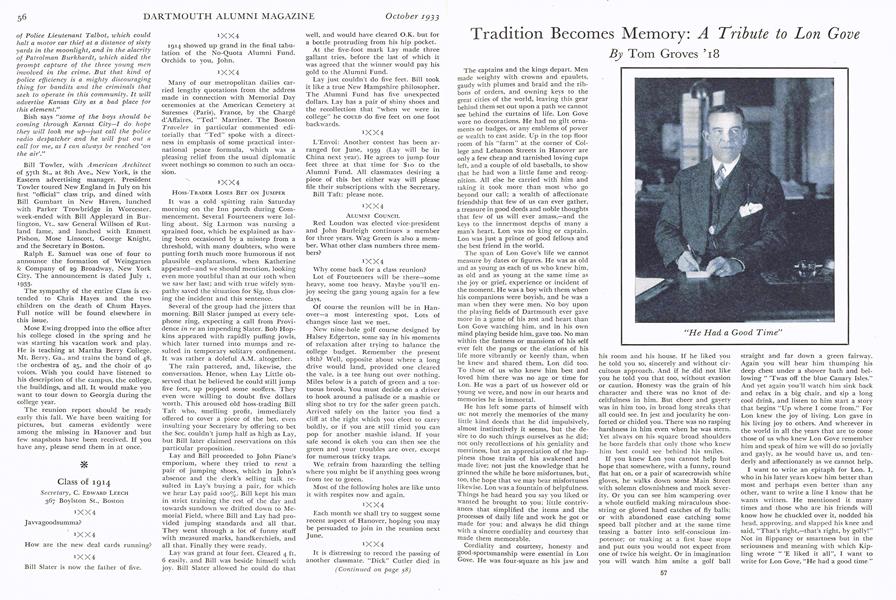
"He Had a Good Time"