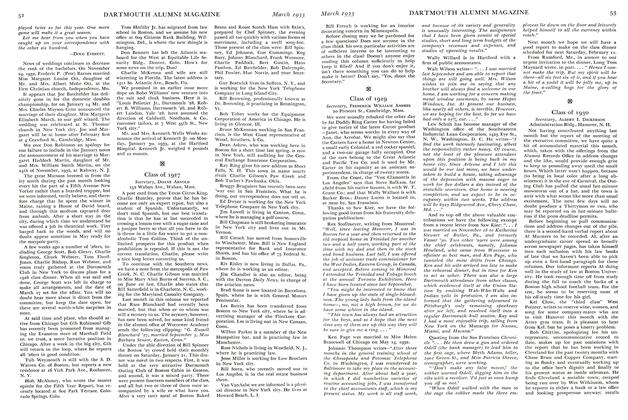
Class of 1932
As this is being set down there are more than a few New Yorkers whose thoughts travel regretfully to Hanover, which we hear is once more white and ready for Carnival. This sorrow at not being able to go back for the occasion probably isn't confined to the Eastern district. Eliot, Charlie Moritz, and Dick Manville out on the Coast, as well as scores of other men in the class (which this scribe brashly picks out as one of the more joyful Carnival- loving groups) are no doubt having a brief cry at not being able to join the parade at the golf course.
Farthest from the scene is Hosmer, who should be about two days out from Calcutta by our dead reckoning, this being the 10th of February. Hatcher got a letter mailed from Bombay. Experts are still at work deciphering the all but illegible writing, but the following bit is ready for quotation:
"Bombay itself, with its shaded streets,brilliant colors, and moonlight, is morethan enough, but when you mix in a luncheon at a club and a dinner at the oldest,and I am sure the most beautiful, European resident home in Bombay, it is almosttoo much. The people are just splendid tothe other deck boy and myself. Jollingsshowed me around and then put me intouch with this guy K (illegible)—Dartmouth '2B and a swell guy—who tookus out to a very luminous pool for a swimand then dinner with two attaches of thelegation. In the midst of it (I am writingthis at the best hotel in India just beforegoing out for a beer in a garden on the waterfront preceding a walk through theshaded streets by moonlight) it is hard to beexpressive, but let me say it is all so fine itscarcely seems credible, there is so muchcolor, such beauty, and between Jollingsand the crew such excitement and rarity.One night dinner in the house listening tothe singing from a Hindu , and thenext winding through the tough street ofthe town after being separated from thecrew and pulling a drunken Norwegianout of a terrible jam and perhaps a riot. . . And here the manuscript breaks off, or at least becomes painfully scrawly, proving pretty well to our minds that India really has got the Boy Wanderer.
I received a letter from Handy Auten, mentioning Wednesday lunches with a Dartmouth crowd around Oak Park. Frank Jaburek is on the same campus as the writer of the letter—McKinlock of North- western—studying law. Handy continues:
"I got the print of our class movies backlast week, and they are on their way toHanover, which is the best place to keepthem, I believe. I have them so arrangedas to make it possible to run a show with-out interruptions if the operator gets twoprojectors and keeps his eyes open. Anygroup in the class is invited to send toMr. S. C. Hayward for them at any time.But I, as technician, and John Wright, asbill-payer, both feel that it would be aswell idea to treat them kindly, all 1807feet of them. The show will last a littleover an hour, run continuously, and heavenalone knows how long with waits betweenthe reels. I'll leave the publicity to someof the fellows who work wonders withwords. I've seen the show about a dozentimes now without getting tired of it, so Iknow that it is not uninteresting. With thatto go on, the class authors should be ableto write reams of alluring advertising."
I am not so sure myself that the movies need any such honeyed words of notice, being sold on the idea of having them here for our next New York class dinner.
Had lunch with Reuel Denney, who is with Spencer, Trask on the Street, and got from him information about Cole, Mil- groom, and a swell beer place on 7th St. Bill is working at Fort Totten, Long Island, and Larry is in Cambridge.
Bill Peck dropped into the apartment last Sunday afternoon. He is at present engaged in research work with the Peck Television Co. As yet, he says, there is nothing being produced, just research. Maybe we'll have something in another year, though. The Peck laboratory is at 115 W. 45th St., in case others might be interested in an investigation of what this newest wonder might offer some day. The following was postmarked Saxtons River, Vt.:
"At a tea, given at their home on December 28, Mr. and Mrs. Maurice F. Brown, ofWinchester, Mass., announced the engagement of their daughter, Miss DorothyBrown, to Mr. J. Gordon Hindes, of Winchester. Miss Brown graduated from Wellesley College in the class of 1930. Mr.Hindes, a member of the Alpha TauOmega fraternity while at Dartmouth, ismaster of English at Vermont Academy."
In behalf of the class, congratulations! Newest among Wall St. neophytes is Randy Kinkead, affiliated with First National of Boston. He was another of the class to see some of the world before settling down, having just come back via Boston from a trip around the world, working aboard the Steel Navigator. At first there was business of going back and forth along the Atlantic coast for a few weeks before they started off for Panama .. . one night in Colon, details lacking, but to all reports, one not soon to be forgotten. Fortnight to Honolulu, where they spent four days sight- seeing. After considering all the other places he visited, Randy will tell you of a dream castle in Hawaii for that day when he tires of the Street. In an island of the Philippine group there is a native village of cooperative copra growers. They pool their product, and it is marketed by a Spanish agent, who pays each man his share and keeps a handsome rake-off. At Bulan, Randy said he felt like Columbus. It was very primitive, and visited by a ship only about once every nine months. At Java he found himself jumping ship with a lad from Michigan . . . finally got back to his outfit by traveling across the island from Sourabaya to Batavia. The Dutch families were very superior, although Randy did not find mangoes wholly enjoyable fare. From this land the ship went to Sumatra, Singapore, where it rested for 11 days taking on rubber, latex, palm oil, and copra, . . . Penang and something about a snake temple . . . Aden to refuel, Port Said, and Boston.
The dope in last month's issue about a certain company's going to Africa on a wißdjammer had no foundation apparently. Cleaves and Newcomb, according to newer rumors, have gone to Mozambique or Madagascar—the informant was not sure which, and Walser was last heard of trying to get a job with the Isthmian Line. Anybody sending correct information in about these gentlemen will get a phonograph record of Bully Morton singing in the Field House shower. Bully, by the way, is reported by Vic Rockhill '31 to be doing well in the bond business in Chicago.
Al Young, besides carrying on his work in the law office, has taken on the job of salesman for a florist. At first he didn't know a peony from a pansy, and while making a call on a prospective client would often have to call the home office for a description of the particular brand of posy the person seemed interested in. But now you may talk with Mr. Young about your garden problems and have him impress you with his astonishing horticultural knowledge. Without intending to give Al any free advertising, I would certainly say that any boys in the Bloomfield district who find it hard in these times to furnish certain people with fresh blooms might do well to call on Al and have him quote some surprisingly low rates.
George Bladworth has kindly handed over a letter from Bob Buckley at Harvard Law School. John Wright is more a hermit that ever. His roommate says, "He's beenin the room studying so long, that he's forgotten where the front door is and can'tget out." Kuke Brister, it transpires, "played football for the Concord (N. H.)Giant. Bill as an end led a charmed lifeand came to be the pride of joy of thefans. . . . Phil Burleigh is selling printingfor a Boston concern, and from all I cansee is making a good play for the smarteryoung ladies. . . . Cal Geary is still loafing,and is beginning to enjoy the life so wellit will take a good-sized salary to move him.He is being ably assisted by John Fish. . . .
John and Peg Swenson look just as fit asever. They have a smart apartment in Concord and seem to be thriving wonderfullyon married life. John is working prettyhard in his father's granite business. Hetook me up to look over his place of business, and I never realized before it was soextensive. At present John's tools consistof a sledge hammer, goggles, and an oldhat, but from the looks of him he'll beswinging a sledge in each hand beforespring. . . . Saw Joe Pipe and John Westonquite some time ago. Joe is selling insurance, but I didn't have a chance to findout John's business. . . . Joe Byram waslooking for work when I was (i.e. last fall),and was thinking of going into insurancetoo."
Thank you, Bob, for the news. It must not be thought that all letters coming to New York find their way into the clutches of the Secretary. Nevertheless that often happens, fellow classmates, so if you have any fear of your letters' being purloined and promiscuously quoted from you'd better be on the safe side and send some mail direct to 19 Barrow St. to be fed to this column, which weakens monthly for lack of material.
John Clark relinquished an entertaining missive from John Keller. The latter is in a training school for salesmen in Cities Service Oil, located in Okmulgee, Okla. He is living there at 521 N. Grand St. Says this sage:
"I am seven months or so away from theheavy, concentrated life of DartmouthCollege. I have found very few, if any, likethe group I kneiu there. In order to glossthe details of what I have seen or heard ordone since then I have compared themwith the details I knew there. And in orderto express them and at the same time tobreak the fall from the four-year permanence of Dartmouth to the scattered in-definiteness of America, I have slammedthese details importantly into a generalization." This generalization, "understandable only to the group I knew at Dartmouth," is not included in the letter. I would suggest that Keller make this up by sending one on which would not be caviar to the general. Although alumni news is supposed to be more or less specific, there is nothing like salting it with the general.
LATEST
This is to be a last minute flash, whichmay or may not eke under the dead-line.It has to do with Carnival.
I don't know whether it was the fewnessof jobs or the abwidance of joie de vivre that has always marked our class, butabout fourteen guys were back, not counting the graduate students. I didn't seethem all myself, and probably there wereothers of whom I didn't even hear a report. But their names, as I got them in oddmoments were: Nate Pearson, Dave Kirby,Bill Mackinney, Art Allen, Bob Reinhardt,Joe Fanelli, John Couzens, J. Amos Wright,Fred Matson, Bill Bucher, Jim North,Scully Smith, and Dick Hazen.It was nice,
—JOHN CLARK.
Secretary, 19 Barrow St., New York