Class of 1935
Bounded into Washington the other day, partly led by the vaporous chimera of New Deal opportunities and partly to see what Gordon Studebaker, sometime of Streeter and Tom Ward's genial household, was doing in charge of the "Educational Radio Script Exchange." There he was in a new building of the Department of the Interior, practically recovered from two years at Stanford University and a year at business school, and surrounded by lovely colored maps sprouting little flags where the educational scripts had taken root. This is a new thing. It seems that a lot of schools and amateur organizations get the opportunity for time on the air over some local station, but don't know quite how to throw together a competent program. Gordon, spurred on by our paternal government and his own paternal sanction (Studebaker Sr. is Commissioner of Education), started out with an empty office and a page and a half memorandum suggesting that he help these organizations out. He has. There are now half a dozen people or so in the office, piles of scripts collected from Gordon only knows where, sheafs of inquiries, and these pesky flags showing the results. It's part of the government program to help educational matters and particularly to foster the use of radio for this purpose. There is no attempt to put into it sinister propaganda, although I suppose the temptation must exist. People write in from Medicine Hat asking how to make strange noises. They send in scripts for criticism. They ask for scripts. They try to sell 'em. The office is preparing a manual which will tell you how to make noises if you are interested.
Previously Gordon and a couple of other chaps had a flier in the movie business by incorporating a small wildcat outfit near Monterey, Calif. The idea was to produce a big western with lots of shootin'. It seems they always sell—approximately a hundred bucks per revolver shot. If there's a fusillade, you can't lose. Anyway, they sold $7,000 worth of stock somehow, made their distributing connections, and would have commenced shootin' but the owners of the $7,000 got cautious and insisted on shorts first. I suppose they wanted to lose the money in driblets. Some people are the limit. Gordon came East after a while. The company struggles on.
Last evening there was a small gathering of the clan at my house in Brooklyn, and President William Eddy of Hobart College, Bill Eddy to many of us, managed to come over for a little while in the evening. He had delivered a powerful sermon that morning in the Columbia University chapel, which showed to me that he had not lost any of the trenchant expression which along more academic lines made him so successful in Hanover. Rode Hale and Sam Stern were among the first arrivals. Sam was bursting with the story of his trip around the world. Sam started south to visit Henriquez, and, as he says, the distances always look shorter when you're away from home. The next thing was a side trip to Ecuador, where he lived according to his story exclusively off pineapple for so long his mouth got sore. Water was scarce and dubious. Then on the chance of picking up one of the Maru boats from the Canal to Japan, Sam was swept neatly off a sandy spit by the tender of a big cruise ship, gently settled into a first class cabin for thirty-six hours and deposited onto the aforementioned Maru, where he was the only white man till they reached Los Angeles. But the Japs were only thinking dastardly deeds then and he got along swell. Ate with chopsticks when the spirit moved him. At L. A. an undertaker and a plastered musician climbed aboard. Sam and the undertaker supported the plastered m. through various dubious sections of the Far East, and Sam finally lent him enough money so that he could be shipped home aboard a transport. Plastered m. was quite annoyed at idea of transport; not at all grateful. Sam wandered westward, stopping at Singapore and being disappointed, coasting around India by way of Ceylon, and thence through the Red Sea waters to li'l ol' Europe and the U. S. A., where he is now vainly trying to make some money with a new-fangled enamel-lac preparation which prevents paint from oxidizing and in some mysterious way is supposed to keep the polish on your car, the brass shiny, the house painted, and the wolf from the door. But he's got the itch to keep a-moverin'; says there are no paper matches in Manila and there ought to be some introduced.
Charlie Brown, however, has got us all beaten. He staggered into Rangoon a while ago with about twenty cents, a bad case of malaria, and his pal on his back. I'll tell you about him later.
Rode Hale, who silenced Sam and me with vicarious tales of the Brown expedition, is himself doing something interesting, though few people get malaria from it. He works for the Intertype Company, who make these terrifically complicated machines which take ideas and spew them out in neat slugs of type-metal. An old fellow named Mergenthaler invented the first machine and still makes them not far from here. But Rode's outfit makes an improved model, which is beginning to give Mergie a run for his Teutonic money. Some change recently was made in design. Mergenthaler had to alter some thousand parts. Intertype changed six. Rode himself doesn't alter parts. He buys things .... and likes it.
Also present were a few old-timers in this column, and of it. Tom Lane, on special request, brought the missus. We wanted to get a look at her and it was worth it. And Tom himself, in spite of the stupid misdirection of a blackjack which was aimed at his head but hit him across the bridge of the nose, has completely recovered and looks simply marvelous. It may be there is something in this married life after all. He has landed a prize job at y & R's and has been doing exceptionally well there.
yVfac McCarty, still on the New Yorker, was here; Put Kingsbury, who is in accounting; Dick Eberhart, running his own insurance business in up-town NYC; Paullynch, who grinds along with Jerry Spingam at Columbia Law. I met Jerry up there the othev day and he says he likes the stuff. Paul 15 not so sure. Genial Jim(Berkey) the real estate magnate from Long Island, Alan Brush, Fitz-Donnell, and George Colton also consumed sandwiches and beer amid the general throng, gut I think you know what they are doing. Bill Chapman complains that every time I mention Price-Waterhouse, his firm, I spell it differently. Well, it is kind of a funny name, now I look at it.
Halvorsen is back. Sellmer is still away. Heigh-ho, heigh-ho It's off to work we go. I'm working with Raymond Rich Associates in the Twentieth Century Fund offices at 330 West 43d St., in case you wondered.
ALUMNI FUND RECORD FOR 1937
234 contributors (46% of graduates),total gifts of $902.36 (55% of objective).
RAND N. STOWELL, Class Agent
Assistants: Henry R. Bankart Jr., James H. Berkey, Otto J. Calderari, Lorenzo T. Carlisle Jr., Bobb Chaney, George H. Colton, Gardner C. Cushman, Alvin G. Dodd, William B. Eisendrath Jr., Maxwell R. Feinberg, William W. Fitzhugh Jr., Donald W. Fraser, Robert K. Hage, Donald C. Hagerman, Ernest E. Hedler, George F. Hill, Herman Hormel Jr., Ferguson W. Hubbell, Claude T. Huck, Richard P. Hurd, John C. Kingery, Kenneth M. Kurson, Milburn McCarty 4th, William E. McMullen, Richard K. Montgomery, Richard D. Muzzy, Landon G. Rockwell, Elmer D. Rogers Jr., Robert E. Roundey, Robert A. Sellmer, David P. Smith, Richard F. Upton, Rutherford H. Van Doorn, A. Lincoln Washburn, Robert J. Williams, Hugh M. Wolff.
CONTRIBUTORS
1935 Adams, Frank O. Alexander, Donald W. Allen, Frank L., Jr. Arthurs, Earl K. Atherton, Alexander S. AuWerter, John T., Jr. Axelrod, Frederic Bankart, H. R., Jr. ■Bash, Ivan Beiley, Murray R. Belsky, Abraham H. Benson, Stanley D. Benton, Charles, Jr. Berkey, James H. gjock, A. Stanley Blum, Morton Boehm, Robert L. Bookheim, Louis W., Jr. gowman, Robert G. Bradt, William W. grown, Charles H. Brown, Sanborn C. gunner, Ed. deS., Jr. Brush, Allen S. gurnkrant, Eugene G. Butts, William S. Calderari, Otto J. Cameron, Donald W. Carrick, Barker C. Chamberlain, George R. Chaney, Bobb Chapman, William J. Clark, Alan B. Clark, William B. Cole, Lewis D. Collins, Robert H. Colton, Chauncey H. Colton, George H. Cook, George A. Cornwell, Franklin J. Cotton, Daniel C. Couper, Dean H. Crane, Carlyle W. Crane, Cloise A. Croninger, F. Howard, Jr. Cummings, Paul C. Curtis, Ellwood F. Cushman, Gardner C. Day, Peter M. Deckert, Harry C. Depinet, Fred E., Jr. Dewey, Horner B. Diamond, Sidney A. Dickinson, James A. I Dorsey, Stephen P. I Drechsel, Edwin J. Eberhart, Richard W. I Eisendrath, Wm. 8., Jr. I Elliott, Frank R. 1 Elsenhans, George E. I Erwin, Russell L. Espaillat, Pedro A. I Evans, Charles H. I Feinberg, Maxwell R. I Feingold, Meyer W., Jr. ] Field, Russell W. 1 Fitzhugh, William W., Jr. 1 Foley, Thomas F., Jr. I Fraser, Donald W. < Funke, Carl H. ( Gahagan, G. William < Ganzel, Charles W. Garth, Winston F., 2nd J Gerson, Edward ] Gillan, Charles A. Glavis, Frank J. 1 Gless, Walter ' Goodman, Bennett E. ] Goodman, E. Edwin Gregory, John B. Griffin, Hobart W. Haas, F. Lowell Hage, Robert K. Hagerman, Donald C. Haley, Frederick T. Harbaugh, Theodore H. Harriman, Benjamin R. Harvey, Edwin J. Harwick, J. William Hattenbach, Monroe L. Hawkins, Henry C., Jr. Heckel, C. Willard Hedler, Ernest E. Heller, Morris L. Hemphill, Philip S. Hermes, Frank, Jr. Hetfield, Bertram C. Hill, George F. Hinman, Edward B. Hinman, Howard D. Hirschland, Richard S. Hodges, Wallace R. Holloway, John A. Holmes, Walter B. Hormel, Herman Howe, John M. Hubbell, F. Wiley Huck, Claude T. Irish, John H. Irving, James K. Jacobs, Bertram C. ■ Jankoff, Bernard R. Jewett, John F. Judd, David B. Kaiser, Howard A. Karch, Gregoire Karlen, Sven B. Keane. Edmund G. King, Donald B. Kingery, John C. Kingsbury, R. .Putnam Klein, Harold Kline, Alan F. Knode, Oliver M., Jr. Knott, Harry J. Knowles, Herbert E. Kuhn, William E., Jr. Kuhns, Robert W., Jr. Kurson, Kenneth M. Lamson, William D. Lane, Thomas H. Lansberry, George W. Lazarus, Ralph Leich, Roland J. Levinson, Richard L. Libbey, Harrison W. Lionett, William F. Loder, Halsey 8., Jr. Luneborg, Victor H. Luria, Phelps P. McCarty, Milburn, Jr. McClarin, William W., Jr. McLellan, E. Robert McMullen, W. Emerson Mallard, Douglas H. Mann, William H., Jr. Marchmont-Robinson, H. Margulis, George Millane, Robert L. Mills, Dumont C., Jr. Moody, W. Gordon Moon, Charles R., Jr. Moran, William H. Muzzy, Richard D. Naramore, Robert W. Nayor, Charles F. Neill, Robert E. Nevin, William M. Niles, Louville F. Offutt, Edward P., Jr. Ogg, Wilfred R. Ostrow, Herbert H. Pacht, Rudolph Parachini, Joseph A. Petke, Walter G. Petrequin, James A. Price, George Quimby, Robert L. Ramsey, Edwin L., Jr. Rapf, Maurice H. Rauch, Marvin Rauschal, William, Jr. Raymond, F. W., Jr. Reagan, Daniel J., Jr. Reich, Edwin S. Richardson, Donald E. Richmond, Guilford H. Richter, Robert Riegelman, William I. Rogers, C. Boyd Rogers, Elmer D., Jr. Rogers, Paul K., Jr. Roitman, Harold B. Rosen, Melvin H. Rothschild, M. N., Jr. Roundey, Robert E. Rowe, Howard B. Ruether, Leßoy F. Russell, Dudley J. Russell, William L., Jr. Ryder, S. Remsen Saunders, Donald K. Sellmer, Robert A. Shattuck, Leroy A., Jr. Sherwood, Eli A. Shuttleworth, Herbert L. Shuttleworth, John H. Silverman, Harold J. Smith, David P. Specht, Frank J. Spingarn, Jerome H. Stearns, Charles H., Jr. Steinle, Duane E. Stem, Walter A. Stern, Samuel R. Stone, Robert A. Stowell, Rand N. Swander, Dan C., Jr. Swift, Thomas G. Tomlinson, F. Byron Tosi, Charles A., Jr. Upton, Richard F. Van Doom, R. H. Van Kirk, Frank W., Jr. Varney, Charles W., Jr. Wachtel, Perry Waggaman, Donald E. Wallace, John Washburn, A. Lincoln Washton, Arnold A. Weil, Adolph, Jr. Weitz, Louis E. Wertheim, Arthur R. Wertz, Gerald W. Whitehill, Lynwood N. Whytlaw, Edward L. Williams, David D. Williams, Robert J. Wilson, Russell S. Wilson, Thomas E. Wolff, Hugh W. Wright, Frank J. . Young, Robert G. Zimmerman, Albert J.
Secretary, 68 Cambridge Place, Brooklyn, N. Y.
More From This Issue
-
 Feature
The Story of the Alumni Fund
March 1938 -
 Feature
Report of 23rd Alumni Fund Campaign
March 1938 -
 Feature
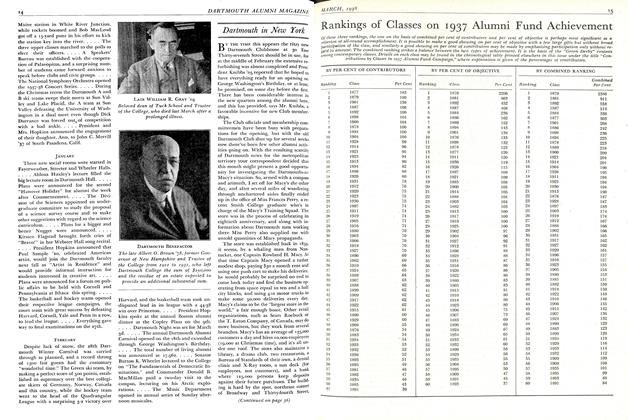
Rankings of Classes on 1937 Alumni Fund Achievement
March 1938 -
 Feature
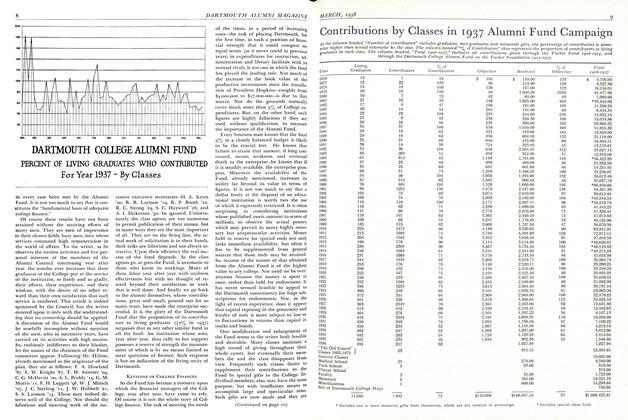
Contributions by Classes in 1937 Alumni Fund Campaign
March 1938 -
 Feature
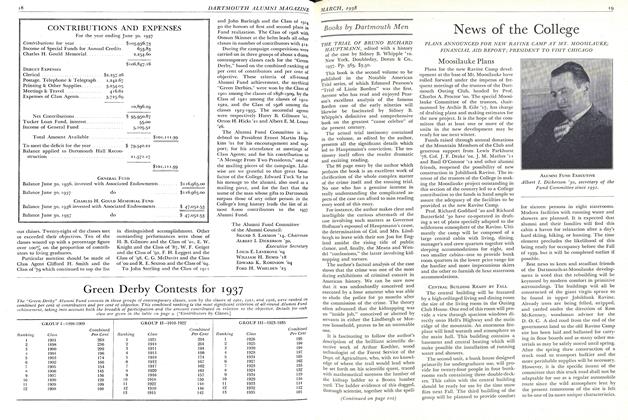
Green Derby Contests for 1937
March 1938 -
Feature
Annual Records of the Fund from 1916 to 1937
March 1938