DOING SOMETHING ABOUT IT
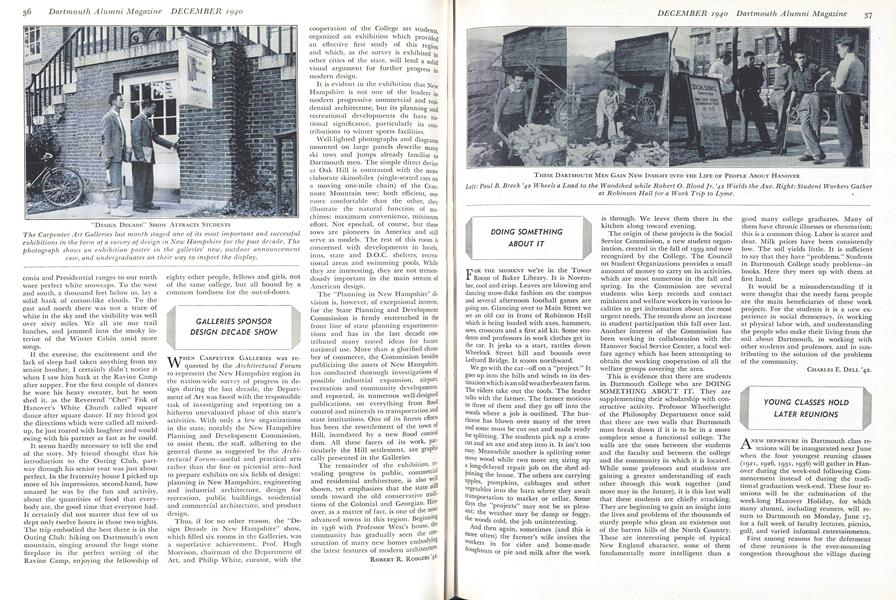
FOR THE MOMENT we're in the Tower Room of Baker Library. It is November, cool and crisp. Leaves are blowing and dancing snow-flake fashion on the campus and several afternoon football games are going on. Glancing over to Main Street we see an old car in front of Robinson Hall which is being loaded with axes, hammers, saws, crosscuts and a first aid kit. Some students and professors in work clothes get in the car. It jerks to a start, rattles down Wheelock Street hill and bounds over Ledyard Bridge. It scoots northward.
We go with the car—off on a "project." It goes up into the hills and winds to its destination which is an old weatherbea ten farm. The riders take out the tools. The leader talks with the farmer. The farmer motions to three of them and they go off into the woods where a job is outlined. The hurricane has blown over many of the trees and some must be cut out and made ready for splitting. The students pick up a crosscut and an axe and step into it. It isn't too easy. Meanwhile another is splitting some stove wood while two more are sizing up a long-delayed repair job on the shed adjoining the house. The others are carrying apples, pumpkins, cabbages and other vegetables into the barn where they await transportation to market or cellar. Some ays the "projects" may not be so pleasant, the weather may be damp or foggy, the woods cold, the job uninteresting.
nd then again, sometimes (and this is more often) the farmer's wife invites the workers in for cider and home-made doughnuts or pie and milk after the work is through. We leave them there in the kitchen along toward evening.
The origin of these projects is the Social Service Commission, a new student organization, created in the fall of 1939 and now recognized by the College. The Council on Student Organizations provides a small amount of money to carry on its activities, which are most numerous in the fall and spring. In the Commission are several students who keep records and contact ministers and welfare workers in various localities to get information about the most urgent needs. The records show an increase in student participation this fall over last. Another interest of the Commission has been working in collaboration with the Hanover Social Service Center, a local welfare agency which has been attempting to obtain the working cooperation of all the welfare groups covering the area.
This is evidence that there are students in Dartmouth College who are DOING SOMETHING ABOUT IT. They are supplementing their scholarship with constructive activity. Professor Wheelwright of the Philosophy Department once said that there are two walls that Dartmouth must break down if it is to be in a more complete sense a functional college. The walls are the ones between the students and the faculty and between the college and the community in which it is located. While some professors and students are gaining a greater understanding of each other through this work together (and more may in the future), it is this last wall that these students are chiefly attacking. They are beginning to gain an insight into the lives and problems of the thousands of sturdy people who glean an existence out of the barren hills of the North Country. These are interesting people of typical New England character, some of them fundamentally more intelligent than a good many college graduates. Many of them have chronic illnesses or rheumatism; this is a common thing. Labor is scarce and dear. Milk prices have been consistently low. The soil yields little. It is sufficient to say that they have "problems." Students in Dartmouth College study problems—in books. Here they meet up with them at first hand.
It would be a misunderstanding if it were thought that the needy farm people are the main beneficiaries of these work projects. For the students it is a new experience in social democracy, in working at physical labor with, and understanding the people who make their living from the soil about Dartmouth, in working with other students and professors, and in contributing to the solution of the problems of the community.
THESE DARTMOUTH MEN GAIN NEW INSIGHT INTO THE LIFE OF PEOPLE ABOUT HANOVER Left: Paul B. Breck '42 Wheels a Load to the Woodshed while Robert O. Blood Jr. '42 Wields the Axe. Right: Student Workers Gatherat Robinson Hall for a Work Trip to Lyme.