1895*
A message from "Bug" Folsom announces that Mrs. Folsom has sufficiently recovered from her unfortunate accident to permit the annual trip South, where they spent February and part of March in Orlando, Florida. "Bug" reports that the weather had not been very warm up to the last week in February. The temperature varying from 44° in the early day to 68° in the middle of the day.
A clipping from the Palm Beach Times of January ist contains the following reference to Frank Austin and his recent creation "The Conidorm."
"Both England and the United States have been offered a revolutionary type of air raid shelter he has designed for abovethe-surface construction, Professor Frank E. Austin, former Dartmouth College instructor, asserted here yesterday.
The Austin "conidorm," fashioned of reinforced concrete and with steep acornshaped roof and conical base, would "shed bombs or meteorites like rain and streamlines tornadoes and explosions" the Hanover, N. H„ man believes. So confident is he of the conidorm's strength that his proposal incorporates the suggestion they be painted a lurid red in a deliberate attempt to attract enemy fire. "It would be impossible to score a direct hit," he said. "Scientists estimate one-tenth second is required to detonate a shell after it has struck a target. Bouncing from the conidorm's acorn-shaped roof, the shell would explode harmlessly.
"By giving proper shape to a concrete house, it can be made a safe retreat that possesses the priceless property of deflecting bombs and bullets coming from any direction, one that is immune from all tank and infantry attacks," he explained. "By placing its entrance up under the eaves, it becomes a gas proof domicile." Gasoline storage, compressed air tanks, and a fresh water well would be sunk beneath the conidorms, according to Professor Austin. He estimates they would remain serviceable for 500 years and would supply possibilities even greater in peacetime than in war. "One is that the conidorm doubtless will prolong life by providing quiet sleeping quarters,' he said. "The interior of a conidorm is muffled from all disturbing outside noises and, when air-conditioned, offers its tenants a refreshing vacation every night."
Prof. Holden apparently is the Veteran legislator of our class. The Hanover Gazette of January 13 displays a group picture of the three representatives from Hanover, of whom Holden is one, in Governor Blood's office at the state house in Concord.
Fred Cleaveland and Mrs. Cleaveland report a fine trip to St. Petersburg, Fla., over good roads and in perfect weather. At the Annual Dartmouth Dinner in St. Petersburg on the night of February 28, Fred was elected president of the St. Petersburg Alumni Association. Preceding the banquet, Mrs. Edwin B. Frost entertained a group of the Dartmouth Alumni at her home in St. Petersburg.
Fund Contributors for 1940 Contributors: 23 (53% of graduates). Total gifts: $552 (74% of objective). EDWARD J. ROSSITER, Class Agent.
1895
Campbell, Arthur F. Cleaveland, Fred C. Davis, Carroll A. Folsom, Percy N. Ford, Joseph A. Foster, William A. Gault, John Gile, Ernest S. Hack, Thomas H. Harley, Joel A. Hayes, John E. R. Holden, Charles A. Lewis, Walter R. Lord, John K. Mclndoe, George J. Mason, Francis E. Newhart, Horace Pollard, Charles W. Rice, William F. Rossiter, Edward J. Shepard, Frederick D. Thompson, J. Walcott West, Arthur D. Wilson, Albion B.
Secretary, White River Junction, Vt.
More From This Issue
-
 Feature
Report of Twenty-Sixth Alumni Fund
April 1941 -
 Feature
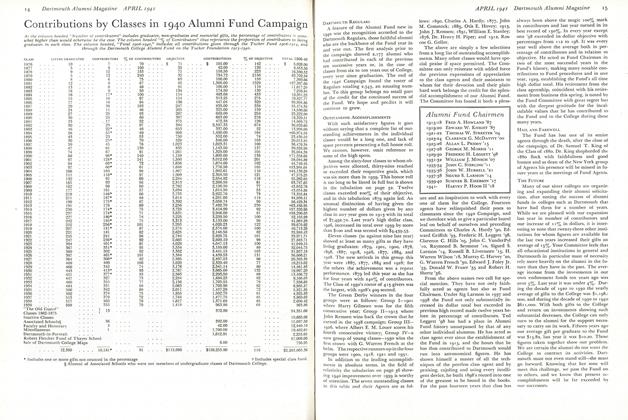
Contributions by Classes in 1940 Alumni Fund Campaign
April 1941 -
 Feature
Thayer School Report
April 1941 -
 Feature
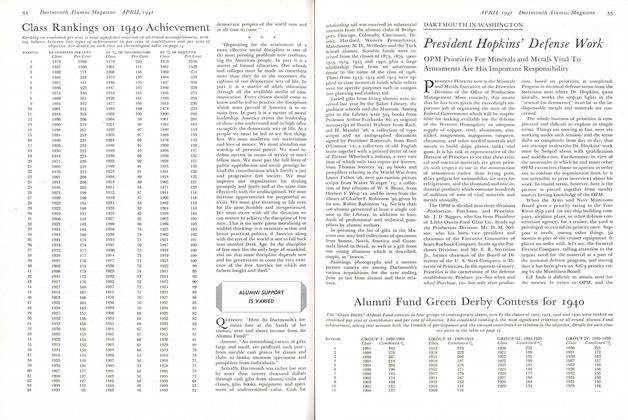
Class Rankings on 1940 Achievement
April 1941 -
 Feature
Dartmouth Regulars
April 1941 -
 Feature
Alumni Fund Records 1915 to 1940
April 1941