Time Marches Back
On September 23, 1915, "the largest student body in the history of Dartmouth" entered Webster to attend Convocation at the beginning of this, the 147 th year of the College; it was, for various reasons, an important year in Dartmouth history, but momentous indeed for the senior class, 191-6.
The newly inaugurated system of marking (literal grades in courses but a numerical average) was regarded in some quarters as evidence of a fiendish plot contrived by the (three words censored) faculty in order to further its obvious design of hounding worthy undergraduates to their academic death. This system, by the way, was substantially that still in use. However, we elected class officers for the year (C. A. Pudrith, P. O. Soutar, R. Parkhurst, J. P. English), chose seniors for the dormitory committees (Reed, H. M. Buffinton; Hallgarten, E. M. Noyes; New Hamp., P. F. Goward; Mass., C. J. Eskeline; North Fayer., H. B. Lowe; Fayer., B. Studley; South Fayer., C. T. Green; Richardson, F. R. Andrews; Crosby, R. F. Evans; Hitchcock, E. H. Parker; Wheeler, H. T. Flanders; Hubbard, R. E. Wyman), and prepared for the football season.
The team had itself a good year and seemed to enjoy defeating Mass. Aggies, Maine, Tufts, Vermont, Amherst, Penn., and Bates, although we lost to Princeton and tied with Syracuse. Seniors on the squad were J. B. McAuliffe, J. N. Colby, P. O. Soutar, H. Fishback, R. G. Tyler. In the fall tennis tournament there were iag entries but only one winner—E. T. Doyle. The cross-country team was generally considered to have done a good job in winning from Penn., finishing second in the New England meet and fourth in the Intercollegiates. This squad included K. D. Tucker, C. F. Durgin, L. Y. Granger, H. Lord, and L. F. Pfinstag.
The dramatic season opened that fall with a "musical" called What Next? in satirical allusion to the rumor that Dartmouth was going coeducational. In Bill Costello's libretto, of course, the college had admitted a tentative quota of gals—a situation which provided suitable vehicles for the talent of W. A. Mackie, R. A. Burlen, A. Dean, J. W. Rogers, J. M. Cheney, and J. M. Killeen. The result was witty, tuneful and should unquestionably be revived at once. In fact, all the plays of our day were pretty average good, anyway. Later in the semester such ambitious undertakings as Shaw's Arms and the Man and Galsworthy's The Pigeon called for work from producers and players and for support from the audience—and got both.
There were other events. The Y.M.C.A. of New Hampshire held its state-wide conference for boys in Hanover, and the task of arranging for the entertainment of the delegates was wisely entrusted to W. W. Banton. President Nichols announced his resignation to the trustees, who accepted it with regret. His kindly attitude toward the undergraduates of the college was illustrated by the tone of his announcement to us all in chapel of his resignation; this announcement was made simultaneously with his letter to the trustees, a fact which somehow gave us the definite feeling that we were expected to be as much concerned with the affairs of Dartmouth College as any other body.
And what did we think of the war in the fall of 'l5? Well, the development of our opinions may clearly and easily be traced in the Dartmouth and is, in the view of this writer, worth tracing. In September we were quietly discussing such matters as preparedness and competitive armaments, but in November someone used the word pacifist in print for the first time, (hen militarist, then other words, and still others. The next scene shows us listening to Norman Angell and to General Wood. Arrange- ments were made to show the movie TheBattle Cry of Peace but could not be car- ried out. The Ford Peace Ship attracted our attention and also two members of the student body as passengers. Military train- ing for all Dartmouth was proposed in a super-mass-meeting, but most communica- tions to the Dartmouth scoffed at the idea. Finally, drill was organized on a voluntary plan, which later became the Dartmouth Battalion. Thus operated even then the w.k. "logic of events," still so widely mis- understood. Yes, this leg of our course is easy to plot—suspiciously easy—, but the log doesn't show what impact upon us came with the news that Dartmouth in Turkey couldn't carry on because of the war, that the Earl of Dartmouth's son had been killed in action because of the war, that Dick Hall had met his death on Christmas Day because of the war. Yet these are subtler things and more important.
Fund Contributors for 1940 Contributors: 180 (78% of graduates). Total gifts: $3,239.50 (100% of objective). WILLIAM L. CLEAVES, Class Agent.
1916
Abraham, Hyman W. Ames, John L., Jr. Andrews, Fletcher R. Bailey, Frederick W. Bates, Henry A. Bean, H. Clifford Bernkopf, Max E. Biel, William Blaney, Porter H. Bobst, Frank T. Brahana, Henry R. Brown, Robert A. Brown, William H. Brundage, Charles E. Brundage, Norman L. Burghardt, Roy C. Burnham, Percy C. Burt, Parker H. Butler, John 8., Jr. Caiman, Alvin R. Campbell, Charles L. Carey, Edmund F. Carleton, Earle J. Chapman, Raymond A. Cheney, Joseph M. Clarke, Charles M. Cleaves, William L. Coakley, Daniel W. Coburn, Richard A. Coffin, C. Carlton Colby, John N.1 Cote, Hugh L. Colton, James H. Conley, Arthur J. Cranston, Earl, 2nd Craver, Edgar A. Curtin, John J. Cutler, Samuel E. Davidson, Lawrence L. Davis, Frederick W. Davis, Phillips N. Dean, Alexander2 DeVoe, Raymond F. Dingwall, Herbert A. Dinsmoor, Daniel S. Doenecke, Justus C. Drury, Chester Dudley, Charles H. Dunbar, J. Frank Durgin, Charles F. Eastman, Arthur G. Eastman, Ben Eigner, Israel Ellis, Richard H. English, John P. Eskeline, Carl J. Evans, Roger F. Fenno, Jesse K. Ferguson, Donald G. Filene, A. Lincoln Fishback, Horace, Jr. Fuller, Granville B. Gammons, Charles C. Garcia, Antonio F. Garrison, Wilbert B.1 George, Ralph H. Gibson, Harold F. Gile, John F. Gluek, Alvin C. Goodrich, John P. Gordon, Douglas R. Gove, Lewis P. Goward, Paul F. Green, Chandler T. Green, H„ Holmes Gumbart, Edward H., Jr. Hale, William A. Harris, Nathaniel P. Harvey, Robert P. Harvey, Shirley W. Hayden, E. Parker Henderson, Kenneth M. Herold, Clifford A. Hitchcock, C. Carleton Hoar, Burton H. Holmes, Carl N. Howell, Arthur L. Howell, George B. Jardine, Alexander J. Jenison, Austin Jones, E. Everett Kiley, Edward L. Kirkland, Edward C. Kittredge, Wallace G. Baker, Austin L., Jr. Banton, William W. Barr, Oliver J., Jr. Bartlett, Robert L. Knight, Edward D. Lapierre, Emery I. Larimer, Joseph M. Larmon, Park J. Lawton, Albert D. Leavitt, Leslie W. Leavitt, Russell H. Lewis, Philip H. Lincoln, Carl K. Lindman, Edwin L. Lindsley, Dan L. Linihan, Martin G. Lord, Herbert Lyman, Stanley M. McAuliffe, John B. McFalls, Edwin L. McKenzie, William H. McLellan, Hiram J. McQuesten, Eugene F. Magill, Roswell F. Marsden, Arthur G. Mendall, Ralph B. Morey, Gardner L. Morse, Roger E. Mott, C. Van Wyck® Mott, William F. Moxon, Benjamin H. Newmark, Joseph D. Olson, Daniel B. Palmer, Clarence A. Parker, Everett H. Parker, Howard B. Parkhurst, Richard Parsons, Charles H., Jr. Paul, W. Stewart Pelletier, John A. Perkins, Lyman G. Perkins, Russell B. Pettengill, Frank G. Porter, Victor W. Pratt, George H., Jr. Pudrith, Chester A.1 Renfrew, W. Howard Richardson, Paul W. Richie, Fred M. Riley, Edward C. Ross, Kenneth W. Shanahan, James A. Shaw, Eliot A. Shedd, Karl E. Shumway, Warren D. Sloane, William E. Smith, George H. Smith, Olin R. Soule, Roderique F. Spelke, Max Stackpole, Philip W. Stamatiades, Philip E. Stearns, John B. Steinert, Robert S. Stieglitz, Henry F. Stillman, DeWitt S. Stowell, Kenneth K. Streeter, Milford 8., Jr. Sully, Wilberforce, Jr. Tapley, Gilbert H. Thieme, Robert B. Tucker, Kenneth D. Tyler, Ralph G. Upham, Warren F. Walker, Theron B„ Ward, Frank R. Warren, Paul A. Welch, John F. Wessel, Donald Whipple, Percival D. White, Chandler T. Williams, Earle R. Wilson, F. Stirling Winters, Edgar S. Wolff, Irving G. Wooldridge, J. Watt Woolworth, Chester M. IMemorial gift from aclassmate.2Memorial giftfrom Mrs.Dean.z Memorial giftfrom Mrs.Mott.
More From This Issue
-
 Feature
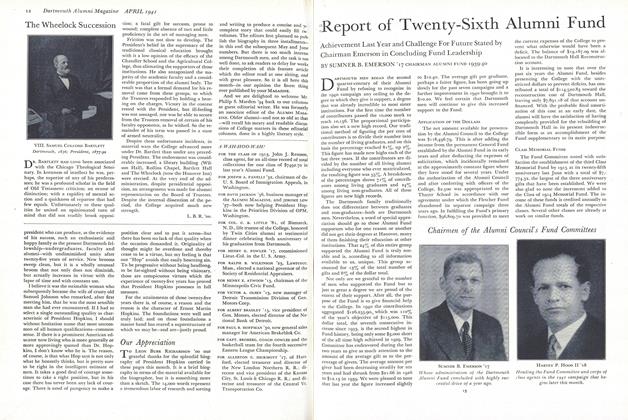
Report of Twenty-Sixth Alumni Fund
April 1941 -
 Feature
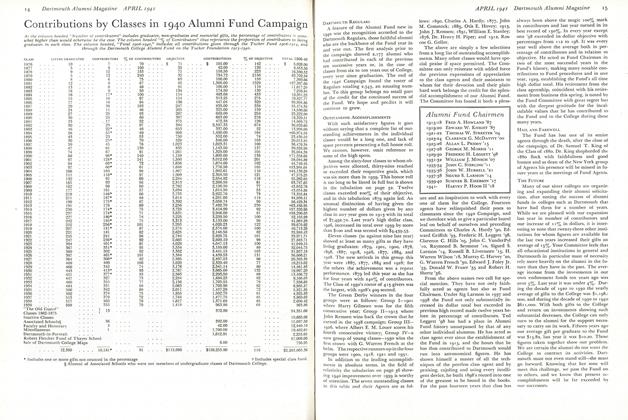
Contributions by Classes in 1940 Alumni Fund Campaign
April 1941 -
 Feature
Thayer School Report
April 1941 -
 Feature
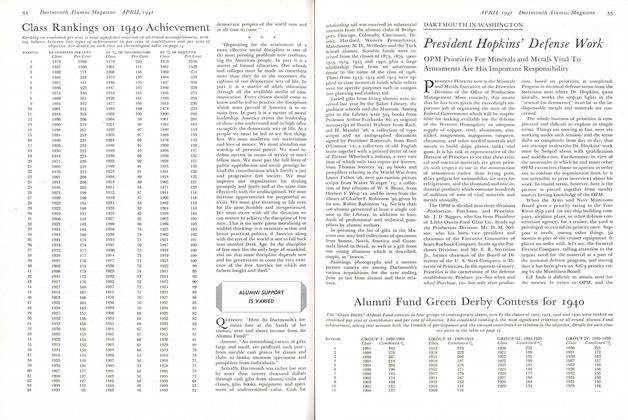
Class Rankings on 1940 Achievement
April 1941 -
 Feature
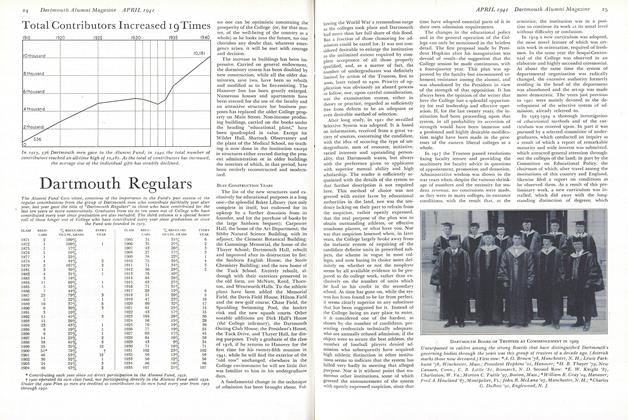
Dartmouth Regulars
April 1941 -
 Feature
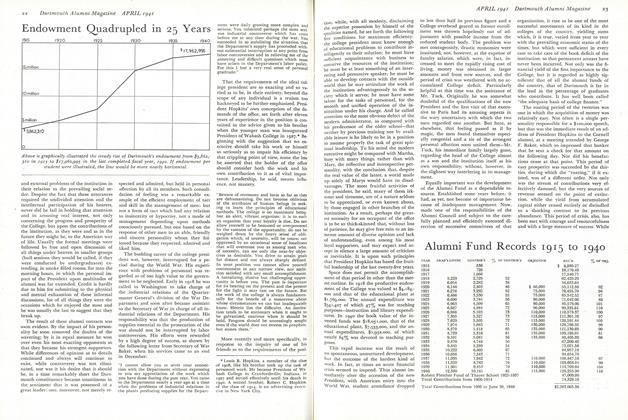
Alumni Fund Records 1915 to 1940
April 1941