1889
At the annual Boston dinner of Dartmouth alumni held March 1 at the Copley Plaza the oldest graduates present, seated at the same table, were Allen and Briggs of the class of '85, Bartlett '89, Bacon '90, Rowe '91, Marden '94 and Richards '96.
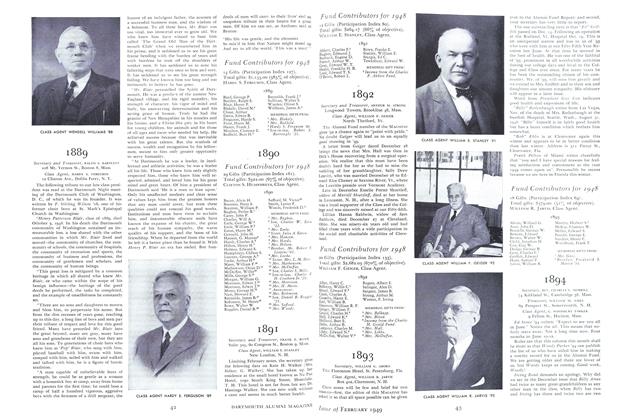
Serving as President of the Rocky Mountain Dartmouth Alumni Association of Great Falls, Mont, is "Doc" Warden, our Class President.
The Hanover (N. H.) Gazette a few months ago, because of its unusual interest in the field of natural history, published an article written at the instigation of Prof. John H. Gerould of Dartmouth, to whom the story had been told, by our "E.B."—Professor Emeritus of Romance Languages at Rutgers University. It described some of our classmate's experiences with snakes. In the spring term of our junior year "E. B." took the course in zoology under Prof. Hitchcock. One sunny day that spring, the article stated, he set out to see if he could find any snakes to observe. Following the road up Balch Hill, about half way up he saw ahead of him a snake curled up apparently asleep. Not knowing there were poisonous snakes there, its copperish yellow color shimmering in the sunlight fascinated him. The snake did not awake at his approach and finally he bent over and began to stroke it gently. At first the snake gave a little start, raising its head, and then began slowly to wave to and fro its head and forepart of its body. Before moving on he repeated his stroking several times and the snake kept on waving. At his next lesson in zoology he told Prof. Hitchcock about his discovery, who informed him not only that the snake was a copperhead and poisonous, but that a friend of his had been bitten on the ankle by a copperhead and so badly poisoned that each year, at the time he had been bitten, his leg would swell up and become very painful.
Some 20 years later "E. B." spent a summer tramping and camping in the Black Mountains of North Carolina. The location in which his tent was pitched was inaccessible by road, could be reached only by trail. He saw plenty of snakes in that region: black snakes, garter snakes, moccasins and rattle snakes. Small black snakes climbed slender saplings by coiling around them, but there was one very large tulip tree, said to be 33 feet around, which stood out in a small opening. One of its lower branches, 25 feet from the ground, as thick as a good-sized tree, stuck out horizontally and was exposed to the sun. He passed this tree occasionally and in fair weather always found the upper side of this big branch covered with a dozen or more large black snakes, motionless, quietly sunning themselves and dozing. He never saw them climbing and wondered how they ever got up there, as the tree was too large to coil around and climb.
Several years later "E. B." and his family camped one summer on the shore of Lake Raponda, a few miles from Wilmington, Vt. At the foot of the lake was a dam that held back the water. One day in passing near the dam he took a short cut under a clump of trees. He came to a damp, darkly-shaded spot under the low branches. As he stepped into this shaded spot, about 12 feet across, he suddenly realized there was something soft squirming under his feet. He drew back quickly and stooped over to investigate. As soon as his eyes got accustomed to the darkness, he saw a solid mass of garter snakes covering the entire area, like a big circular flower bed, all twisted together and several layers deep. There must have been scores of them, his article stated.
The publication of this article created considerable interest among local naturalists, whose comments on matters raised by "E. B." 's modest venture into snakeology later appeared in the columns of the Gazette.
Secretary and Treasurer, 108 Mt. Vernon St., Boston 8, Mass. Class Agent,12 Clinton Ave., Dobbs Ferry, N. Y.