1908*
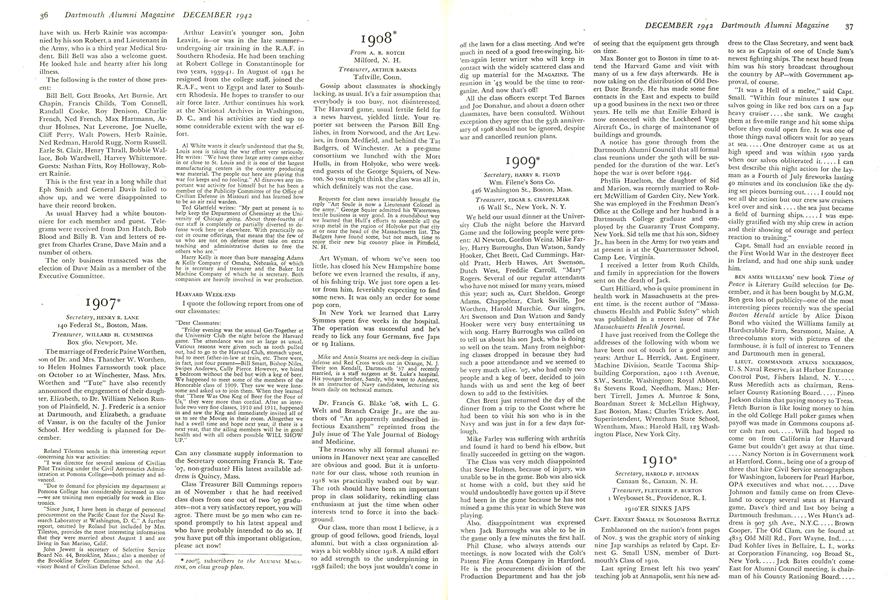
Gossip about classmates is shockingly lacking, as usual. It's a fair assumption that everybody is too busy, not disinterested. The Harvard game, usual fertile field for a news harvest, yielded little. Your reporter sat between the Parson Bill Englishes, in from Norwood, and the Art Lewises, in from Medfield, and behind the Tat Badgers, of Winchester. At a pre-game consortium we lunched with the Mort Hulls, in from Holyoke, who were weekend guests of the George Squiers, of Newton. So you might think the plass was all in, which definitely was not the case.
Requests for class news invariably brought the reply "Art Soule is now a Lieutenant Colonel in the army."_ George Squier admitted his Watertown textile business is very good. In a roundabout way we learned that Hull's efforts to assemble all the scrap metal in the region of Holyoke put that city at or near the head of the Massachusetts list. The Badgers have found some, but not much, time to enjoy their new big country place in Pittsfield, N. H.
Art Wyman, of whom we've seen too little, has closed his New Hampshire home before we even learned the results, if any, of his fishing trip. We just tore open a letter from him, feverishly expecting to find some news. It was only an order for some pop corn.
In New York we learned that Larry Symmes spent five weeks in the hospital. The operation was successful and he's ready to lick any four Germans, five Japs or 19 Italians.
Mike and Annis Stearns are neck-deep in civilian defense and Red Cross work out in Orange, N. J. Their son Kendall, Dartmouth '37 and recently married, is a staff surgeon at St. Luke's hospital. His younger brother, Sandy, who went to Amherst, is an instructor of Navy candidates, lecturing six hours daily on technical matters.
Dr. Francis G. Blake 'OB, with L. G. Welt and Branch Craige Jr., are the authors of "An apparently undescribed infectious Exanthem" reprinted from the July issue of The Yale Journal of Biology and Medicine.
The reasons why all formal alumni reunions in Hanover next year are cancelled are obvious and good. But it is unfortunate for our class, whose 10th reunion in 1918 was practically washed out by war. The 10th should have been an important prop in class solidarity, rekindling class enthusiasm at just the time when other interests tend to force it into the background.
Our class, more than most I believe, is a group of good fellows, good friends, loyal alumni, but with a class organization always a bit wobbly since 1918. A mild effort to add strength to the underpinning in 1938 failed; the boys just wouldn't come in off the lawn for a class meeting. And we're much in need of a good free-swinging, hit'em-again letter writer who will keep in contact with the widely scattered class and dig up material for the MAGAZINE. The reunion in '43 would be the time to reorganize. And now that's off!
All the class officers except Ted Barnes and Joe Donahue, and about a dozen other classmates, have been consulted. Without exception they agree that the 35th anniversary of 1908 should not be ignored, despite war and cancelled reunion plans.
From A. B. ROTCH Milford, N. H.
Treasurer, Taftville, Conn.