1897
The College has accepted the portrait of John Poor given by the class at its reunion in May. It will be hung in the observatory, so long associated with his work. A Boston physicist, who took post-graduate work in physics at Dartmouth, and, in that connection, worked with John, tells me that he regarded John as an outstanding scientist, and that in his opinion if John had been of the self-advertising temperament, he would have been one of the best-known scientists in America. Personally, I miss John very much indeed. He was accustomed to state scientific principles in Homely and understandable language, such as that it is correct to refer to a "pound of light." I seldom read a book without thinking of John. He said: "If in reading you come to something you don't understand, don't puzzle over it. Read along and it will very likely be explained." I have found that it works that way.
Johnson is again in the limelight. When his retirement age arrived as superintendent of schools in Ayer, Shirley and Foxboro, it was voted that he be requested to remain for the duration of the war. The duties of a school superintendent, always sufficiently onerous, have been greatly complicated by having the great cantonment of Fort Devens in his district.
If any of you are considering retiring, listen to Erdix Smith's experience:
"Last year, after forty years of the practice of medicine, I decided to take a real vacation.
"We spent from early in December to the last of April in Florida, fishing and hunting on its rivers and lakes, trolling for the big ones in the Gulf of Mexico, and in the Atlantic Ocean, casting for bonefish and tarpon down off the Keys; driving, swimming in the surf, playing golf and shuffleboard, going to games, picnics, and parties.
"In spite of all these attractions I was often homesick for the old job, and longed to be doing some honest-to-goodness work. I made up my mind that shorter vacations were more satisfactory, and that retirement was entirely out of the question for the present. Except for a week spent at the Cape, one at Sunapee Lake and one at the College of Surgeons I have been on the job for the last year, and I imagine I will have my belly full of work before this war is over."
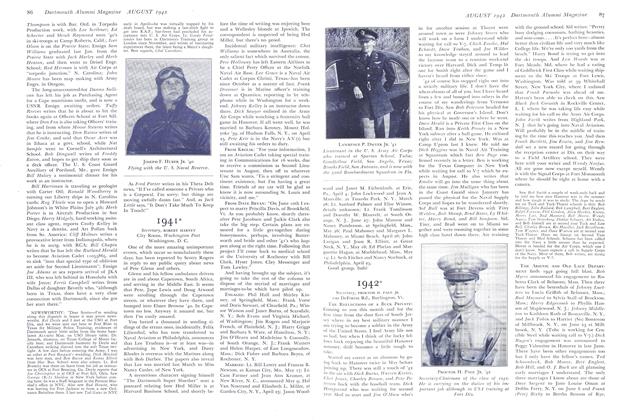
Dr. Eckstorm, while his two sons-in-law are fighting the battles for freedom, is keeping the "home fires burning." What thrilling memories come back to the members of the Dartmouth classes of 1895-1901 as they recall the many spectacular feats of the genial doctor on the football field.
Now the scene has changed. Dr. Eckstorm is seen in the home with his fond and admiring grandsons, who are presenting to "Daddy Jack" as they call him, gifts on Father's Day, since they are unable to send any to their father whose address is unknown.
Dr. Eckstorm is Ohio Penitentiary physician; he started a rose garden at the institution and it has now four hundred bushes, and its beauty has a refining and kindly influence upon the inmates; one of their number has contributed a most appreciative article to the Penitentiary paper.
Dr. Eckstorm served as Major Surgeon of the 112th Ammunition Train in the last war and retired as Major Surgeon of the 166 th Infantry in 1937 after thirty-five years service in the Ohio National Guard.
Secretary, 53 State St., Boston, Mass.
* 100% subscribers to the ALUMNI MAGAZINE, on class group plan.