"Our Fight for Survival"
President Hopkins Delivers Keynote Address At Herald Tribune Forum in New York
PRESIDENT HOPKINS gave the keynote address at the New York Herald-Tribune Forum on Current Problems, November 16, 17. The theme of the Forum, which has become recognized as a rostrum of outstanding significance, was this year "Our Fight for Survival in a Free World."
The scene five thousand people crowded into the ballroom of the Waldorf Astoria Hotel in New York. They came from almost every state and many foreign countries. Every word on the program was carried by radio to listeners throughout the world. There were many Army and Navy uniforms both among speakers and dignitaries on the platform and in the huge crowd. The Forum, in its eleventh year, is an educational institution. Its program was filled with leaders in all walks of life. The speakers included President Roosevelt, Major General Allen Gullion, Wendell Wilkie, Secretary Claude R. Wickard, William M. Jeffers, James F. Byrnes, Henry J. Kaiser, Elmer Davis, John L. Sullivan '21 (Assistant Secretary of the Treasury), Lieut. Donald B. Aldrich '17 USNR, Sumner Welles, and others of outstanding distinction in world affairs.
Presiding Officer Mrs. Ogden Reid, vice president of the Herald-Tribune, introduced all speakers on the program. She has collaborated through the years with the founder of the Forum, Mrs. William B. Meloney. Mrs. Reid, able, petite and dynamic manager and director of the program, sounded a significant keynote herself when she said in her welcoming address: "There is one word that I wish could beremoved from our thinking now and froma post-war world. That word is 'peace.' Efforts for achieving peace have been completely fruitless, and I believe we shouldrecognize the fact. Actually the state ofpeace arrives only with death. People wholive fully do so only if they fight."
The opening address by President Hopkins on the subject "Our Fight for Survival in a Free World," follows in full:
THE PANORAMA OF THE WORLD SCENE spreads wide in a college community at a time like this. Nowhere, I believe, unless in the intelligence departments of the armed services and I am not sure there is the opportunity offered so directly 10 know what men are actually thinking who will control the country's affairs in the next generation. Boys who recently were sitting in college halls under instruction secure, as they supposed, under the protecting mantle of civilization, ambitious for the opportunities and satisfactions of domestic and of civil life, are now creeping through the jungles in the South Pacific, thrown back upon the simple laws of primitive conquest, to kill or be killed; or they are being lashed by the stinging sand as well as by the shot and shell of the Libyan Desert. Boys on the floors of the seven seas in submarines, and others just down from combat in the stratosphere, boys in remote corners of the earth who have ferried bombers thence all these send back their thoughts and queries on life as it looks to them and bespeak their developing convictions as to what civilized life ought to be. "Boys" I have said, and that is what they were but a few weeks or months ago. But over night they have become men and such men as to command the admiration and thrill the hearts of all who know them. Having some contact with and some knowledge of the thoughts of such as these, as they fight the nation's battle is, I think, my own credential for being on such a program as this.
Recently a father has shown me a letter from his son. I quote from it:
"I don't fool myself that I am being altruistic or idealistic. As far as I am concerned, I am fighting definitely for myself and for conditions under which I hope some day to bring up my children. But by and by when there is more time to talk about things, I should like to know whether it was ignorance or just plain don't-give-a-damn-ness that argued, and let me and the fellows I knew grow up believing, that all one had to do to have peace was to refuse to get ready to fight. What were experienced people and those professing high ideals doing while somebody stacked the cards on us? And why, if our educational system is so damned good, didn't somebody tell us facts instead of theories about these guys we're shooting at and those other guys we're playing with?"
I recite this verbatim because it is fairly typical of a very general sentiment among those in active service whose letters I have seen, or from whom I have heard, or about whose attitudes I have known, who believe that alike in the policies of government, in their home communities, in their churches, and in their halls of education they have been let down in seeking knowledge and let in for something that need not have been by people who simply dogmatized about life with no personal knowledge concerning it. The beginning of a fight for survival in a free world is for us to bring the phrase "search for truth" down to earth out of the fleecy clouds of ethereal suggestion and to translate the words into its better understood equivalent of "search for reality."
The same instinct which has led us with our congenital inaptitude in languages to shout at those whose words we cannot understand has led us metaphorically to shout at those whose thoughts we could not understand; and worse, to assume, even if we couldn't understand them, that they could and did understand us. We have shouted our assumptions in regard to race superiority to Japan ever since Perry sailed into Tokyo, completely oblivious of the fact that patronizing a proud and feudal civilization would not be so likely to produce friendly subserviency as bitter resentment, to the effects of which we are now subject. We have shouted our specific prescriptions for democracy to Germany ever since the Armistice, oblivious of the fact that a people who have never had democracy and who had never been given opportunity for cultivating desire for it would retreat still farther from the conception of it rather than approach it, if circumstances required the sudden acceptance of one alternative or the other.
There are such things as racial traits which must be recognized and understood and on which we must base our assumptions if we are to deal with associated groups of mankind on a basis of reality. Tacitus said of the Germans centuries ago that "To cultivate the earth and await the regular produce of the seasons is not the maxim of a German; you will more easily persuade him to attack the enemy and provoke honorable wounds on the field of battle. In a word, to earn by the sweat of your brow what you may gain by the price of your blood is, in the opinion of a German, a sluggish principle, unworthy of a soldier."
It was an unreal humanitarianism that allowed the first World War to end at the German boundary; it was political inertia that allowed Hitler to go into the Ruhr; it was deliberate self-deception that allowed opposing military forces to test their mechanical equipment on hapless Spain; and it was culpable compromise that deliberately planned to throw Czechoslovakia to the wolves of Nazism in false hope of buying peace for the negotiators. Likewise it was at least extraordinary ignorance of the realities of the situation that allowed England and America to disregard the significance of Japan's threat in 1931 when she went into Manchuria.
No American, however, was in a position to speak effectively on any of these things since in an utterly unreal concep. tion of our immunities, to say nothing of our responsibilities, we had at the close of the first World War withdrawn from participation in world affairs, erected high tariff barriers against the rest of the world, and in periodical outbursts of self-righteousness shouted from our national housetops that all other peoples of the earth were imperialistically acquisitive or politically corrupt or socially degenerate, according to our respective vague impressions or self-interested prejudices. Such was the atmosphere of unreality in which America, critical of and antagonistic to Europe and ignorant about and patronizing of Asia, adopted the unjustified assumption that she lived in a world apart from the rest of mankind and that her people could sit idly but disapprovingly by without misfortune while the rest of mankind rushed on to catastrophe. Certainly the first requisite in a fight for survival in a free world is that we should open our minds, rechannel our thinking, and make mental effort to become understanding of the world in which we live rather than to dream of a makebelieve world which our imagination has devised.
FORGET BASIS OF PROSPERITY
People have little consciousness of values they have never lacked. This is true in such material details of life as variety of diet, ease of transportation, bodily comforts and a multitude of household luxuries. How much more in a land of abundant resources, of easy government, and of unquestioned liberties is it true of an abstract blessing like freedom. It seems to be an attribute of human beings individually or in the mass that the more largely they prosper, the more rapidly they forget the basis of their prosperity. The question has not been completely answered even yet, and will not be until the peace conference has ended, to what extent men will accept self-sacrifice and deprivation to save freedom compared with what men in the past have undergone to win it. We had fallen subject to what the Bible refers to as the "voice of a multitude being at ease."
A few years ago during a summer vacation on the coast of Maine, I expressed doubt about the desirability of some of my young friends embarking on a cruise on a day of high winds and of rough water. An experienced captain who had listened to my objections remarked sententiously, "Nobody ever learned to be a good sailor on a smooth sea." That remark has remained with me since as illustrative of an important principle. We as a people, I think, were on the road to forgetting that strength develops through the overcoming of difficulties and that when no longer men are called upon to make effort, strength wanes. It is with such thoughts in mind that sometimes I wonder even if, despite its staggering cost, this fight for survival in free world and for a free world did not have to be undertaken to save our civilization. The difficulties of the course we have set and the nature of the struggle into which we have been plunged are not such that we can spare ourselves in any way or forego any effort of which we are capable without disaster. It is a sorrowful road to travel but it may be that it was the only one that could be taken that would have led us back to our birthright.
I have repeatedly said of the Germans what I would now say of the Japanese likewise, that much as we abhor the purpose to which these people have been for years conditioned to attempt domination of the world, the thoughtful observer must concede a grudging admiration for the scope of the planning that was devised, for the unity of purpose that was secured, for the details of organization that were mastered, and for the efficiency of operations when at last these were undertaken. However mistakenly applied, their respective bids for world domination have been the result of long consideration, of brilliantly conceived plans, and of self-discipline to an extent unprecedented in world history before. To those of us who do not believe that good can live by compromise with evil, it seems clear that these qualities, demonstrated by our enemies, define the nature and characteristics of qualities necessary to defeat them. Nothing less than theirs in consecration to the cause, in intensity of purpose, in mental acumen, or in willingness to undergo the exactions of physical hardship can be effective.
PEARL HARBOR WROTE AXIS CREED
No reiterated assertion was ever more completely true than that we as a people did not want war. We loathed the thought of war, as we do today, from every boy in a foreign fox-hole to every mother in an American home. So keen was our hatred of all for which war stands that almost to the last moment we turned away from recognizing that only the choice was ours of whether we should carry the war to the Axis or should await Hitler's convenience as to when and how he should bring war to us. Then came Pearl Harbor, which wrote the determination, the ruthlessness, and the brutality of the Axis creed so plain that all could read. The unity which had been so slow in developing was established in a single day. The Axis assumption of weakness in our democracy because of mutual antagonisms and partisan feuds was proved false. Prompt answer was given to the anxious query which had been in the minds of some whether in our rich and powerful America loyalty to democratic ideals had become "but as the ghost of friendship dead, a shadow in the glass, of faith gone by."
So at last we closed ranks. Democracy's hosts turned their backs on materialism,abandoned "safety first" as a national ideal, and moved forward to full cooperation with those who had previously had comprehension forced upon them that a world dominated by Nazism or Japanese feudalism could be nothing else than an abhorrent world of darkness and evil. Now for a long time, it is inevitable, prior claim upon our thoughts and efforts must be given to military victory. It would, however, be tragic misfortune if in our concentration upon necessities of the present, we withheld consideration of the needs of the future. When eventually military victory shall have been won, the final, great issues of the peace conference will remain to be met. America never had greater reason to be concerned than that not again shall she be found lacking at this stage. Problems loom for settlement at that time greater and more complex than man has ever faced before. What, for instance, after the wanton destruction and brutal suffering thrust upon her in savage attempts at her extinction, will be Poland's attitude at the peace table or that of Russia or of Holland or of Norway or of Belgium, as compared with what in different perspective would be the attitude to which we should commit ourselves? To what extent, if at all, should we be justified in ignoring the fact that these people must live with Germany as near neighbors, as contrasted with our comparative remoteness? So of China and Japan! Again, for instance, until the so-called educational system of Germany is thrown into reverse and a new generation has been compelled to distinguish between search for truth and officially prescribed falsehood, she should not again be given the privilege of self-determination as to educational method.
In such problems as these, democracy will find difficulties for which no answers will develop in easy generalizations. For myself, I have long accepted Thomas Jefferson's declaration as a desirable premise for thoughts on education, when he wrote of the foundation of the University of Virginia, "I have sworn upon the altar of God eternal hostility against every tyranny over the mind of man." Furthermore, I believe it to be indispensable in a world as small as ours that as definitely as we resist such tyranny over our own minds, we strive that the effects of such tyranny be not allowed to develop anywhere. It is only elementary realism that otherwise no peace can be anything except ephemeral.
Moreover, there is in connection with our survival in a free world the question to be asked of ourselves how to restore the balance at the close of the war in our educational system so that again the development of the whole man receives its due regard, as against the overdevelopment of technical education imperative for mechanized warfare. If the German principles of higher education had ever fostered anything except procedures calculated to develop high specialization and if the German educational system, even in its lower grades, had not carefully avoided anything in the nature of general education, it might have proved less easy for German opportunists to have mobilized a whole population to Nazism so promptly. Such statements apply, of course, still more definitely to a system that precludes even "dangerous thoughts" and punishes men presumed to hold these, as is the case in Japan.
In America we have profited by experience and have achieved a balance between the two types of education which on the one hand makes for scientific advance and material efficiency and on the other hand makes for richness of living. The advantages of this balance, sui generis, in our democracy should not be forgotten in the stress of conflict, insistent as such stress must be, for eventually it is indispensable to survival in a free world to have men of wide interests as well as those whose interests are highly and exclusively specialized. Even while recognizing the advantages in a democracy of wide variety in the forms of institutions of higher learning, the liberal college should be insistent in protecting its own birthright. In the interest of society at large, it must not allow itself to be displaced by the technical school or circumscribed by limitations imposed upon it by demands of the professional schools or of the graduate schools. Neither efficiency nor professional scholarship by itself alone makes for a sufficient goal in life to make a fight for survival worth while.
Sometimes I have felt that amid many grievances against Germany, there was none more justly held than that of her deleterious influence upon American higher education for the last century. Wherever one sees all general knowledge of such methods as make for wide intelligence being completely sacrificed for highly specialized knowledge in our colleges and universities; wherever one sees the subject being held of more importance than the student; wherever one finds an attitude that the student body exists in order that a faculty may be maintained there one finds the mark of the German university and there one finds that belief is held that what a man does is more important than the spirit which leads him to do it; that knowledge is more important than understanding; that science is all-inclusive in its ability to satisfy the soul of man; and that politics and administration of the state are something with which even the intellectuals should not be allowed to concern themselves except under direction of the politicians. It was thus that Hitler was enabled to subjugate his own people first of all.
To insure survival in a free world, nothing is sufficient except that we develop and utilize all of the power of which we are capable, which is a manner of speech for saying that we must make ourselves the most powerful nation on the earth. This introduces its own great problems for the peace to come. We may well recall Emerson's words, "All kinds of power usually emerge at the same time; good energy and bad; power of mind with physical health; the ecstasy of devotion with the exasperations of debauchery." Only in a free world wherein the use of power is withheld except for the public good is that broad margin of life beyond mere existence made possible which constitutes civilization. If coincident with the development of the might which our power will give us, we do not develop the restraint and the intelligence to utilize it for an enduring peace, in which materialism and self-seeking shall be subordinated to the common welfare of the peoples of the earth, not only will we contribute to the making of still another war but in the disappointment and disillusionment of those who return from waging this conflict we shall have the makings of what youth made of France after the last war, as evidenced a couple of decades later when a new crisis began to appear.
On the contrary, if our power be intelligently developed and responsibly held, the people of America will be possessed of the greatest opportunity ever presented to any people upon the face of the earth to make its name glorious through all time. Let us dwell constantly upon the thought that this could be. It could be if intelligently and discriminatingly America should utilize its might for a realistic establishment of a brave, clean world wherein within the limits of the common good all men of whatever race or whatever color should be free to live their own lives, to think their own thoughts, and to dream their own dreams, unharried by circumstance and uninterfered with by their fellow men.
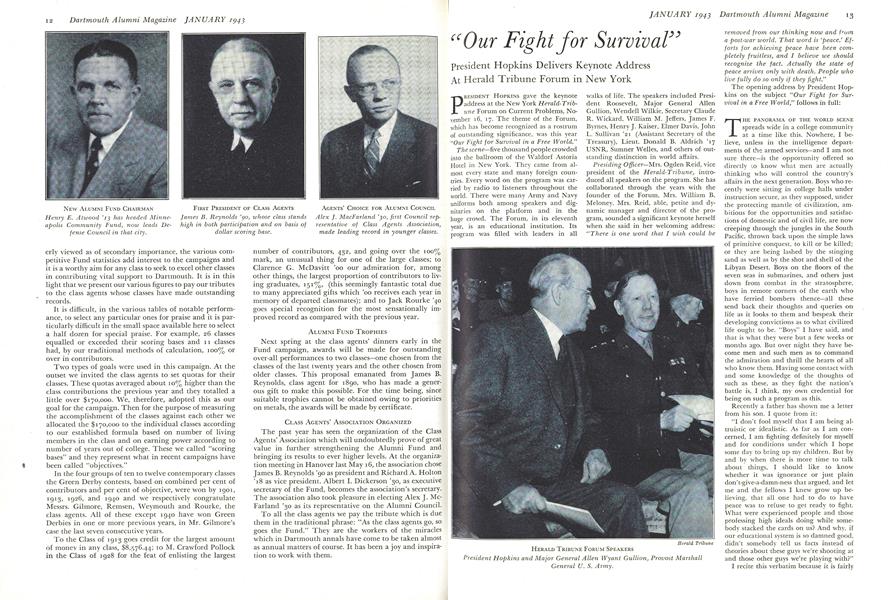
HERALD TRIBUNE FORUM SPEAKERS President Hopkins and Major General Allen Wyant Gullion, Provost MarshallGeneral U. S. Army.
LT. CMDR. CHARLES J. ZIMMERMAN '23 Head Agent for "Chicago Network" ofClass of 1923 resigns to accept Navy commission.
LT. VAN NESS JAMIESON '29In three-year term increased his class's dollar total 150%, greatly broadened participation.