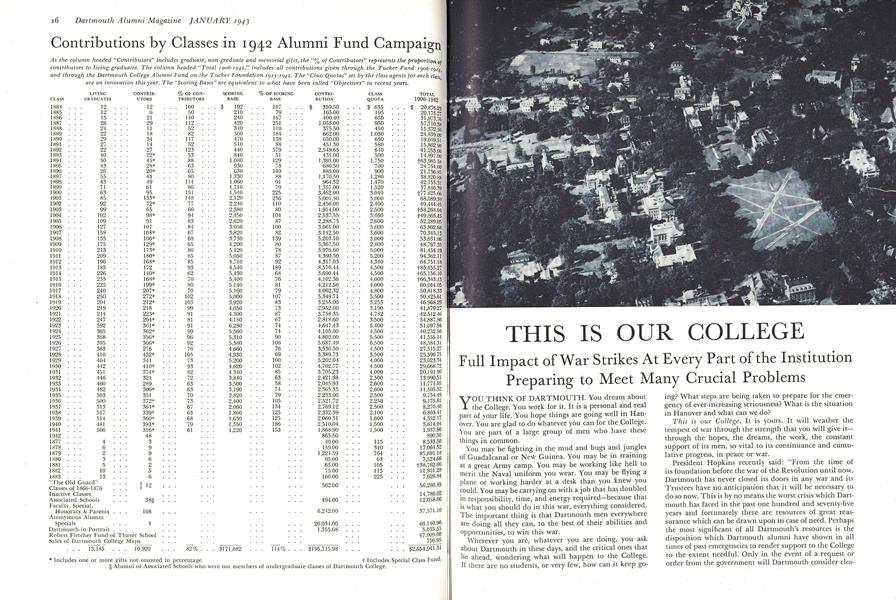
THIS IS OUR COLLEGE
Full Impact of War Strikes At Every Part of the Institution Preparing to Meet Many Crucial Problems
YOU THINK OF DARTMOUTH. You dream about the College. You work for it. It is a personal and real part of your life. You hope things are going well in Hanover. You are glad to do whatever you can for the College. You are part of a large group of men who have these things in common.
You may be fighting in the mud and bugs and jungles of Guadalcanal or New Guinea. You may be in training at a great Army camp. You may be working like hell to merit the Naval uniform you wear. You may be flying a plane or working harder at a desk than you knew you could. You may be carrying on with a job that has doubled in responsibility, time, and energy required because that is what you should do in this war, everything considered. The important thing is that Dartmouth men everywhere are doing all they can, to the best of their abilities and opportunities, to win this war.
Wherever you are, whatever you are doing, you ask about Dartmouth in these days, and the critical ones that lie ahead, wondering what will happen to the College. If there are no students, or very few, how can it keep ing? What steps are being taken to prepare for the emergency of ever-increasing seriousness? What is the situation in Hanover and what can we do?
This is our College. It is yours. It will weather the tempest of war through the strength that you will give it through the hopes, the dreams, the work, the constant support of its men, so vital to its continuance and cumulative progress, in peace or war.
President Hopkins recently said: "From the time of its foundation before the war of the Revolution until now, Dartmouth has never closed its doors in any war and its Trustees have no anticipation that it will be necessary to do so now. This is by no means the worst crisis which Dartmouth has faced in the past one hundred and seventy-five years and fortunately there are resources of great reassurance which can be drawn upon in case of need. Perhaps the most significant of all Dartmouth's resources is the disposition which Dartmouth alumni have shown in all times of past emergencies to render support to the College to the extent needful. Only in the event of a request or order from the government will Dartmouth consider clos going, and in that event we should steadfastly urge the vital importance of maintaining at least a nucleus of the historic liberal college through the emergency."
The pages that follow are a report to Dartmouth men on the state of their college as the mighty impact of war hits in full force.
Enrollment
PROPOSALS HAVE BEEN FREQUENTLY MADE and widely supported for using the colleges as virtually shortterm West Points, in which recruits would get a thorough military and physical training plus as much academic instruction as might be feasible and possible. The Air Corps is using hotels in Miami in this way. The Navy and other branches of the armed forces are using colleges for indoctrination and special training schools. Housing is a big Army problem.
As this issue of the ALUMNI MAGAZINE goes to press theManpower Commission announces inauguration of ArmyNavy programs for colleges. Picked groups of 18 and 19year-old recruits will be assigned to training in some 200colleges and universities after their induction throughSelective Service. College students now enrolled in Army,Navy, or Marine Corps Reserves will be left in collegefor varying periods, depending upon number of semestersremaining for completion of degree requirements and alsodiffering with the policies of the several branches of service. It is not expected that college training of inducteeswill begin immediately but the program will start assoon as practicable. More complete information, affectedby decisions yet to be made in Washington, will be carriedin our next issue.
This will be comparable in one way to the Student Army Training Corps (SATC) of World War I when students in uniform attended courses in which the content was prescribed to a considerable extent by the government. There is a difference, however, and it is a major one. The SATC at Dartmouth, for example, was made up of regularly enrolled undergraduates who were studying for the Dartmouth degree. In the plan now most favored in Washington, 18 and 19-year-olds, whether drafted or enlisted for Army, Navy and Marine Corps service, would be sorted out and selected groups would be assigned for academic and military training at certain colleges. Various reports indicate that the plan would permit these picked recruits to stay at the college training centers from three to a maximum of six semesters. Presumably they would not necessarily be candidates for a college degree.
Only a part of those called from the great reservoir of 18 and 19-year-old manpower would be given this special training to qualify them for technical and scientific Army or Navy jobs, and to lead to officers training.
Because Dartmouth is included among the larger colleges, capable of accommodating hundreds of trainees and with teachers and facilities for instruction of large numbers in the sciences, it is possible that the College may become such a training center. The chances of this development are greater in Hanover than in many a college where strictly limited capacity of buildings, instruction staff, and equipment may force these smaller institutions into an extremely precarious situation.
The darkest view is one that has the colleges folding up in the near future from lack of students. But the facts are that the government needs just such plants as the colleges have complete for housing, instructing, exercising, and feeding large groups of men. The availability of these services may keep the doors of many institutions open even though their regularly admitted students are few in number, and only a skeleton of their former programs remain.
Seniors Graduate
Dartmouth seniors left Hanover December 12. Their's was no parting with a familiar campus lined with spring foliage and June-green grass. They missed the pleasant final hours and days with parents eager to be shown the College and the town. There was no long black-robed line marching to the Bema. There was simply a senior banquet with many a toast among friends for luck in the uncertain future. Then came departure on a cold gray day in December hurrying home for Christmas and for immediate military service.
Thus the senior class, except for a few to graduate May 2, left Hanover and with their going enrollment dropped to about 1500 as compared with the pre-war normal student body of 2400. The long winter vacation (to save fuel) began December 22. Only when College reopens January 18 will answers be known to the questions: Howmany undergraduates will come back in spiteof the draft,hell and high water? How soon will the draft and over-allmanpower plan start operating on 18-20 year olds?
President Hopkins sticks to his courageous conviction that Dartmouth is going to continue to operate even if enrollment is reduced to a handful of bona fide students. He has said repeatedly that the College stands ready to make its plant and facilities available in any way possible to the government. It was this offer made by him months before Pearl Harbor that led to the establishment in Hanover in July, 1942, of the Naval Training School of Indoctrination for groups of one thousand student officers, taking successive sixty-day training periods. It is likely that the present military atmosphere of the campus will become even more pronounced in the future. But predictions are that a "home guard" will keep the College, as such, going.
Enlisted Reserve Corps
ADJUSTMENTS WILL SURELY need to be made in whatever Lover-all plan is adopted in Washington for training and using the nation's college-age manpower in respect to the present status of College Enlisted Reserve Corps. The Navy has its V-7, V-5, and V-1 plans under which undergraduates have been recruited, sworn in, and left in college for varying periods of time, but subject to call to active duty. The Army has a comparable plan for college students and the Marine Corps similarly leaves men in college until summer training periods are completed, or until their call to duty is necessary.
At Dartmouth these student enrollment programs have been well supported. A total of 361 are now enrolled in the Army Enlisted Reserve Corps, Army Air Corps, and other reserve classifications. A total of 170 students are committed to the Navy V-7 plan, 60 to the V-5 program, 184 to V-1, and other Navy branches 43. There are 103 undergraduates in the Marine Corps Reserve. (Figures are approximate and include seniors, many of whom have received report orders for early service.) Grand total of students in reserve corps last month was about 921.
A fusion between these mobilization plans that permit a certain period in college is bound to be made with whatever new programs are involved now that the vast new reservoir of 18 and 19-year-olds may be drawn upon. Students enrolled in reserve corps (which include pre-medical students) are removed from Selective Service status.
Admissions
DECREASING ENROLLMENT raises many critical problems for the College. The question may well be asked: "Why not lower standards of admission and secure largeentering classes of 17-year-olds, who may be left in Collegefor two or three semesters?" Examples are cited of other institutions that are accepting entering classes of largerthan normal size.
The policy at Dartmouth has been for the present freshman class of 1946, and will continue to be, "no lowering of standards of admission." In the words of Dean Strong: "We will not take any boys that we do not want." The Selective Process of admission has had high standards as one of its major objectives. These are widely recognized among schools and prospective applicants. They are the basis of exacting requirements by the faculty in class room standards. Units of work completed toward the Dartmouth degree have come to represent high quality. To break into this circle by lowering admissions standards would immediately and adversely affect all of the other groups and factors mentioned above. The result, it is held, would be harmful now and would also raise serious difficulties in rebuilding standards after the war. These standards should be preserved. This is the hard and not the easy way out.
There has been much discussion on the advisability of attempting to increase numbers of applications by seeking to stimulate greater interest in Dartmouth among prospective applicants. At the Alumni Council meeting recently it was agreed that all alumni should understand the serious enrollment problem facing the College. But it was the opinion of the Council, in consultation with President Hopkins and Dean Strong, that efforts to increase the number of applications should be made only along the lines of the following resolution, which was unanimously adopted:
"In the conviction that, the interest of Darttnouth College is best served, by the maintenance of its high standardsof admission during the present emergency, it is recommended that Alumni Interviewing Committees be urgedto devote special attention to those applicants having favorable qualifications, in order that the particular advantages which Dartmouth offers in a changing college worldin the high standards which it has set and is determinedto maintain, and in its unusual environment may bemore fully appreciated by such applicants, to the end thattheir interest in enrolling in Dartmouth may be strengthened."
In line with the above, alumni are urged to devote special attention "to those applicants having favorable qualifications." The bars are not down. Standards are being maintained. The College will welcome applications from well qualified secondary school students. All Dartmouth men can be helpful in this situation.
The special summer term for entering freshmen, class of 1947, will begin June 28. New freshmen will not be admitted previous to that date nor will students be accepted who have not completed the entire secondary school program a policy at variance with recently-adopted procedures at numerous other colleges where freshmen are admitted before completion of the high school or prep school program. Although freshmen may delay their entrance until beginning of the fall semester, September 10, they are advised to start their work June 28.
Science
CURRICULUM EMPHASIS has shifted sharply from cultural subjects to the applied arts and sciences. Faculty committees but mostly students themselves have been responsible for crowding from the curriculum many courses and substituting others of particular usefulness and promise in preparation for war service.
Increases are notable in Mathematics which, with 898 students, has the highest enrollment of any subject in the College except English. Substantial increases in Physics, Chemistry, Navigation (Astronomy 11) and several of the new defense courses tell the story of changing emphasis in the war-time curriculum. Science is required of students enrolled in Army and Navy Reserve Corps. It is so highly useful to all men facing military service as to become a "must" on student elective cards. If the College should become largely a military training school, a not unexpected development, there would be even greater emphasis on Mathematics, Physics, English, Mechanical Drawing, and some other subjects of greatest value in preparation for Army-Navy service.
New Courses
MONTHS BEFORE PEARL HARBOR steps were taken by the College to inaugurate courses of particular utility in military training but also in line with the liberal arts program. Prominent among these are the study of Chinese and Russian. A new department of Geography has been established to meet the need for studying physical and economic factors that are largely determinative in many of the world's affairs.
For the first time in the College's curriculum history the following courses were offered in recent semesters: DefenseMathematics, Radio Technique, Map Interpretation, TheUnited States in World Affairs in the Nineteenth Century,Modern War Strategy and National Policy, Power Politics,Components of Democratic Thought, Test and Measurements of Military Personnel, Naval Orientation.
Significant in curriculum developments are the changes brought by the new emphasis on Geography, Chinese, and Russian, broadening the base of Dartmouth's traditional liberal arts courses. The war is being fought over the entire globe. The prediction is that never again will a college curriculum that neglects globular emphasis be considered adequate or satisfactory.
The Faculty
WITH NEARLY SEVENTY members of the faculty and administration already in war service, the decrease to date in the official staff has been proportionally greater than has been the falling off in students. With decimation of enrollment in the offing steps have been taken to mobilize resources of the faculty for full-time service in one way or another.
President Hopkins has proposed to some of the preparatory schools a lease-lend program whereby teachers of some subjects not in demand in Hanover may fill vacancies on prep school faculties where student bodies will presumably be maintained with sizeable enrollments. The possibilities of this proposal are being explored.
Dean Bill, Dean of the Faculty, has asked teachers in all departments to indicate whether they may be available for a period of intensive preparation in Mathematics, Physics, Chemistry, and other sciences. Their response has been very gratifying. In some cases the current four-week vacation is being used for training faculty volunteers as instructors in the sciences. If courses in these subjects, at an elementary level, are to be prescribed by the Government for training Army and Navy recruits then a much larger teaching staff than is now available in the sciences win be needed at Dartmouth. The prospect that demand for instruction in many of the social sciences and humanities will be reduced or eliminated by induction of 18 and 19-year-olds makes the plan a highly desirable one.
MANY STAFF MEMBERS VOLUNTEER
Meanwhile many of the faculty and administration have sought and secured opportunities for active service in the war effort. All are eager to do their utmost to relieve the College of financial burden in the emergency. But to all President Hopkins has said that he and the Trustees refuse to think of a shut down in Hanover, and that ways and means will be sought to keep the College going and to make use of the fine spirit and talents of the staff. No better demonstration of their spirit couM be given than use of the vacation period for intensive "refresher" courses in Physics, Math, Chemistry, and Mechanical Drawing.
Finances
As RECORDED IN our November issue the College balanced its books for the fiscal year ending June 30, 1942, and put aside a modest reserve as a war emergency fund. Thus the first financial report after six months of war was a favorable one. The Alumni Fund was given major credit for the good showing and was hailed as "a truly magnificent accomplishment" by Halsey C. Edgerton '06, treasurer of the College.
Because half of Dartmouth's income is derived from tuition, the big question on finances in the future is that of the number of students. No prediction can be made because of all the uncertainties surrounding plans for drafting 18 and 19-year-olds and the indefiniteness, at this writing, of any over-all manpower mobilization program. The present fiscal year may be more favorable because fees for three rather than the normal two semesters will be received. But the 1943-44 year will be very much tougher. It is Mr. Edgerton's prediction that the shrinkage of income in 1943-44 will be very serious.
It is expected that the substantial proportion of Dartmouth endowments invested in stocks will produce decreased income because of the reduction of dividends on account of increased corporation tax rates. Meanwhile, wage rates and materials entering into the costs of operating the College have increased considerably. Fuel alone, in spite of closing down for the long vacation of four weeks in mid-winter, will involve an increase for the year of about $30,000.
NAVAL TRAINING SCHOOL HELPFUL
One encouraging factor in the financial picture is the use of a substantial part of the Dartmouth plant for the Naval Training School. Comments are sometimes heard that this solves the College's financial troubles. In reply to this easy assumption Mr. Edgerton says: "Such is not the case. It is not a profit making venture. We are trying to contribute to the war effort by making our plant available for this training work. We have asked the Navy to meet the operating costs and to pay us a return on the dormitories utilized equivalent to what we were getting from the same buildings with a full student enrollment. The program relieves us from carrying many items of expense which we would otherwise encounter in connection with partly used or not seriously needed plant."
What type of financial arrangement would be made with the Army or Navy if the College is used as a short-term training school for drafted or enlisted recruits is not known. Statements by Washington authorities indicate that conversion to the Army-Navy plan would be voluntary and colleges would be paid by the Government for instruction and maintenance of men on a contract basis. What basis of payment would be used is still entirely problematical.
Financial problems of the utmost seriousness face the College for the duration. In his report, Treasurer Edgerton pointed to the greatest single factor of security in the fight for survival that Dartmouth must make when he wrote: "We considered the 1941 Alumni Fund a remarkable showing and one which would not soon be equalled. Nevertheless, without the stimulus of the Twenty-Fifth Anniversary appeal, the totals for 1941-42 are in excess of the figures for the previous year an amazing accomplishment and a remarkable evidence of the generous feeling which Dartmouth men have for their College."
Student Activities
DARTMOUTH, UNDERGRADUATES, and the Hanover community too, are conditioned to a considerable variety and number of highly efficient student, or "extra-curriculum," activities. Far from the distracting influences of cities the undergraduates have from long custom devoted much time and energy and thought to providing services and entertainment for each other. There are those who hold the emphasis on student activities to have certain educational values. And there are those who think the time spent is largely wasted.
Undergraduates publish Hanover's only daily paper. They produce the only dramatics north of Boston. They have established and creditably operate the Dartmouth Broadcasting System whose nightly programs reach the college community on a campus network. Excellence in many non-athletic activities the Glee Club and Band, the Aegis, student government groups (Palaeopitus, Green Key, Interfraternity and Interdormitory Councils) all these projects have become so much a part of Dartmouth as to endure through times good and bad.
The Outing Club has created a trade mark for the College by which it is popularly known throughout the nation. Its distinctive activities have for 30 years played a major role in undergraduate life. Winter Carnival is out for the duration. It has lately been attacked as one of the frills of College life which could be done without. This criticism will surely be widely discussed when times are again appropriate for scheduling Carnivals, but the pertinent point here is that the Winter Carnival and intercollegiate skiing are Dartmouth products, created and perfected by students in the process of DOC growth.
Relying so largely upon self-entertainment it is to be expected that student activities will survive a lot of punishment before there is a noticeable falling off in either the variety of quality of their programs. During the fall semester enrollment was 20% down but student affairs showed no marked retrenchment.
The Dartmouth, for example, has been published daily except Saturdays in spite of much depleted advertising revenue. Shows by The Players have achieved a degree of excellence unusual even for this group whose dramatic talents and performances have earned high praise for many years. Along other lines of non-athletic activity, standards of the past have been maintained although available personnel and audiences and supporters have somewhat dwindled.
Athletics, both intercollegiate and intramural games, are being carried on in the face of serious difficulties. Views of the Director of Athletics, William H. McCarter '19, on the future of athletics at Dartmouth, with comments on various sports, are included in the regular section "Big Green Teams" in this issue.
With the deep-rooted tradition of emphasis on and support of activities outside the classroom at Dartmouth, it is apparent that they will play an important role in student life so long as there is personnel to keep them going.
Fraternities
To help guide the fraternities through crises of obvious acuteness, President Hopkins has named Harry R. Wellman '07, of Tuck School, for many years a counselor both officially and unofficially of College undergradutes and Tuck men, as College Adviser to Fraternities, saying, "Due to existing circumstances and the uncertain future of the fraternities this position becomes one of prime importance." "Much concern is being expressed," he said, "both by graduates and undergraduates as to the problem of house maintenance, the meeting of overhead expense, the relationship of the fraternity system, as such, to the undergraduate body as a whole in war time, and emergency questions which may arise between individual fraternities and the official College as the College moves more definitely onto a war-time basis."
Mr. Hopkins also announced the establishment of a Fraternity Board of Control of six men under the chairmanship of Mr. Wellman, to be composed of three men chosen from graduate fraternity members resident in or near Hanover, as appointees of the President, and three students picked by the Fraternity Council. A few days later he announced his appointees as William H. McCarter '19, Chi Phi; Andrew G. Truxal, Phi Kappa Psi; and Andrew J. Scarlett '10, SAE. Undergraduate members of the Board are John Roberts '44, president of DKE, and president of the Inter-Fraternity Council; Charles Martus '44, KKK, and William Harrison '44, Phi Gamma Delta.
Within a very few days after Mr. Wellman's appointment matters of importance began to be decided. First was the announcement that exactly one week after the Council had presented its petition to Dean Neidlinger, Professor Wellman accepted the request of the fraternities that the entire class of 1946 will be rushed this month. Later in the week, reports came of the creation of a subcommittee on fraternity assets under the chairmanship of Professor J. P. Richardson '99. Among the others members are Max Norton '19 and Professor Charles W. Sargent '15 of Tuck School, who has for several years audited the fraternities. The normal fraternity chapter is committed to $1500 a year in fixed charges even if closed down this sum representing mortgage payments, taxes, insurance and similar fixed charges.
Associated Schools
UNCERTAINTY AND READINESS to make rapid changes in plans are as much the situation in the Medical, Thayer and Tuck Schools as in the College itself. What seems to be a good program today may not fit the demands on education made by the war tomorrow. In the cases of all three Schools every effort has been made to cooperate with the College and with the national program to accelerate their work and to prepare their students for specialized and vital services. The Schools are relatively small and their faculties are prepared to follow a flexible policy of adaptation to the points and methods of greatest need and usefulness.
Enrollment has been high in all three Schools. Thayer and Tuck have admitted their students after fewer semesters in College than were previously required. They will, if necessary, reduce required credits for work by underclassmen even further if the acceleration will assist in meeting the demand for specialized and technical training of officers and others needed at vital points named by the Manpower Commission.
Medical School
Operating on an accelerated schedule, with a slightly longer session required by various rules and regulations, the Dartmouth Medical School will graduate a class February 6 and October 30. The continuous session of the School is a major contribution to the part played by the College in providing skilled officers for Army and Navy service. Six semesters of pre-medical studies in the College are required for admission to Medical School. Under the accelerated schedule this work is completed in two calendar years.
Not all Dartmouth students preparing for medicine can be accommodated in the Dartmouth Medical School. The capacity for entering classes is 24 and total enrollment for the two-year course cannot exceed 48. After receiving the two-year certificate the men take their advanced two years at a university medical school.
Enrollment in the Medical School at Dartmouth stands at capacity 49 which is about 20% over the normal enrollment that was previously considered to be capacity. Some 40-50 members of the junior class who are not headed for the School in Hanover left Dartmouth last month to enroll in other medical schools. This fact has raised the question of granting Dartmouth degrees to these men although they have completed only three years of residence as Dartmouth students. Their fourth year will be taken elsewhere as the first year of medicine. The war has caused them to leave Hanover without their
Bachelor's Degree from Dartmouth in order to accelerate their progress toward the medical degree and availability for Army and Navy service. The Trustees of the College will determine whether or not these men, in these unusual circumstances, should receive a Dartmouth degree after satisfactory completion of their first year of medicine (which ordinarily would have been their fourth year at Dartmouth) although in residence at Harvard, Columbia, Johns Hopkins, or other medical schools of high rank.
The Medical School faculty has been reduced by calls to active duty and those remaining are carrying a heavier load both in clinical and instruction work. The student body of the School is composed entirely of commissioned officers in the Army and Navy. Dr. John P. Bowler '15, Dean, and Dr. Rolf C. Syvertsen '18, Secretary of the Medical School, report that every student has rallied to the increased pressure of time and extra work in a most satisfactory manner.
Rumor has come out of Washington that the pre-medical course will be further speeded up by reducing entrance requirements for medical schools from six to four or five semesters. Authorities at Dartmouth, in commenting on this report which is only a rumor at this writing, say that pre-medical preparation could not be satisfactorily completed in a drastically shortened period of college work; and if any such change is contemplated it would affect standards of the medical profession and would need to be accepted by all colleges and medical schools in the country.
DARTMOUTH EYE INSTITUTE
ALTHOUGH THE SCIENTIFIC investigations of the Dartmouth Eye Institute are primarily in the field of pure, rather than applied research, its advice has been sought on certain problems of the armed services. Some of the problems developed into contracts with the government for specific research of a confidential nature. In one important branch of the armed services, a better selection of personnel is now possible because of new visual tests created out of the scientific knowledge of the Institute.
The Clinical Division of the Dartmouth Eye Institute has advised undergraduates on their difficulty in meeting visual requirements of the Army and Navy and has, through professional care, assisted, several students to pass these visual tests. The Clinical Division has also been of service to staff members of the Naval Training School in Hanover.
Thayer School
At the start of the fall semester requirements for admission to Thayer School were reduced to four semesters of College courses from the six semesters of pre-war days. Thus a student may enter Thayer School in one and one-third calendar years by following the accelerated program. Dean Frank W. Garran has announced four major courses for the engineering degree Technical and Communica- tions Engineering, in addition to the traditional Civil Engineer curriculum and the Tuck-Thayer major (combined engineering and business studies). The large enrollment of 55 students was cut last month by the graduation of 14. An entering class of about 20 is expected January 18. But so many men are leaving the first-year class to enter armed services, and many others are receiving such attractive offers from industry, that a net decrease in enrollment is expected next semester. The faculty has been increased to handle the greatly augmented burden of instruction for the larger enrollment.
A project of great value in neighboring industrial centers has been carried on by the Thayer School since the summer of 1941. War Training Courses have been given to about 1000 men and women employees, mostly for machine-tool industries in Claremont, N. H., and Springfield, Vt.
Dean Garran believes that the Thayer School can train as many as 100 students for a special Army or Navy engineering program. The modern facilities of the new Thayer School building (Horace S. Cummings Memorial), the able instruction staff, and willingness to maintain flexible adaptability to the most useful program in the war effort, are factors that make the Thayer School a most important part of Dartmouth's contribution to the war.
Tuck School
A new curriculum went into operation last May 25 under which the Tuck School dropped its graduate student courses in favor of a three semester course with Dartmouth students admitted in the middle of their junior year, having completed five semesters. The required college work could thus be done in one and two-thirds calendar years under the accelerated three semester per year program. These plans were formed to meet the needs of specialized branches of the Army and Navy, war industries, and Federal agencies of the Government. New curriculum emphasis is placed on the courses in Management, Production, Labor Relations, Personnel Administration, Industrial Engineering, Accounting, and Statistics, although some opportunity for electives is provided in Marketing, Sales, Advertising, Retailing, and Banking and Investments to prepare for long-run future careers of Tuck School students as well as their immediate war service.
Enrollment in the School has been high during the fall semester. A total of 91 College seniors graduated last month. There are 59 juniors who have completed the first of the three semesters of the Tuck School curriculum, most of whom are in one of the Reserve Corps permitting them to continue, at least for the time being, with preparation for technical service. Tuck enrollment also included 16 students who received the Master of Commercial Science degree last month.
Dean Herluf V. Olsen '22 cannot predict what the Tuck enrollment will be in the spring semester starting January 18. Members of student reserve corps may be permitted to continue their specialized training in the School. It is likely that requirements for admission may be further reduced in respect to college work by admission at the end of sophomore year, or four semesters. Tuck School is frequently mentioned as a logical training center for commissioned officers in the Navy Supply Corps. But there is no plan projected, beyond the offer of its facilities.
It is true of the Tuck School, as of all three of the Associated Schools, that its faculty is in great demand for important positions in war service. Because of their specialized fields of knowledge and experience it would be a simple matter to place the majority of the faculty in responsible positions in Washington. Dean Olsen reports that it has been no easy matter to keep a business school faculty intact because of heavy demands coming from Federal agencies for their services.
Navy in Hanover
THE DAY STARTS EARLY a "window-closing squad" does its work in every Navy room at 5:30 A.M. Reveille at 6:00 followed by setting up exercises, cleaning rooms, breakfast. Shortly before 8:00 o'clock, when dawn is just beginning to move over Balch Hill these wintry mornings, long blue columns form in front of dormitories New Hampshire, Topliff, Smith, Woodward, Ripley. Commands are called. The Navy marches to the campus and platoons scatter to classrooms in Dartmouth Hall, Webster, and McNutt.
Meanwhile a detail emerges from College Hall headquarters for the daily ceremony of colors. Promptly at 8:00 o'clock the bugle sounds and everyone within sight stops, stands at attention, while the flag goes up the mast.
This morning rite, conducted in the half-light dusk, is very new for Dartmouth. An observer standing near the Old Row hears the bugle but only dimly sees near-by Navy columns which turn to the flag and salute. Sleepy undergraduates hurrying to eight o'clocks stop and turn toward the bugle call. As the last notes die away sharp commands move the blue lines into the warmth and light of classrooms.
Another long and busy day has begun.
For it is a long and busy day. If it was ever true in the early days of indoctrination schools some months ago that the schedule was not exacting it was only because the training was brand-new to the Navy and to everyone concerned. For some months past the curriculum has been highly developed and just about every moment of the student officer's day is filled with requirements equal to the capacity of his mind and body. Academic work is divided into three courses Seamanship, Navigation, and Ordnance. Daily classes in these subjects are an hour and a quarter long with drill, study, athletics, demonstration, and equipment-practice rounding out the program until 4:30 when liberty is scheduled until 6:00. During the late afternoon liberty it is expected that men will get outdoors and fill up on North Country air skating, skiing or walking. This is also the time for a daily invasion of Main Street when cash registers ring out in all directions and when the ordinary civilian resident is well advised to avoid shopping and especially trying to get a hair cut.
Immediately after supper, study period begins and extends until taps at 10:00. The program is the same for Saturday except liberty begins at noon and runs until study period Sunday evening at 7:30.
Green men who are soon to be placed in responsible and varied jobs in the Navy deck, engineering, ordnance, intelligence, and aviation duty need to dig and dig hard if they are to acquire a smattering of knowledge in the three major courses of study. Quizzes at the beginning of every hour in some of the courses test the student's thoroughness of preparation of the day's assignment. A weekly test is another check on his academic standing. In addition to all the book work, lectures, Navy movies, flag drills, mock courts, Morse and semaphore code drills, etc., there is a program of physical conditioning that has resulted in almost universal improvement in strength during the sixty-day course. Incoming officers are tested by the local corps of Tunney-men for athletic skills and physical strength. Other tests at the end of the training period have revealed a gratifying rise in physical condition.
Commanding Officer of the Training School is Captain H. M. Briggs, Annapolis 1913. Executive Officer is Lt. Comdr. Daniel Stubbs, Annapolis 1925. The executive and teaching staff of about 50 is made up of some officers who were assigned to Hanover duty in July and others have been selected from graduates of the School. A group of about 40 enlisted men are valued assistants in the operation of the School. Arrangements have been made with Dick Hall's House for its use as an infirmary. Sick Bay is located in the gym where Naval doctors and dentists have their headquarters.
It is a great tribute to the efficiency and industry of the staff of the School that so much has been accomplished with so little in the way of experience and facilities. The job of organizing the School early in the summer was little different from that of starting a college, except for availability of the buildings. Within a few weeks the program was operating smoothly, the 101 "bugs" in the system had been worked out, and the School at Dartmouth had achieved the reputation of being something of a model among the indoctrination schools of the country.
Efforts are constantly made to improve every part of the School's work. The job to be done preparing a thousand men for early and, in many cases, active duty is regarded with the utmost seriousness by all concerned. Whether the program needs adjustment in small detail or at a point of major importance, the officers of the staff, and also officers of the College if they are concerned, are determined that the improvements shall be made if a higher degree of perfection in the important job of student-officer training may be achieved thereby.
From the College's point of view relationships with the Navy have been so harmonious that no problem has arisen that could not be settled quickly and to the satisfaction of both parties. Hanover has been filled to capacity for several months. There have been problems of housing and feeding that have seemed insuperable in advance but ways have always been found to expand facilities of the village a little more. Particularly in respect to food has the work done by the Dartmouth Dining Association, expertly managed by Mrs. Elizabeth W. Hayward, been a major factor in good relationships. Labor problems, present in Hanover as elsewhere, have contributed to the seriousness of some situations. For example, laundry service for an additional thousand men has been no simple matter and has required trucking of bundles to St. Johnsbury and Rutland, Vt., as well as taxing the capacity of nearby laundries.
Hanover's Chamber of Commerce has done good work in locating rooms for visiting Navy wives, operating an information service, and undertaking numerous projects for the entertainment and accommodation of both staff and student officers and their families. Undergraduates have struck up friendships with men in the Naval Unit. Fraternities have entertained them and a cordial welcome has been extended to the Navy for attendance at all sorts of functions, ranging from church services to private hospitality and social occasions.
The Navy is very much a part of our College. Now in its third session the present class will graduate January 28 and the fourth School will begin February 3. In order to provide more living space to relieve crowding in dormitories Middle Fayerweather was taken over at the end of the fall semester, December 22, as an additional "ship."
The Alumni Front
THE TRUE STRENGTH of Dartmouth alumni organization is revealed in the results to date of the impact of war on alumni affairs and on the men who run them. Far from a disorganizing or destructive influence such projects as the Alumni Fund, Admissions, Vocational Guidance, and circulation of the ALUMNI MAGAZINE show vigor equal tand even greater than in normal times. Men who are burdened with civilian duties demanding the utmost of their time and energy continue to pitch in and do the work that many hundreds of alumni so capably handle for the College throughout the class and alumni club organizations.
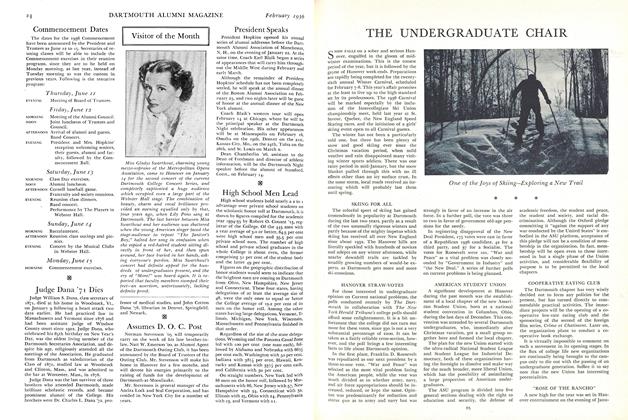
The Alumni Fund two years ago, in the campaign celebrating President Hopkins' 25th Anniversary, broke all records with total collections of more than $196,000. Last year, with the nation at war and with crisis facing the College, gifts totaled almost as much as the Anniversary Year —more than $195,000. Class agents strove as never before and Dartmouth men responded as never before in the long and phenomenally successful history of the Alumni Fund. Plans are being made for beginning this year's campaign earlier the first general mailing piece goes out within a month. In this issue of the ALUMNI MAGAZINE is carried the report of last year's spectacular campaign. Again the alumni will demonstrate to the best of their abilities and resources the indispensable value of their support of the institution. Final results cannot be predicted but it is certain that the 1943 campaign will continue to provide Dartmouth with its greatest single factor of security among the many uncertainties of the immediate future.
Class Gifts
Inaugurated by the class of 1913 five years ago, classes establish a Class Memorial Fund at their 25th Reunions. Additions are made to the principal of the Fund at subsequent reunions. The College holds Class Funds and annual income therefrom is credited to the Alumni Fund achievement of the class. Here is a tradition, young but firmly established, that the Alumni Council feels will increasingly in the future become a most important source of support to the College. The five classes that have set up 25th Reunion Gifts in this form and the present amounts of the funds are: 1913, $1,418.75; 1914, $2,495.89; 1915, $9,134.32' $4,313-97; and 1917, $6,661.50.
The total of the above class funds is $24,024.43. The class of 1918 will establish its Memorial Fund this year, having collected gifts over the past three years. Other classes that are approaching their 25th reunions 1919, 1920, 1921 have committees engaged in securing gifts, and several younger classes are making a start. For example, the class of 1937 has purchased a $0,000 war bond toward its 25th Reunion Class Gift in 1962.
Vocational Guidance
Under the leadership of its committee on Vocational Guidance the Alumni Council is projecting a plan for helping men secure employment to their liking and aptitudes when the war is over. Thousands of Dartmouth alumni will take off uniforms and leave jobs in Washington and war industries. No hit or miss program of personnel guidance will be adequate to provide the help that many of them will need. Preliminary plans are already being made. Time is now available to develop a broad and sound program of vocational help for a sizeable proportion of the entire alumni body. This service will be valuable and perhaps vital in making readjustments to civilian careers.
Class Organization
The Group Subscription Plan of the ALUMNI MAGAZINE is continuing to operate satisfactorily under war conditions. Some difficulties might have been expected to develop, resulting in loss of the 100% circulation of the MAGAZINE that has been held to for some years past. To date dues collections are reported by class treasurers to be nearly as high, or equal to, last year. The Alumni Council has expressed its opinion that wide circulation of the publication is of the greatest importance in holding the College together in these times. Copies are reaching men in the service monthly, both through direct mailing and through the generosity of a group of Dartmouth men whereby copies are sent to libraries of about 200 army camps and navy stations.
Class Reunions
With transportation difficulties becoming constantly more acute the action of the Alumni Council in October of suspending class reunions for the duration has become a move of unquestioned soundness. It would not be possible to secure large attendance at reunions during the war. Many members of the younger classes are in the armed forces and many others could not travel to Hanover. Formal class reunions will be suspended for the duration with the exception of the 50-year reunion which may be held this spring.
Hope has been expressed that a great home-coming reunion weekend may be held in Hanover after the war when all postponed reunions would be scheduled and when all Dartmouth men would gather on Hanover Plain to rededicate the College and to pledge their devotion to its purposes in a new era of progress. Such a Dartmouth home-coming would not be scheduled until six months or more after the war when a maximum attendance of alumni from reuning and other classes might be expected. Meanwhile Dartmouth has taken the leadership, and so far as we know is the first college to announce suspension of reunions a move recognizing that reunions can wait until the end of the war, while considerations of vital importance to the nation are given precedence.
The Liberal College
WHAT IS THE FUTURE OF THE LIBERAL COLLEGE? Of great importance to Dartmouth men is a thorough discussion and understanding of this question because Dartmouth is representative in maximum degree of the privately endowed colleges of America. Questions are certain to be raised during and after the war as to the justification for existence of the liberal college as compared with other types of institutions whose utilitarian values have acquired prestige through their technical contributions to the war effort.
Emphasis on sciences in the college curriculum has been greatly accelerated by the war. There is pessimism in regard to the future of any except the vocational schools. Opinions are offered that no free educational institution can survive and that all will be subject to the subsidy and control of the Government.
Some universities have recently been advocating a high degree of specialization with compression of the college course into two years, leading earlier and directly into advanced and graduate work. The possible adoption of educational policies of this nature is furthered by the war which has already resulted in tremendous acceleration of undergraduate work. At Dartmouth the degree, in continuous session, may be achieved by crowding eight semesters into two and one-half calendar years. Critics will ask: "Why go back to the four-year plan when work for the bachelor's degree may be completed in two or three years?"
The privately endowed liberal college has been from earliest days a part of America. It has concentrated upon giving men a solid foundation for living and has sought to make its students and graduates aware of cultural values entirely apart, from the business of earning a living. The four-year undergraduate course is the final formal education of more than 50% of the men enrolled in the colleges. For their students a strong argument can and should be made for the broad base of the liberal arts course over a period of years that provides some leisure along with academic work.
Varied types of education have existed side by side in America with choice between them available to prospective students. This wide choice among institutions of higher learning has been a distinguishing characteristic of American education and one which may be preserved only through the thought and solicitude of those who cherish the purposes and achievements of the liberal college.
The war has brought sweeping changes. All men and institutions have already been greatly affected. Some of the educational changes are going to have a lasting effect. Others, however, are going to point clearly to the greater value of maintaining certain proven procedures in the colleges. The present is a period of testing what was best of the old and what is most promising of the new.
Dartmouth's objective may well be, in these years of stress and readjustment, to make up its mind first of all that America and the world need the free institutionone whose major purpose is the search for truth. We must be ready to fight for its survival. We need Dartmouth as a group of alumni, students, teachers, and friends to speak and act with courage and conviction. But we need also to determine, through thoughtful and candid analysis, what of our past procedures have been most effective in achieving purposes of the liberal college and which of the new policies may most effectively put new blood into its life-stream.
Meanwhile, a message from a young Dartmouth man in the service forms our conclusion. It represents what many men in uniform are thinking and it says what they want said about our college. He wrote: "Dartmouth is one ofthe things I want to see there when I come back."
PROFESSOR NEEF has directed enrollment of undergraduates in Army, Navy and Marine Corps Reserves.Above, a visiting board of Army officers examines applicants. Total of 921 students (including seniors) were enrolled in Student Reserve Corps, as of last month.
NEW STUDENTS visit historic Dartmouth spots andare welcomed to Hanover by the Green Key when College opened for its summer and fall semesters. Below, newemphasis on sciences is shown by greatly increased studentenrollment in physics which totalled 420 last semester.Other sciences are also in great demand.
PRE-MEDICAL STUDIES AND COURSES IN SCIENCES ATTRACT INCREASED ENROLLMENT FOR WAR PREPARATION.
ASSOCIATED SCHOOLS will play a major role in Dartmouth's contribution to the war training. Medical Schoolenrollment is capacity, 20% above normal. Dr. Rolf C.Syvertsen '18, at left, shown with students in Anatomyclass. Both Thayer and Tuck Schools operate on accelerated programs and are prepared to adapt their expertteaching and modern facilities to such engineering, industrial, and management courses as may be most usefulto the Government.
WAR LEADERS IN COLLEGE meet frequently to discuss more closely relating Dartmouth's work to militaryservice. Above, left to right, Prof. A. J. Scarlett ' 10, chairman of the Committee on Educational Policy, Prof. Wm.Stuart Messer, vice chairman of the Committee on Defense Instruction, and President Hopkins. Below, Prof.Leslie F. Murch, of the Physics Department carrying muchincreased burden of instruction. Bottom, left, Professorof Chinese, Wing-Tsit Chan, visiting lecturer in ChineseCulture, and Dimitri S. von Mohrenschildt, visiting lecturer in Russian Civilization. Both are new teachers inHanover, handling subjects of significance in the war effort. Establishment of a department of geography is another important war development.
DARTMOUTH PLAYERS have achieved leadership instudent activities. Their production of Maxwell Anderson's Broadway hit "The Eve of St. Mark" (scene at top)preceded by a week its opening in New York. Other Players' shows have also been hits in Hanover. Editor of The Dartmouth, Junius Hoffman '44, above, continues dailypublication in spite of greatly reduced advertising. Prewar leisurely student activity shown below.
WINTRY FORMATION OF A COMPANY, NAVAL TRAINING SCHOOL, OUTSIDE USS NEW HAMPSHIRE.
CAPTAIN AND EXECUTIVE OFFICER of the Training School at Dartmouth are Capt. H. M. Briggs, left, andLt. Comdr. Daniel Stubbs. In June they had orders toestablish the School in Hanover, they had several Dartmouth buildings, and little else. One thousand studentofficers were soon fitted into the smoothly operating program which has been called a model for other schools.
COLLEGE HALL houses administration and offices. Chief Warrant Officer John Sargent (center) presides over a corps of yeomen and Civil Service Stenographers. Right—incoming Naval students are welcomedwith inoculations at Sick Bay in the gym..
RELATIONSHIPS are cordial between the Navy andCollege. Below Lieut. Tate in foreground supervises flagdrill in east wing of gym where flag hoists run from balcony to ceiling. Indoor drill is given on a new deck laidover dirt floor in the track wing.