1929
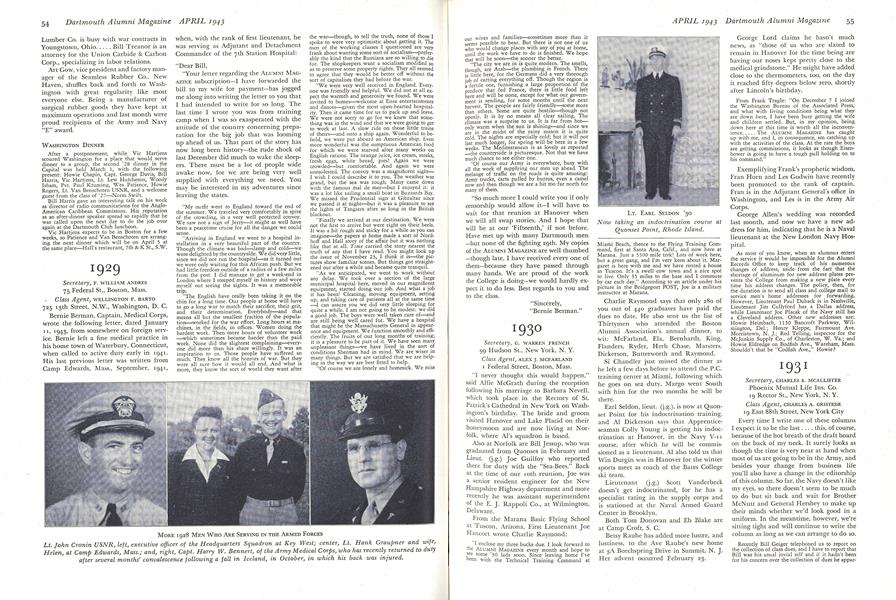
Bernie Berman, Captain, Medical Corps, wrote the following letter, dated January 11, 1943, from somewhere on foreign service. Bernie left a fine medical practice in his home town of Waterbury, Connecticut, when called to active duty early in 1941. His last previous letter was written from Camp Edwards, Mass., September, 1941, when, with the rank o£ first lieutenant, he was serving as Adjutant and Detachment Commander of the 7th Station Hospital: "Dear Bill,
"Your letter regarding the ALUMNI MAGAZINE subscription—l have forwarded the bill to my wife for payment—has jogged me along into writing the letter to you that I had intended to write for so long. The last time I wrote you was from training camp when I was so exasperated with the attitude of the country concerning preparation for the big job that was looming up ahead of us. That part of the story has now long been history—the rude shock of last December did much to wake the sleepers. There must be a lot of people wide awake now, for we are being very well supplied with everything we need. You may be interested in my adventures since leaving the states.
"My outfit went to England toward the end of the summer. We traveled very comfortably in spite of the crowding, in a very well protected convoy. We saw not a sign of Jerry—it might as well have been a peacetime cruise for all the danger we could sense.
"Arriving in England we went to a hospital installation in a very beautiful part of the country. Though the climate was bad—damp and cold—-we were delighted by the countryside. We did very little, since we did not run the hospital—as it turned out we were only waiting for this African push. But we had little freedom outside of a radius of a few miles from the post. I did manage to get a week-end in London where I steeped myself in history and wore myself out seeing the sights. It was a memorable trip.
"The English have really been taking it on the chin for a long time. Our people at home will have to go a long way to match their sacrifice, their grit, and their determination. Everybody—and that means all but the smallest fraction of the population worked for the war effort. Long hours at machines, in the fields, in offices. Women doing the hardest work. Then more hours of volunteer work which sometimes became harder than the paid work. None did the slightest complaining—everyone did more than his share willingly. It was an inspiration to us. Those people have suffered so much. They know all the horrors of war. But they were all sure how it would all end. And what is more, they know the sort of world they want after the war—though, to tell the truth, none of those I spoke to were very optimistic about getting it. The men of the working classes I questioned are very frank about wanting some sort of socialism—preferably the kind that the Russians are so willing to die for. The shopkeepers want a socialism modified so as to preserve some property rights. They all seemed to agree that they would be better off without the sort of capitalism they had before the war.
"We were very well received in England. Everyone was friendly and helpful. We did not at all expect the warmth and generosity we found. We were invited to homes—welcome at Ensa entertainments and dances—given the most open-hearted hospitality. Then it came time for us to pack up and leave. We were not sorry to go for we knew that something was in the wind and that we were going to get to work at last. A slow ride on those little trains of theirs—and onto a ship again. Wonderful to behold, we were put aboard an American ship. Even more wonderful was the sumptuous American food for which we were starved after many weeks on English rations. The orange juice, ice cream, steaks, fresh eggs, white bread, pies! Again we were crowded—but comfortable. And again we were unmolested. The convoy was a magnificent sight I wish I could describe it to you. The weather was grand, but the sea was rough. Many came down with the famous mal de mer—but I enjoyed it: it was a lot like sailing a small boat in Buzzards Bay. We missed the Prudential sign at Gibraltar since we passed it at night—but it was a pleasure to see the lights of Tangiers after so long in the British blackout.
"Finally we arrived at our destination. We were not the first to arrive but were right on their heels. It was a bit rough and sticky for a while as you can imagine—the papers at home made a sort of Nord- hoff and Hall story of the affair but it was nothing like that at all. Time carried the story nearest the truth of any that I have read. You might look up the issue of November 23, I think it is—the pictures show familiar scenes. But things got straightened out after a while and became quite tranquil.
"As we anticipated, we went to work without any delay. We took over a section of the large municipal hospital here, moved in our magnificent equipment, started doing our job. And what a job it has been! Cleaning, moving equipment, setting up, and taking care of patients all at the same time —1 can assure you we did very little sleeping for quite a while. I am not going to be modest: we did a good job. The boys -were well taken care of—and are still being well cared for. We have a hospital that might be the Massachusetts General in appearance and equipment. We function smoothly and efficiently. The fruits of our long months of training; it is a pleasure to be part of it. We have seen many unpleasant things—we have lived in the sort of conditions Sherman had in mind. We are wiser in many things. But we are satisfied that we are helping in the way we are best fitted to help.
"Of course we are lonely and homesick. We miss our wives and families—sometimes more than it seems possible to bear. But there is not one of us who would change places with any of you at home, until the work we have to do is finished. We hope that will be soon—the sooner the better.
"The city we are in is quite modern. The smells, though, are Arab—the plumbing is French. There is little here, for the Germans did a very thorough job of carting everything off. Though the region is a fertile one, furnishing a large proportion of the produce that fed France, there is little food left here and will be none, except for what our government is sending, for some months until the next harvest. The people are fairly friendly—some more than others. Some are quite hostile—though not openly. It is by no means all clear sailing. The climate was a surprise to us. It is far from hot only warm when the sun is shining—and since we are in the midst of the rainy season it is quite cold. The nights are especially cold; but it will not last much longer, for spring will be here in a few weeks. The Mediterranean is as lovely as reported the countryside is picturesque. Not that we have much chance to see either one.
"Of course our Army is everywhere, busy with all the work of supplying our men up ahead. The melange of traffic on the roads is quite amusing: Army trucks, carts pulled by burros, even a camel now and then though we are a bit too far north for many of them.
"So much more I could write you if only censorship would allow it—l will have to wait for that reunion at Hanover when we will all swap stories. And I hope that will be at our 'Fifteenth,' if not before. Have met up with many Dartmouth men —but none of the fighting 29th. My copies of the ALUMNI MAGAZINE are well thumbed —though late, I have received every one of them—because they have passed through many hands. We are proud of the work the College is doing—we would hardly expect it to do less. Best regards to you and to the class.
"Sincerely, "Bernie Berman."
Secretary, 75 Federal St., Boston, Mass. Class Agent, 725 13th Street, N.W., Washington, D. C.