The Undergraduate Chair
Country's Largest V-12 Unit Takes Over at Dartmouth Absorbing Undergraduate Editor Among Other Things
YOUR UNDERGRADUATE EDITOR is now in the United States Navy. It would seem, at first hand, unusual for him to still be in a post where he supposedly reflects undergraduate life at Dartmouth to its alumni. But he is also in Dartmouth College. And in fact he would almost have to be in the Navy to be able to reflect the Dartmouth of today. In Hanover the Navy is Dartmouth and Dartmouth is the Navy. For most purposes the terms are synonymous.
The Naval V-12 Unit began officially on July Ist. Some two thousand men are now enrolled in the program, making Dartmouth the largest such unit in the country. Perhaps the new V-12 Unit was at a slight disadvantage. The Navy had already been in Hanover long before July Ist. Hanover had seen over five thousand Naval Officers pass through the Indoctrination School during the past year. Therefore when the V-12 Unit took over, the new representatives of the Navy came into a critical atmosphere. Hanover was wise to marching feet and snappy hep-2-3-4's. It had heard of a building being called a ship and a floor being called a deck. It was fully aware of the authoritative tone and discipline of Uncle Sam's Navy. And so Hanover could gaze with a weather eye at the newcomers.
The newcomers have done all right. They are younger. They are inexperienced. Some have uniforms and some still wear baggy pants and high school shirts. Classes and new professors are a little confusing. Navy time is a bit odd. But a week or so has gone by now and that has been short enough time to catch on, but the newcomers have done all right.
In a week the marching looked just as military and snappy -as any that's been seen in Hanover. And if everyone hasn't a uniform yet, the V-12 men still represent the Navy in as fine a way as any members of that organization that have preceded them.
Perhaps the best compliment heard was the comment a few nights ago of an enlisted man on the Navy staff who has been here since the Navy first came to town. Sitting on the porch of Navy headquarters and watching a group of V-12 men march by, he turned to a fellow sailor and commented, "You know, I've seen five thousand officers march by here and I never got as much of a kick as I do out of looking at these young guys go past." Navy men at Dartmouth get the same academic advantages and as liberal an education as any civilian ever has. Indeed, Navy and civilian students sit side by side in the classroom. But it is no joyride. If Dartmouth was ever accused of being a country club at any time in its existence, such a title would now be about as appropriate as applying the same name to Attu Island.
At six in the morning the V-12 boys are routed out of bed and within five minutes are stirring up the early morning fog with vigorous calisthenics. Rooms are then swept and picked up, beds made, and everything made ready for inspection. Breakfast comes about seven and the men march to it, as they do every meal.
The rest of the morning is devoted to classes as always. The afternoon sees classes also—more than in ordinary times. At three-thirty comes an hour or more of drill and exercises and then evening "chow" at five thirty.
One hour—from seven till eight in the evening—is free. At eight men must be in their rooms. At ten the lights are switched out. Permission for late study in the library is available to trainees one evening per week.
It's not easy. The routine makes college nothing like the pleasant four years of a man's life that it used to be. But it's a great idea. It's giving men a college education at Dartmouth that they might never have had in the present war days and that they might never have had even in days of peace because of financial or other reasons.
And besides being good for the men of the Navy, it is good for Dartmouth. It is giving Dartmouth a crack at playing a vital role in the conflict. The grade of officers that will come out of the V-12 school will depend largely on what Dartmouth has done for them. And the grade of men that will come out of the war to run the future will depend just as much on the same factor.
If it has been a popular notion that colleges are folding up because of the draft, it is untrue. They are more flourishing than before. And Dartmouth is more alive today than it ever has been.
MILESTONES
PHI BETA KAPPA, Class o£ 1944: Edward W. Doty 111, Robert W. Kerwin, Joseph W. Woythaler, Ralph G. Beaman, Eben G. Blackett, John E. Grimm III, Raymond F. Heidner Jr., David H. Merrill, Ralph A. Rieth Jr., George S. Springsteen Jr., Charles M. Wilder, Donald M. Davidson, Howard L. Gilman, Raymond C. Snell Jr., William N. Turpin, and William Y. Wallace.
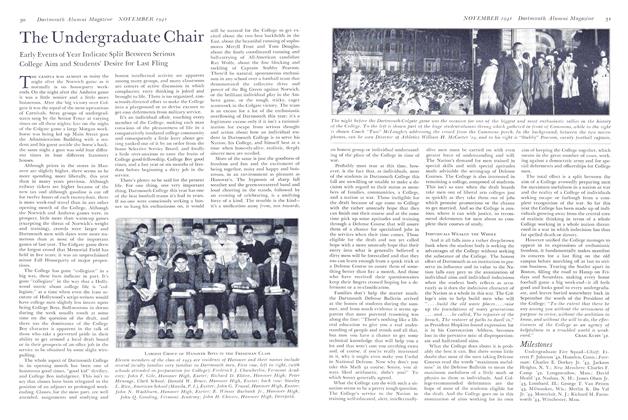
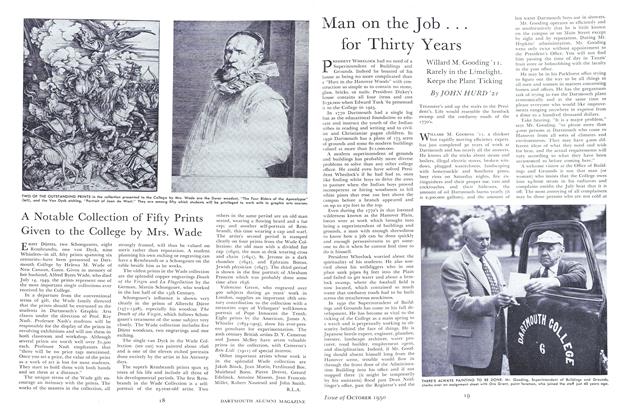
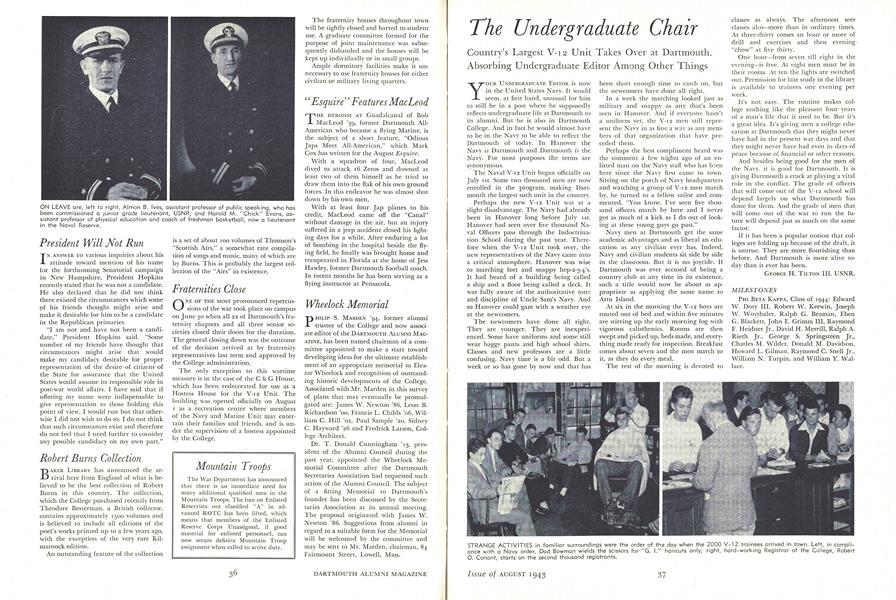
STRANGE ACTIVITIES in familiar surroundings were the order of the day when the 2000 V-12 trainees arrived in town. Left, in compliance with a Navy order, Dad Bowman wields the scissors for "G. I." haircuts only; right, hard-working Registrar of the College, Robert 0. Conant, starts on the second thousand registrants.