1933
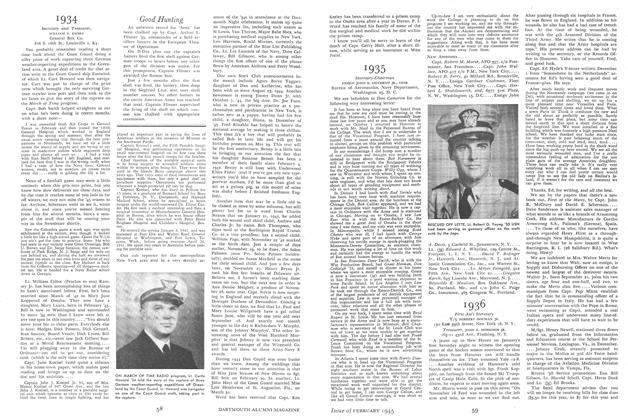
When two Army bombers collided over Spokane, Wash., last July and crashed in flames, '33 lost one of its ablest and most highly respected men. Captain Ford K. Sayre's death leaves a gap in the ranks of Dartmouth men and of the residents of Hanover that can never be filled. Ford brought to Hanover in 1929 a rare combination of qualities that quickly won the admiration not only of his classmates but of all who were privileged to know him. After graduation, first as director of Dartmouth-at-Moosilauke and, from 1936 on, as manager of The Hanover Inn, he played an increasingly important and prominent role in the affairs of the College. In the Air Forces he displayed the same versatility, initiative, and good judgment for which we had always known him. As an able servant of the College, as a leader in the community, and in the many activities in which he took such an active and distinguished part, as a man of great enterprise and rare personal charm, he lived a full life from which all of us gained much. To his wife, Peggy, and to his three children, Ford Jr., Margaret, and Robert, we extend our deepest sympathy.
We can report a good deal of activity on the '33 front in Hanover during the summer months. In July Frank Ripley took a day off from his busy life as manager of The Troy Blanket Mills to show us how the twentieth century prospector looks for mica. We took zoology instead of geology when we were in College so we can't vouch for Rip's story, but here it is: If you can believe Ripley, that plane ride to Hanover in his Stinson three-seater was a mica-prospecting trip. The idea is that Rip flies the plane kinda low in a valley and one mica expert looks out one side and the other mica expert looks out the other until they get to the June, then Rip comes down, hops a bus to Hanover to tell us about it while the other guys have a drink or something, and then they all fly low down valleys all the way home again. We'll admit the story isn't very convincing, especially if you've got the oldfashioned idea that mica is something buried in the ground somewhere that shaggy old men sometimes go grubbing around for with pickaxes; but Rip says it's so, and after a couple of Old-Fashioneds we were almost ready to believe it ourself. If true, prospecting twentieth-century style seems a good way to make a living; easy on the feet, and leaves a little time to visit with your friends.
Lt. John Aleck USNR also put in an appearance in July when, in the line of duty, he spent a couple of days checking up on some phase of the operation of the V-12 program here. Professors Foley, Messer, and Yours Truly had lunch with John one day and we brought along a copy of the G.I. bill of rights, hoping that John's distinguished legal talents could disentangle certain passages for us and he could tell us what they meant. His was a masterful performance. We all came away convinced that we knew about as well as the authors of the bill did what it meant, and that if that left something to be desired the fault was theirs, not ours. John is our candidate for the Supreme Court when the time rolls around again to pack it.
Early in August Lt. John Rockwell USNR brought us an eye-witness account of the ro-bombing of London, from which he had just returned to have a few patches put on his destroyer which had participated in the Invasion. When he went into the Service a couple of years ago John got a little schooling and then did convoy and patrol work in the Atlantic until he became navigating officer on the destroyer. A little later in August, Sam Black and his charming wife Jean spent a week of their vacation at the Inn. Sam, by the way, has been upped to the august position of secretary and general counsel of The Stanley Works in New Britain, Conn. Lt. Bob WatsonUSNR had a few days with his family in Hanover before reporting for duty in Florida, where he will be trained for service on LST's. Bob had a tough break early in his indoctrination course at Fort Schuyler when he suffered injuries to his back, which required an operation and a rather prolonged convalescence. He has recovered completely. Gordon F. Hull Jr. is returning to Hanover this month to assume his new duties as assistant professor of Physics. Gordon has been engaged in extremely interesting research in electronics, so he will bring to his teaching not only a splendid background of academic training but also invaluable research experience.
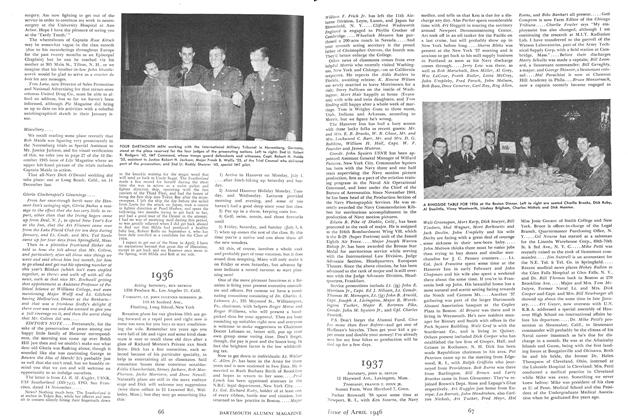
Lt. Page Worthington USMCR, according to recent reports, has completed several courses of training, received a promotion to first lieutenant, and been assigned to a Scout Bomber outfit as adjutant. The word is that he may be travelling before too long. Bill Jones recenly received his captaincy in the Army. Bill entered the Service in July, 1942. After induction he was sent to the Air Force Technical School at Miami Beach, after which he was assigned to one of the first Troop Carrier Wings to go overseas. He has served in England, North Africa, and is now in Italy.
A month or so ago we received a swell letter from Bob Sands, who has been in India with the Air Corps. He was in the hospital at the time he wrote, recovering from what he described as "a mild case of Malaria." He describes his Army career as follows: "My Army career covers a pe of two years now, a third of it spent overseas. I'm in the Air Corps, concerned primarily with problems of supply, for which I was trained at various stations in Texas and Florida. It has been an interesting and active line. My first assignment here in India was with the—Air Commando Force, and it provided many instances of considerable excitement. On several occasions I accompanied supplies into Burma and must admit that it was something of a thrill to realize that we were operating behind the Jap lines, contributing in a small way to the cause. This is basically the story. There were details of interest that have to be omitted, unfortunately, for security reasons,"
Lt. William J. Starr Jr. is another guy who has seen plenty of action since his graduation from indoctrination school at Harvard in the fall of 1942. He first served on an escort-carrier during the winter and spring, 1942-1943, at the height of the submarine campaign in the Atlantic. Transferred to a larger carrier in May, 1943, he has seen action in most of the major actions in the Pacific since that time. He was in the Gilberts invasion, then in the task-force attack on Nauru. He participated in three task-force attacks on Kavieng, the invasion of the Marshalls, both Eniwetok and Kwajalein, the first task-force attack on Truk, the first task-force attacks on Guam, Saipan, and Tinian, attacks on Palau, Yap, and Woleai, the invasion of Hollandia, and the second task-force attack on Truk. He was recently transferred to another ship.
Secretary, 20 Valley Rd., Hanover, N. H. Treasurer, 2812 Grant Bldg., Pittsburgh, Pa.