The Hanover Scene
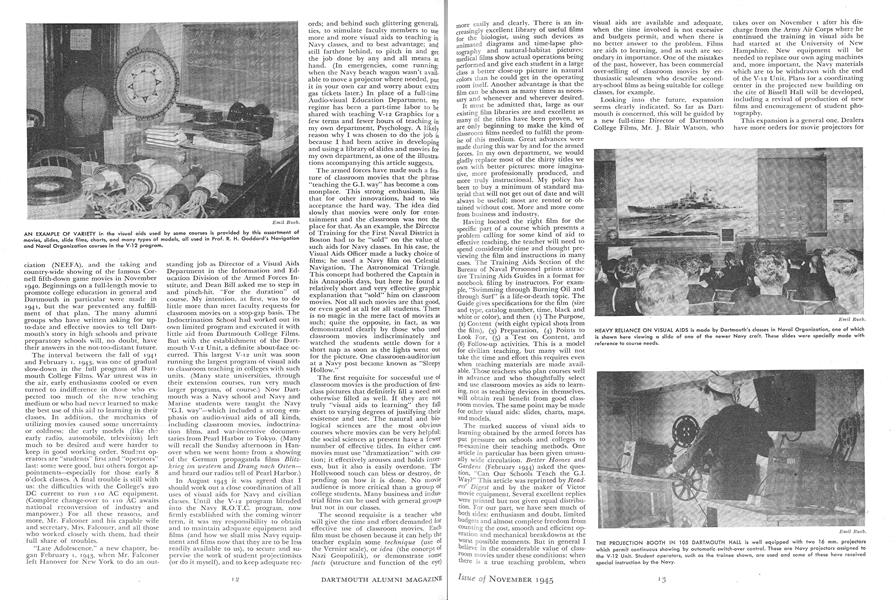
ON THIS MID-OCTOBER AFTERNOON copper leaves are swirling down from the campus elms. Students are scuffing their way across the green to final examinations in the gym, their spirits not exactly lifted by the noisy touch football games going on at the north and south ends of the campus among V-12ers and civilians who are either brighties or just lucky in their exam schedules. Over in front of Dartmouth Hall, the Department of Buildings and Grounds is represented in this fall scene by a group of workmen raking their way backwards down the slope, ahead of them a clean swath of green lawn, behind them and underfoot the growing heaps of leaves that will be gathered up in a burlap contraption and carted off to be burned. It looks like a good day for private leave-burning too. and that means something to look forward to—a walk home in the early dusk, pungent with the smoke of leaves burning in driveways and backyards, and lighted by an almost full moon coming up over Velvet Rocks at the incredible hour of 5:30, thanks to Eastern Standard Time.
The autumn foliage seems to have been highly successful this year, maybe because the end of gasoline rationing made it possible once more to drive into the countryside to see the multi-colored sights. More than in any recent year the alumni have been back in a steady stream, enjoying the bright fall weather and filling the Hanover Inn with cheerful bustle. Young men in uniform, their faces vaguely familiar, are met on Main Street, at football practice, or in the Ad Building where one and all repair to check up on the procedures for readmission to Dartmouth next term or in March. Faculty members, away for war service for a varying period of years, are also back in increasing numbers, their faces wearing expressions of contentment at being back in the academic environs of Hanover.
The tide has definitely turned. When the new term opens on November 5 the civilian College will be a great deal more like its normal self, in student life as well as in enrollment, and come March the resemblance to pre-war Dartmouth will be tremendously increased. A lot more students who knew Dartmouth before the war are a prime necessity if the continuity of tradition and undergraduate life is to be preserved, and it is heartening to know of the impending return of hundreds of veterans who will fill that need. At a football rally (now a rather aimless affair) or in such a detail as the rendition of Dartmouth's famous cheer (now given slowly and with an ungodly emphasis on the HOO in Wah-hoo-Wah) one is aware that this continuity in the student way of doing things has been broken by wartime circumstances and that only the return of former Dartmouth students in sizable numbers will restore it. Fortunately, that return began this term, will accelerate in November, and will be in full force from March on. When Dartmouth returns to its normal two-semester year next September, and the Class of 1950 matriculates all at once, we look for things to be thoroughly under control. Meanwhile, student cars are once more buzzing about town, thanks to a recent ruling by the Committee on Administration, and with the reopening of the Dartmouth fraternity chapters almost a certainty for the March term, the coming months will be filled with plans for rushing and pledging. There's even talk about getting The Dartmouth rolling again after another term or so, on the assumption that near-capacity enrollment in March will provide sufficient support and that increased campus activity will justify a daily paper.
The leaves may be falling and some bare and rather cheerless days may be directly ahead until snow brings a whole new season to the campus, but there are too many impending changes and events for anyone to worry overmuch about that short interval, which is good for the soul, anyway.
Topping everything in the near future, of course, is the start of President Dickey's administration on November 1. Coming only once in every two or three decades, such an event is stimulating enough in itself, but November will also usher in Dartmouth's new NROTC Unit and, yes sir, married veterans living with their wives in kitchenette suites in Middle Fayerweather. Squaws on the hallowed Dartmouth reservation, and right in the tepees of the braves, will be as real as anything you can think of, and by next issue we hope to have pictures to prove it. Having seen that series of advertisements entitled "Never Underestimate the Power of a Woman," we are not inclined to take this invasion lightly, as most undergraduates and some of our elderly colleagues are all set to do
(although we share their delight at the prospect); and we can only hope that there will be no Trojan Horse wheeled within what the press calls "the masculine stronghold of Dartmouth."
Even a Trojan Horse, however, might come in handy, in view of the local housing pinch which has Hanover ready to burst out of its stays. The influx of married veterans who naturally want to be with their wives has created an extraordinary problem of temporary nature, and the Committee on Student Residence has been taking positive steps to meet it. In addition to setting aside two dormitories for these couples, the College is providing apartments in four large houses in town, and the latest report, as we approach our deadline, is that forty small, temporary dwellings will be erected on the site of the Lebanon Street tennis courts, to be readv for the March term if humanly possible. Government aid is a prospect in connection with these small prefabricated houses, but construction cannot wait upon the arrival of definite word, so the College is moving commendably ahead to meet the need. Developments such as these indicate the interestingly difficult nature of the College's reconversion period. By the time the leaves fall again, the problems should be clearer and the situation more tightly under control. No one could ask for a more exciting and challenging year than the one coming up.