"THE LOOSE-ENDERS"
Dartmouth's Roving Professors a Unique Teaching Group
OVER A CENTURY AGO, Ralph Waldo Emerson traveled two days by stage from Cambridge to address the Literary Societies of Dartmouth College. His address anticipated with a good deal of academic commotion in Hanover, because he had established himself as a radical in education the year before, when on August 31, 1837, he gave his famous address, "The American Scholar," at Cambridge.
At Dartmouth, Emerson amplified the same revoluntionary message: "When he (the scholar) comprehends his duties, he above all men is a realist and converses with things. For the scholar is the student of the world; and of what worth the world is, and with what emphasis it accosts the soul of man, such is the worth, such is the call of the scholar."
Emerson, if he could have his way, would have a man be both thinker and doer, teacher and scholar; and it is the impression of these as reciprocal processes that is most vivid to anyone visiting today six comparatively recent enterprises at Dartmouth College: Robert Frost's seminar in Baker Library; Virgil Poling's Student Workshop in Bissell Hall; Ray Nash's Graphic Arts Workshop in the basement of Baker; Douglas Wade's natural history headquarters in the old Dragon tomb; Ross McKenney's D.O.C. Hobby Workshop in Bissell; or Paul Sample's studio on the top floor of Carpenter. Together, these six "roving professors" offer outside of the more routine curriculum an educational opportunity unique among American colleges, and one designed to give to Dartmouth undergraduates avocational interests which they can take away from Hanover and endlessly develop to the great enrichment of their lives.
That Emerson's words are being taken m a literal sense, now, at Dartmouth, makes his speech in Hanover, which was considered by Thomas Carlyle his "nobest utterance," perhaps more contemporary today than when it was given:
Go into the forest, you shall find all new and undiscovered .... the man who stands on the seashore or who rambles in the woods, seems to be the first man that ever stood on the shore, or entered a grove, his sensations and his world are so novel and strange .... when I see the day break, I am not reminded of Homeric pictures But I feel, perhaps, the pain an alien world; a world not yet subdued by the thought "
It is to the seeking individual man, to whom the world is "not yet subdued to the thought," who wishes to find out and to achieve for himself, that the College has offered these opportunities which at first seem very different from each other, but which have actually more points of similarity than difference. That they answered a fundamental need has been shown by the immediate, and sometimes almost overwhelming, response of the students.
ROBERT FROST has been Ticknor Fellow in the Humanities and Dartmouth's poet-in-residence since October 1, 1943. His seminar is limited to fifteen boys who meet with him three evenings a week in the fall and spring, and also have individual conferences. "When I am gone, during the winter months," Frost said with a not very fierce look, "I leave them with a little burden, something to do. That's because it's easier to punish them than to hold them entirely with charm."
He spoke of his seminar at Dartmouth between interviews with students hoping to enroll in it—many more than it is possible for him to accept. On one wall of his study ("Don't call this my office—it's too nice") is Paul Sample's painting of Beaver Meadow. There is a desk, a bookcase and many comfortable chairs.
Frost's black and white collie dog Gillie seems to know his master's "study hours," for he was settled down to wait. The November twilight had come early, but without the rebuff of lights being suddenly switched on; Frost sat with the quietness of the country man who is in no hurry to end the day by getting up to light the lamps.
He said, "I think my course is a sort of admission that there is always something that is left over from the routine, that has to be accounted for—call it the loose ends. Routine is more restful, it keeps us busy and quiet, but someone must pick up the loose ends. In fact, I think that is what you might call all of us fellows who teach off the routine—the Loose-Enders. That's it, the Loose-Enders." He said this word as if the sound of it pleased him, and the matter was settled.
"The thing that we Loose-Enders have in common—that's what you're after, isn't it, what we have in common?—is that we are interested in achievement. We point out, or remind the boys of it—we can't do more at that age than remind them—that something must be done with all these acres of land, these books: not repetition or marks or another person's work. A teacher is paid, partly, to be nice. Life isn't.
"At the age of these boys the idea of writing should be a secret thing, like a love affair. Of course some of them will agonize out loud and you try to help them. But the thought of writing should be exciting and secret when you are young. I encourage my students to write if they want to, and in order to see what it means to accomplish a piece of writing, and that helps them to understand how to read. In that way I hope to get them past the frustration and suffering of so many who, as they grow older, say, 'I should have written.' There are too many of these sad people.
There was an interruption as a student knocked at the door and asked about his chances of getting into Frost's course. "That would have made sixteen," Frost said as he returned. "How does a man know who to turn away? When I first started to teach, I had a class of ten who were required to have had two years of English. But they also let me have two 'long shots' who had never had any English. Of course, the long shots usually turned out pretty well—sometimes best." As he said this, Robert Frost had a lively glint in his eye which seemed to say he almost wished there were more people around to hear this heresy. He patted his dog, and sat down again.
"I was talking about my course," he said. "As we live we try to see the truth, and to hear the sound of it, too. For the writer the truth comes at different times. It may be suddenly, when he is brushing a fly off his nose; while he is reading or talking or doing nothing. A word or thought will send his mind off in a new direction. A writer lives under a spell, and he writes under it.
"A person may pick up a book in three different ways. The general reader, if the writer has done a good job of casting the spell, sinks right under and stays there. Then there is the critic or scholar, who reads for a mental analysis of the writer's methods, or for information. Then there is a third kind of reader, who knows the spell of the writer, who feels it (it may be quick, sharp—or perhaps lingering, like an echo)—this reader sees how it happens. He is the kind of reader I hope to help.
"Some will say that we Loose-Enders claim that if a man uses his hands, he will be a happier person. Or if he observes nature. Or if he paints a picture. Or chops wood. I myself am one of those fellows who belong to the observer's school:—to carve, to paint, to chop wood—they're all nice things to do. I like them. But a man can live in books all his years, never stir from his room, and still live a free, lively sort of life. Collins was a poet so literary, so unobserving, that you couldn't believe he would write a poem that would live, but he did.
"Avocations are fine; apprenticeship for a trade is an important matter. Education, which began as a study of words and numbers and still, with all its elaborations goes back to that, is another. But achievement, performance—that belongs somewhere else. Perhaps the difference between achievement and repetition can be compared to that between a living and a dead language. A living language belongs to gestures, to accent and tone. At a knock on the door you say, 'Come in!' That belongs to two people, to the one who speaks and the one who hears. A printed sign is like the dead language—'Come in.'
"Someone once asked me to say who I considered closest to a poet on a college faculty, and I answered that it was the athlete. He competes, using only his own skill and strength; he wins or loses; and there is the question of fame."
More students had come to see Frost and were waiting for him in the hall outside. But before he left, Robert Frost said quickly and almost shyly, "You see I circle around a good deal when I talk—that's my way. But I think I am only saying a few things in different ways. Perhaps I am only saying one thing: To be able to read a book in the spirit of the writer who creates—that seems to me to be one of life's great achievements."
Anyone who hears Robert Frost talk comes to look for the deep meanings of some of the words he speaks lightly, and the lightness he gives some of the solemn ones: his wise great love of words. But perhaps it is the privilege of his students to know best the implications of his poem The Woodpile. A man "just far from home" comes upon an abandoned wood pile in a half-cleared swampy place.
It was a cord of maple, cut and split And piled—and measured, four by four by eight.
And not another like it could X see. No runner tracks in this year's snow looped
near it. And it was older sure than this year's cutting, Or even last year's or the year's before. The wood was grey and the bark warping oil it
And the pile somewhat sunken. Clematis Had wound strings round and round it like a bundle.
What held it though on one side was a tree Still_growing, and on one a stake and prop, These latter about to tall. I thought that only Someone who lived in turning to fresh tasks Could so forget his handiwork on which He spent himself, the labour of his axe, And leave it there far from a useful fireplac To warm the frozen swamp as best it could With the slow smokeless burning of decay.
I N the days of Eleazar Wheelock, manual X work by the students was a required art of the curriculum. The undergraduates were forbidden "at any time to speak diminutively of the practice of labor or by any means to cast contempt upon it by words or action." More than one man was expelled from college because he refused to do his chores. The very existence of the institution at one time depended upon the undergraduate's contribution of manual work.
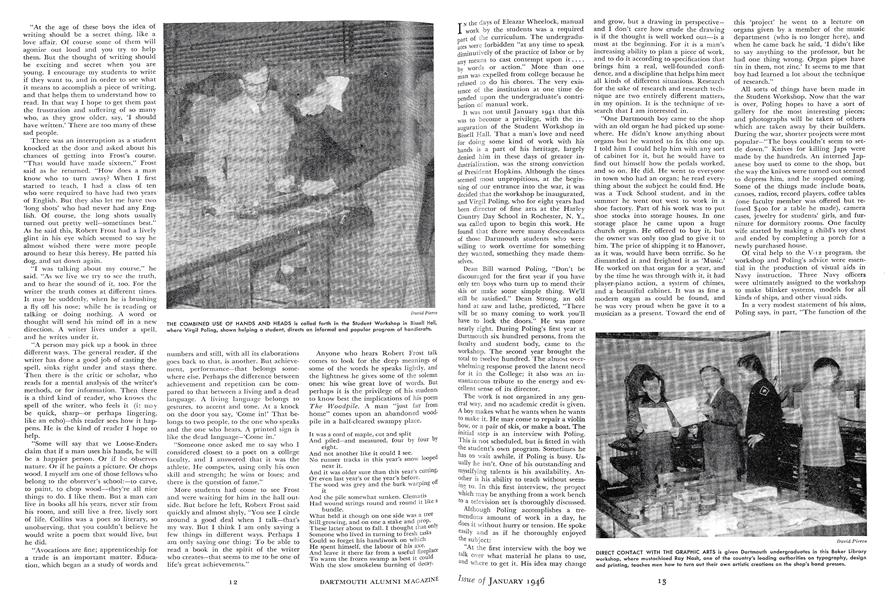
It was not until January 1941 that this was to become a privilege, with the inauguration of the Student Workshop in Bissell Hall. That a man's love and need for doing some kind of work with his hands is a part of his heritage, largely denied him in these days of greater industrialization, was the strong conviction of President Hopkins. Although the times seemed most unpropitious, at the beginning of our entrance into the war, it was decided that the workshop be inaugurated, and Virgil Poling, who for eight years had been director of fine arts at the Harley Country Day School in Rochester, N. Y., was called upon to begin this work. He found that there were many descendants of those Dartmouth students who were willing to work overtime for something they wanted, something they made themselves.
Dean Bill warned Poling, "Don't be discouraged for the first year if you have only ten boys who turn up to mend their skis or make some simple thing. We'll still be satisfied." Dean Strong, an old hand at saw and lathe, predicted, "There will be so many coming to work you'll have to lock the doors." He was more nearly right. During Poling's first year at Dartmouth six hundred persons, from the faculty and student body, came to the workshop. The second year brought the total to twelve hundred. The almost overwhelming response proved the latent need for it in the College; it also was an instantaneous tribute to the energy and excellent sense of its director.
The work is not organized in any general way, and no academic credit is given. A boy makes what he wants when he wants to make it. He may come to repair a violin bow, or a pair of skis, or make a boat. The initial step is an interview with Poling. This is not scheduled, but is fitted in with the student's own program. Sometimes he has to wait awhile, if Poling is busy. Usually he isn't. One of his outstanding and mystifying talents is his availability. Another is his ability to teach without seemig to. In this first interview, the project which may be anything from a work bench to a television set is thoroughly discussed.
Although Poling accomplishes a tremendous amount of work in a day, he does it without hurry or tension. He spoke easily and as if he thoroughly enjoyed the subject:
At the first interview with the boy we talk over what material he plans to use, and where to get it. His idea may change and grow, but a drawing in perspective and I don't care how crude the drawing is if the thought is well worked out—is a must at the beginning. For it is a man's increasing ability to plan a piece of work, and to do it according to specification that brings him a real, well-founded confidence, and a discipline that helps him meet all kinds of different situations. Research for the sake of research and research technique are two entirely different matters, in my opinion. It is tire technique of research that I am interested in.
"One Dartmouth boy came to the shop with an old organ he had picked up somewhere. He didn't know anything about organs but he wanted to fix this one up. I told him I could help him with any sort of cabinet for it, but he would have to find out himself how the pedals worked, and so on. He did. He went to everyone in town who had an organ; he read everything about the subject he could find. He was a Tuck School student, and in the summer he went out west to work in a shoe factory. Part of his work was to put shoe stocks into storage houses. In one storage place he came upon a huge church organ. He offered to buy it, but the owner was only too glad to give it to him. The price of shipping it to Hanover, as it was, would have been terrific. So he dismantled it and freighted it as 'Music.' He worked on that organ for a year, and by the time he was through with it, it had player-piano action, a system of chimes, and a beautiful cabinet. It was as fine a modern organ as could be found, and he was very proud when he gave it to a musician as a present. Toward the end of this 'project' he went to a lecture on organs given by a member of the music department (who is no longer here), and when he came back he said, 'I didn't like to say anything to the professor, but he had one thing wrong. Organ pipes have tin in them, not zinc.' It seems to me that boy had learned a lot about the technique of research."
All sorts of things have been made in the Student Workshop. Now that the war is over, Poling hopes to have a sort of gallery for the most interesting pieces; and photographs will be taken of others which are taken away by their builders. During the war, shorter projects were most popular—"The boys couldn't seem to settle down." Knives for killing Japs were made by the hundreds. An interned Japanese boy used to come to the shop, but the way the knives were turned out seemed to depress him, and he stopped coming. Some of the things made include boats, canoes, radios, record players, coffee tables (one faculty member was offered but refused $400 for a table he made), camera cases, jewelry for students' girls, and furniture for dormitory rooms. One faculty wife started by making a child's toy chest and ended by completing a porch for a newly purchased house.
Of vital help to the V-12 program, the workshop and Poling's advice were essential in the production of visual aids in Navy instruction. Three Navy officers were ultimately assigned to the workshop to make blinker systems, models for all kinds of ships, and other visual aids.
In a very modest statement of his aims, Poling says, in part, "The function of the Student Workshop is to offer to the students and officers of the Coilege an opportunity to work with their hands .... to develop and coordinate the skills of mind and hand for the satisfaction to the individual and his increased ability to plan and execute .... to influence the student to discover for himself the satisfaction of good work habits, through which he will be increasingly able to visualize the necessary steps between the initial problem and its successful conclusion .... to learn the use of hand tools as well as power tools
to aid the student in the evaluation of himself."
John Stearns, of the Classics Department, who is a worker in the shop, found what he called a description of Poling's endeavors, written by a Greek poet over 2,000 years ago, and sent it in: "There is no sweeter solace for a man's ills in life than Craftmanship; our mind, immersed in this pursuit, sails like a ship straight past its troubles and forgets them."
BAKER LIBRARY, since its completion has been a center for many different phases of college life. One of the earliest activities developed there, which has had steadily increasing prestige and interest, .is Ray Nash's course and workshop, devoted to the Graphic Arts. When Ray Nash, now an assistant professor in the Art Department, came to Dartmouth in February 1937, he was well known as an authority on calligraphy, and as a leading American typographer, designer and printer. His Graphic Arts Workshop has been a pioneer model for enterprises of this kind, and many other colleges have created workshops along the lines of the one at Dartmouth. It is essentially the laboratory for art 58, the art of the book, where members of the class each week spend two hours, supplementing the two hour lectures in this regular three hour course.
The human impulse to draw pictures, make letters, and represent meanings in symbols is so near the reflex level, much as speech is, that it can only be salvaged by presenting the student with a fresh and individualized approach. Some students learn best through the eye; others by hearing or touch. In Nash's course, which consists of two hours of lecture, two of shop a week, the boys become familiar with a craftsman's materials by handling them, studying, and using them. Nash's first task, which is seldom realized by the student, is finding out what the boy most wants to do.
"Sometimes you must go a long way back to find a motivation," he said, "but I have never found a case where it didn't exist. One boy said he wasn't interested in anything, and I was beginning to believe him, when I came upon the discovery that he was very proud of his family. He finally planned and printed a very fine design for a poster, to be put on an ancestral cobbler's bench, explaining its history. I saw him enthusiastic for the first time; and he had learned a lot as he went along. And he was the sort of boy, who, once he discovered the fascination of bookish things, would not give them up.
"The more ramifications that result from a project the better. For the boys who say, 'I can't draw a straight line' (Who can, for that matter?) we have developed a Dartmouth Alphabet. The boys go to the old cemeteries around here, get rubbings of letters of different periods, and bring them back to the shop. They make an alphabet on wood, and in the doing, learn the forms painlessly, get a knowledge of design, and some of the history of this part of the country. They discover the names of local stonecutters, and look them up in the College Archives. By means of this kind of project, we have obtained an interesting collection of local designs and names."
In Professor Nash's course there is considerable reading of authorities, (he has in his study adjoining the seminar room a personal collection of books in the fields of bibliography, calligraphy, typography and print making which his students use freely).
Once a student is embarked upon a project, the problem often becomes one of how to stop him, or at least slow him down. That the Graphic Arts Workshop brings out student independence and initiative has been proved repeatedly. At the time of the 1938 hurricane the editors of The Dartmouth, who had done work in the shop, came at once to the hand press and printed a Dartmouth which has become a collector's item around Hanover.
The College Publications Committee, which has charge of all official bulletins, posters, pamphlets, and books, works under Ray Nash's expert counsel. Students, at one stage or another, have a hand in the planning, and often in the actual carrying out, of these publications. The record of student work in the Graphic Arts Shop is as varied as the personalities of the boys, and is of a high degree of excellence. At the present time, an undergraduate who will go into the railroad business, is planning and printing a timetable. Another is reproducing a poem of Robert Frost's for a friend. Another is at work on a calligraphy project. When Ray Nash was called upon to devise a new timetable for the Boston and Maine, for which he is typographical consultant, students made plans and suggestions for this timetable which has subsequently won fame because it is so easy to read and understand.
Most of the students who have had the concrete rewards and pleasures of this kind of work return to it later, either as part of their profession, or for pleasure. No one relinquishes easily something he has come to love, and the craftsmans pleasure is of the heart as well as the hand In Ray Nash's description of the Graphic Arts workshop, written for Print, of which he is associate editor, he describes a student worker:
"He will cut designs with a knife on a plank of pine or pear, engrave them on the end grain of boxwood, trace or scratch them on copper, dash them on lithographic stone. He prints his woodblock and type on the relief press, intaglio plates on the rolling press, lithograph on a planographic press. Each experience yields an entirely fresh orientation toward graphic arts as a whole, and the artists who pursued these different media. By direct contact he becomes to some degree infected by the excitement.... the graphic artist has for the stuff he works in and is inspired by."
FOR many years the land, given to the College in the form of grants by New Hampshire, was its sole endowment and outside source of income.
Today the Dartmouth undergraduate depends upon this college estate of for- ets, mountains and rivers for recreation, and, increasingly, for learning. The activi- ties of Doug Wade, the College Natural- ists, are limited only by the top of Moosi- lauke, the breadth of the college acres and the interest of the students.
Dean Bill once said, "Since the Dart- mouth man costs the College a good deal more than he pays in tuition, I thought he should be even more expensive; worth even more to himself and the world; and Mr. Hopkins abetted me in this idea."
Doug Wade, who answered Dean Bill's summons in May 1943, came from the University of Missouri, where he was an instructor in Wildlife Management, Mammology, and Living in the Outdoors. For two years he studied trapping activities for the Game Commission in Pennsylvania. He is now chairman of the New Hampshire Recreation Council and editor and secretary of the Audubon Society of New Hampshire, as well as treasurer of the Wildlife Society. Since coming to Hanover he has become a vital link between Dartmouth-Indoors and Dartmouth- Outdoors. His work, like that of Robert Frost, Virgil Poling, Ross McKenney and Paul Sample is directed solely to the student who comes to work on a voluntary basis.
In the roomy and attractive office at 11 College Street, an undergraduate naturalist can pursue almost any kind of subject related to outdoor living. There is an excellent library of magazines and books, opportunities for, and exhibits of, student photography; game and trail and forest conservation maps. Students keep an extensive up-to-date file on birds and on local plants, to which the Hanover community is an active contributor. But the student's interest, while it may be pursued here, originates outdoors, and the fields, and hills—the beautiful and varied country around Hanover—make up Wade's Workshop.
Once a boy goes out hunting in the fall and, because he has been trained to do this, looks for deer tracks in fields on the edge of young forests, rather than in the wilderness—for deer like best the forestedge where there are cleared lands, with apple trees—this student will not be content ever to hunt as the average sportsman does. The Dartmouth man who studies the progress of human habitation about Hanover sees how the ways of wildlife reflect it; how in the abandoned upper pastures, now covered by second and thirdgrowth forests, many animals that once belonged there are missing, and others are returning, such as wildcats and bear. He knows that the hurricane opened up large areas for wood thrushes, grosbeaks and white-throated sparrows: that spruce partridges will be found in the sub-arctic conditions which are duplicated on the slopes of Moosilauke. In the country south of Hanover, around Cornish, he knows he is apt to find more cottontail rabbits and ring-necked pheasants. Along the lowlands near the river, he looks for beaver, mink, muskrats, weasels, red fox, and deer.
But it is Doug Wade's conviction that even more than the pleasure this hunter may get through a greater knowledge, will be his reward in observing and taking part in a drama, the ever-changing connection between man and nature. Perhaps one of Wade's young naturalists goes to Clark's Pond. There he will see an example of this contest; where the beavers wanted to build a dam and flood out a lake preempted by man. "Doc" Griggs, although he didn't want to. ripped out the beaver dam near his cabir., since it was gradually flooding his property. Or as these students (there are at present about sixty of them) become interested in conservation programs, they observe how it works in nature; how man-abandoned fields are replanted by foxes and skunks that eat fruit and berries, and how the extermination of these animals would be harmful. A row of young cedars along a farmer's fence means that they were planted by birds that eat cedar seeds. These students discover that there are a great many misconceptions on the subject of pests and predatory animals. A pest one year may be a benefactor another; and man when he upsets Nature, does violence to his own interests.
One of Wade's most enthusiastic pupils is Dean Bill, who believes that for peace of mind and for life-long interest there is no more worthwhile study than the one Wade encourages. Very few weeks go by without Wade's receiving some query, like this, from Dean Bill:
"Dear Doug: If you feel like a hit of research, I wish you would discover the species of largish bird that for several weeks has been squawking raucously, almost continuously, night and day, up around Occom Ridge."
"Dear Doug: To my great delight that white-throated sparrow is still at my feeding station. I am quite sure that he has not missed a day all winter. Probably this experience will cause him to sing, 'Oh Hanover! Hanover! Hanover!' "
Much of what Wade hopes to do lies in the future. He would like to see a college greenhouse for the amateur putterer who likes to work with the soil and who will later enjoy his own garden. He would also like to see a laboratory houseboat on the river, for use in the summer by students interested in the study of bird, plant, fish and game life along the river banks. He believes also that there is a unique opportunity for an observation station on Moosilauke where sub-arctic conditions offer unusual advantages for study.
Because it is hard to make Doug Wade talk about his own accomplishments, it was necessary to go to John Rand, graduate manager of the Outing Club, to find out the many helpful contributions Wade has freely made to the D.0.C., in both work and advice. He goes on many of their weekend trips. He is faculty adviser to the executive committee, an officer chosen by the undergraduates, and also is on the board of trustees of the Outing Club.
With the end of the war, the D.O.C. hopes to take an active part in state conservation programs. A knowledge of how to cut forest land, with the maximum advantages of clearing, and incentive to game, is a science, the knowledge of which is of great help to D.O.C. workers who are planning new trails and opening up areas with the idea of greater advantages for recreation and hunting, as well as convenience. As John Rand says, "We don't want to cut trails, as we used to, just because they are the shortest way between two points."
With Doug Wade's coming to the College, a new conception of the way of looking at nature, of using it to maximum advantage, and of understanding both its beauty and its relationship to man, has been brought to Dartmouth and the community of Hanover.
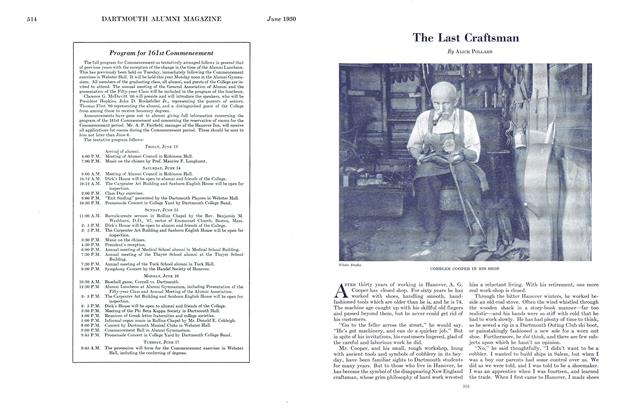
Ross MCKENNEY, Dartmouth's woodsman-at-large, came to the College six years ago, through the influence of an alumnus. McKenney was told that he was a free lance, and could do anything he wanted in the way of interesting men in outdoor life and in encouraging them to make things with their hands. He has made an outstanding success of both.
His father was a guide in northern Maine, and McKenney himself has been a woodsman since he was nine years old. At that age, he went out alone into the woods and shot three bears. His gun jammed on the third, as the mother bear charged him, and he barely killed her before she. got him. When he was safe he threw down his gun and ran. He learned early and lastingly the advice he gives Dartmouth men: "Don't lose your head in the woods. When you do you've lost the most valuable part of your equipment.
From the age of thirteen to sixteen he cooked for a railroad survey crew north of Moosehead Lake, and was in charge of both cooking and packing all the food. After that he "followed the woods"; was a lumberjack, a trapper and guide. He has the distinction of being the first president of the Maine Guides Association, which has served as a model for other states.
He has been on a trap line for as long as five months at a time. He says, "A man alone in the woods first has to become used to the silence. He learns to ignore it, or in some way, absorb it. But he has to keep busy. And if he gets a great longing for something, say like company or music, it is better for him to give in, or it can destroy him. I have packed up and traveled forty miles to hear music."
McKenney has known "a lot of Indians, mostly Penobscot," and has learned much of their knowledge of the woods, which he teaches the Dartmouth boys he works with. "Indians know what is real. They have a true sense of the sun, the winds, and the forest. But they have a feeling for revenge that I think could never be bred out of them. I try to teach the boys the lessons they can learn from animals—they play fairer than men. When an animal is licked in a fight, he goes off; he doesn't come sneaking back to get even. I try to get the boys to understand the language of animals and birds—when they are frightened, in pain or angry. They can be sentinels in the woods."
McKenney, on trips to the Dartmouth Grant, shows his followers—he sometimes takes as many as eighteen at a time—how to cook with or without dishes in the woods; how to keep warm outdoors without blankets in 20-below weather; how to find their way in strange country. He says, "A man is lost when he becomes afraid. He loses his sense of direction only when fear comes in."
Although no college credit is given for any of McKenney's work, he has planned a course, which usually covers two years, for "Dartmouth New Hampshire Junior Guides"; and a pin is given to those who complete it. This course is both thorough and arduous; it includes woodsmanship, fire fighting, first aid, life saving, camping, map reading, cooking, forest conservation and other subjects. The boy has to answer questionnaires which are presented to the State Forestry Board and the Fish and Game Commission. If he passes satisfactorily, he is given the pin which permits him to go into closed forest and game areas. So far, about fifty pins have been issued. McKenney considers forest-fire fighting very important and has actively cooperated in this with the State.
It is only through visiting McKenneys D.O.C. Hobby Workshop, where so strong is the spirit of outdoors that you would hardly be surprised at finding a bear making himself a pair of snowshoes, that the full extent of McKenney's imagination ana ingenuity is brought home. As he says, We make about anything we have a mind to.
A large number have a mind to make snowshoes. First the boy goes out into the woods—near Moose Mountain is a goo place—and cuts down an ash tree. This is split into fourths, then strips are made, an steamed, so that they can be shaped around a form. Cross pieces for toe and heel are similarly made. Natural rawhide, which has been soaked in water is used for the mesh. This is dried for two weeks, on the frame, then given two or three coats of varnish. A trail shoe has a narrow tail that acts like a rudder, but to McKenney's way of thinking, the broader and stubbier "bear paw" is the best all-round type of snowshoe.
Paddles are also a popular product. Again, like John Ledyard, the boy goes out into the woods and cuts himself a tree. Mc- Kenney advises following an Indian custom here-that the paddle, after having been completed as far as the sandpaper stage be "buried in muck, good muck and water," for two months. Then it will not warp.
Pack boards and pack baskets, toboggans, all kinds of flies for fly fishing, belts, moccasins, knives, saws and axe handles are some of the current projects. Of great interest is a "first aid toboggan," which will ultimately be used on isolated ski trails. It is now being built in miniature. It is made with a removable stretcher, so constructed that jolts and jars of rough trails are reduced to a minimum. There is a steering device and a place for a companion (and for his skis) to ride beside the victim, who, according to his injury, can be placed in any position. When constructed in aluminum, as is now planned, the entire toboggan will weigh no more than ninety pounds.
Ross McKenney is not trammeled by tradition, and he can convey, to anything that has use, a sort of natural appearance and suitability. As he sits at the wheel of his most recent woods-going acquisition, an Army command car—the better to scale the hills with—in his coonskin cap, and his checkered woodsman's shirt, he looks practical, cheerful, and equally ready for enjoyment or emergency—whatever comes.
BEFORE he came to Dartmouth as Artistin-Residence in 1938, Paul Sample once wrote in the ALUMNI MAGAZINE, 'An artist's contribution should result from, as it were, the orderly flowering of his plan of life."
Sample's own life and work are the best exemplifications of this belief. He practices his conviction that "a painter is a craftsman, and he works a ten-hour rather then a six-hour day." As a result, since he has been at Dartmouth he has not only produced a great number of paintings, which have won many honors, prizes, and places in leading galleries, but he is on hand to teach and to help any Dartmouth student, from the beginner's stage on, who wants to paint, draw or model in clay. The students can follow Sample's paintings from the preliminary sketches to the final result, and are free to discuss the process with him.
Paul Sample came to Dartmouth from the University of Southern California, where he had been teaching since 1936. He had a good many professional students there, and one of the things he likes best at Dartmouth is teaching boys who paint for the love of it.
Tuesday afternoons are devoted to a group of students, varying from ten to twenty in number, who go outdoors to sketch or paint, or, in the winter, work from still life. Once a week for two hours in the evening, Sample conducts a life class.
One class was visited on a changeful, typical Hanover day in November. After about an hour and a half outdoors, the group, including some civilians, some V-12 students, returned from a chilly spot on the river bank, with their sketches, roughly made, and with the colors written in. One V-12 boy ruefully surveying his sketch, said, "It's tough to make a still life that's interesting, but when you're trying to do a landscape, it's some job to decide what to leave out!"
Sample had made his own sketch, along with the others. Back in the studio, he went from one student to another, explaining and suggesting: "This was a good day to get the river, because the light was changing. There were both blue sky and gray clouds. Try this to bring out the dark hills —and the contrast of the lighter places with snow."
To one boy who had stayed in the studio to work he said, "Have you tried doing any barns yet? They're good to paint. There's a fine one to try on the Stone farm, as you come into Hanover on the West Lebanon Road." In all of these suggestions there was ease and informality, but a great deal of seriousness, which the boys themselves reflected.
The same evening there was a life class with a student model. The class sketched poses which varied in duration from half a minute to forty-five minutes. During rest periods the model descended from the platform to have a cigarette and to see how his companions had treated him. It was also in the intermissions between poses that Sample talked, and illustrated with sketches the lessons in anatomy, structure and motion that the poses revealed. The rest of the time Sample sketched along with the class. In this group, too, one was struck by the combination of ease and seriousness with which the students worked.
Paul Sample has received many letters from students he has taught. "They write asking me about all sorts of things, materials, and so on. One man, Charles Geer, painted all through the war. We'll have an exhibition in Carpenter later of his work. I believe that an artist necessarily matures later than college age. I don't expect great technique in college, or artistic maturity. That comes later. The boys I am in contact with are from excellent backgrounds for the arts. They are an interesting group to deal with. There should be some good artists among them."
When Sample has completed one of his paintings, he has sometimes had "Open House," when the students drop in to see the finished thing, and to discuss its progress from the first sketches on. Sample said, with characteristic modesty, "I have been impressed by the interest." He believes that an artist inevitably reflects his surroundings, and the paintings which he has completed in Hanover show his own great capacity as an artist, and his outstanding qualities as a craftsman. Some of the best known paintings are "Will Bond" "Church Supper," "Beaver Meadow" "Road over the Mountain," "Norwich Holiday," "Matthew 6:19" (the Country Auction), "Band Concert," "Dartmouth Row." One of Sample's paintings, "The River" hangs in the White House; and another, "Janitor's Holiday," is in the New York Metropolitan Museum.
When asked what sort of subject he liked best to paint, Paul Sample made no direct answer. Instead he got down an album containing reproductions of some of his work and looked through it carefully. Then he said, "I seem to like to paint landscapes—but a landscape without people in it is a lonely sort of thing. I seem generally to put people in—and show them resting or working, or whatever it is that people do."
Though many of his students will not become artists, those who have worked with Paul Sample do not forget what it means to be one. They have experienced some of the industry, humility and love of that calling. Nor, in his work as a teacher, does Sample overlook his own conviction, which he expressed in these words:
"Most painters of any importance have taught, and have liked to do so. They have considered it part of their routine and have felt rightly that the contact with young talents is valuable to master as well as students."
While Ralph Waldo Emerson could not have imagined an atomic age, his words to scholars have a startling prophetic note: "Some fetish of government.... or war, or man, is cried up by half mankind and cried down by the other half, as if all depended on this particular up or down Let him (the scholar) not quit his belief that a popgun is a popgun, though the ancient and honorable of the earth affirm it to be the crack of doom
"In self-trust all the virtues are comprehended Is it not the chief disgrace in the world, not to be an unit;—not to be reckoned one character—not to yield that peculiar fruit which each man was created to bear Please God, ours shall not be so. We will walk on our own feet; we will work with our own hands; we will speak our own minds."
Dartmouth achieving these aims, recalls once more, in a complex and dangerous age, her living motto, Vox clamantis indeserto.
IN HIS BAKER LIBRARY STUDY, Robert Frost '96, George Ticknor Fellow in the Humanities, meets with some of the Dartmouth undergraduates who have the rare privilege of discussing almost any topic under the sun, but especially writing and literature, with America's foremost living man of letters.
THE COMBINED USE OF HANDS AND HEADS is called forth in the Student Workshop in Bissell Hall, where Virgil Poling, shown helping a student, directs an informal and popular program of handicrafts.
DIRECT CONTACT WITH THE GRAPHIC ARTS is given Dartmouth undergraduates in this Baker Library workshop, where mustachioed Ray Nash, one of the country's leading authorities on typography, design and printing, teaches men how to turn out their own artistic creations on the shop's hand presses.
WITH THE WHOLE NORTH COUNTRY AS HIS WORKSHOP, Douglas Wade, College Naturalist, directs a year-round program for the benefit of students interested in the natural life of the region. Occasionally he and his enthusiastic followers are caught indoors (as above) studying maps in their headquarters in the old Dragon Tomb.
ANOTHER INDOOR SPOT WITH AN OUTDOOR FLAVOR is the D.O.C. Hobby Shop in Bissell Hall, where Ross McKenney, woodsman extraordinary, helps Dartmouth men make "whatever they have a mind to." Snowshoes are still a popular item and Ross knows how to make them, as shown in this picture taken early in the shop's history.
WATCHING THE MASTER AT WORK is an added opportunity for the student artists who take part in the informal classes conducted by Paul Sample '20, Dartmouth's noted Artist-in-Residence. Here, in his Car- penter Hall studio. Sample is shown finishing an oil painting of New York's Central Park Zoo.
CLASS NOTES EDITOR