With the Faculty
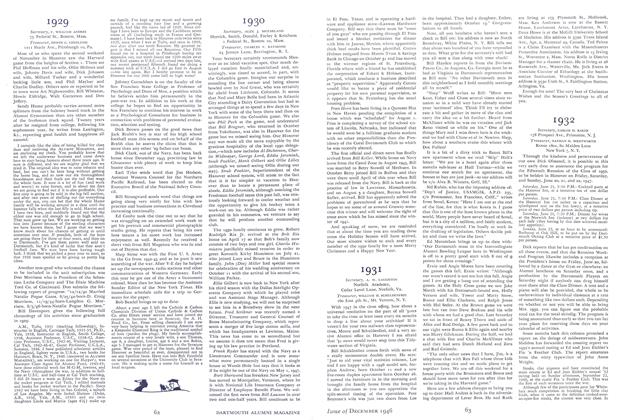
JOHN W. FINCH, Assistant Professor of English, is the author of a play, TheWanhope Building, which is scheduled to be produced on Broadway in January or February. It has been accepted by Theater, Inc., for production in the experimental theater program which supplements its more orthodox producing efforts. The latter help finance the experimental plays put on by Theater, Inc., which last season brought The Old Vic company from England for a notable Broadway run.
Professor Finch describes The WanhopeBuilding as a fantastic play, with a symbolic title. It deals with the future and provides roles for 29 characters. In genre the play is somewhat like the highly successful The Skin of Our Teeth.
Professor Finch, graduate of Wesley an in 1933, joined the Dartmouth faculty in 1939 after five years of teaching at Harvard, where he took his Master's degree in English and completed the course and residence requirements for a Ph.D. in American Civilization. His special interests are in the field of American literature and he has for some years been studying Hawthorne and Henry James. During the war, Professor Finch served two combat tours in the Pacific as Naval air combat intelligence officer, the first with a land-based fighter squadron in the Solomons, Bougainville and Green Island, and the second aboard the aircraft carrier Yorktown off Formosa, Iwo Jima, Tokio, and Okinawa.
HERBERT R. SENSENIG '28, Assistant Professor of German, came back to Dartmouth from wartime service with more interesting and timely news in his head than almost any other faculty member only what he had been up to was top secret and he couldn't talk about it. The War Department has now given him permission to reveal that he was one of the Twelfth Army Group officers assigned to interrogate Goering, von Ribbentrop, Keitel, and the other Nazi big-wigs after their capture in Germany. Professor Sensenig, who was a Captain in Army intelligence, saw and talked with the infamous Nazi hierarchy every day and lived with them, as a consequence of which he formed pretty definite ideas about their personalities. He described some of his experiences and impressions in an interview printed in TheDartmouth last month, and he has promised to write about them for the 1928 class column in the January ALUMNI MAGAZINE.
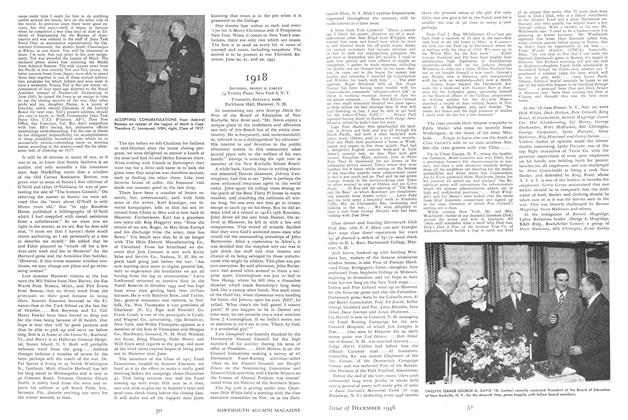
DANIEL MARX JR. '29, who is rapidly establishing himself as one of the country's leading authorities on ocean transportation, may now be addressed as "Doctor" as well as "Professor." The young Dartmouth economist was awarded his Ph.D. degree by the University of California last month. His dissertation was a study of the U. S. Maritime Commission and stated the view that greater consideration should be given to the effect of U. S. shipping on this country's international relations.
Professor Marx, who is teaching the course in international trade this semester, was chief of vessel utilization and of the cargo reports section of the War Shipping Administration during the war. His special interest in shipping goes back to the period from 1931 to 1996 when he was with the McCormick Steamship Company in San Francisco as assistant to the .executive vice president. He gave up a promising business career to do graduate work in economics at the University of California from 1938 to 1941 and in the latter year he returned to Dartmouth as an instructor. For a short period in 1941 he served as shipping consultant to the Office of the Administrator of Export Control.
Professor Marx is continuing his research and writing in the maritime field. He has prepared articles on his specialty for the Institute of Pacific Relations and the American Economic Association, and by invitation of the Yale Law Journal he is participating in a symposium on world organization appearing soon in that publication.
EIGHT MEMBERS of the Dartmouth science departments took an active part in the 26th annual meeting of the New Hampshire Academy of Science at Keene on October 25 and 26. W. Wedgwood Bowen, Professor of Zoology and Director of the Dartmouth Museum, delivered the President's Address on the topic, "The Temperature Factor in Bird Migration." Members of the Dartmouth teaching staff who delivered papers during the two-day. gathering were William W. Ballard '28, Professor of Zoology; James F. Crow, Assistant Professor of Zoology; George Z. Dimitroff, Assistant Professor of Astronomy; Roy P. Forster, Assistant Professor of Zoology; Elden B. Hartshorn '12, Professor of Chemistry; Allen L. King, Assistant Professor of Physics; and Andrew H. McNair, Professor of Geology. All together, the Dartmouth scientists presented two-thirds of the material discussed at the 1946 meeting of the Academy.
Richard H. Goddard '20, 'Professor of Astronomy and Director of Dartmouth's Shattuck Observatory, was elected Vice President of the Academy for the coming year.
IN RECENT YEARS, through the agency of the Dartmouth Speakers' Bureau directed by Prof. Herbert W. Hill, the Dartmouth faculty has played an increasingly active role in the educational and civic life of nearby communities. Typical of the public service rendered by the faculty beyond the confines of Hanover is the forum on "Can We Avoid Another Depression?" which three members of the Department of Economics will stage early in December at Plymouth, N. H., as part of the town's Community Forum. At this meeting at the Plymouth State Teachers College, the panel discussion will be presented by Prof. William A. Carter '20, department chairman, Prof. James F. Cusick, and Prof. Harry P. Bell.
DAYTON D. MCKEAN, Professor of Government, journeyed to Philadelphia in mid-November to participate in the session ,on State Government at the meetings of the National Municipal League, whose membership includes mayors and other local political officers from all sections of the country. Professor McKean, who teaches courses on state government, municipal government and American parties and politics, was a Democratic candidate for the New Hampshire General Court in last month's elections but fell victim to the Republican tide which ran as strongly in Hanover as elsewhere.
Professor McKean, while at Princeton, was a member of the New Jersey Assembly and the New Jersey Social Security Commission. After coming to Dartmouth in 1937 he was granted special leave of absence for two years, 1941-43, to serve as deputy commissioner of finance under Governor Edison of New Jersey. In the latter post he was right-hand man to the Governor in his battle against the Hague machine, which Professor McKean exposed in his 1940 book, The Complete Boss:Frank Hague and His Machine. Legislative pressure groups in New Jersey also came under the critcial eye of the professor, whose Dartmouth classroom discussions of state and local government are backed up by a wealth of first-hand experience.
THE FACULTY of the Dartmouth Medical School will include a new specialist next month when Dr. Walter C. Lobitz Jr. of Rochester, Minn., joins the staff as Instructor in Dermatology and Syphilology. Another new appointment, already effective, is that of Dr. Norman W. Loud of Fall River, Mass., as Instructor in Radiology.
Dr. Loud, an A.B. graduate from Harvard in 1915, also obtained his M.D. degree there in 1919. He is a certificant of the American Board of Radiology and has been working at the Veterans' Hospital in White River Junction, Vt. Before that he was attached to the Truesdale Hospital in Fall River.
Dr. Lobitz, who started his college studies at Brown, received his B.S. and M.D. degrees at the University of Cincinnati in 1939 and 1941, respectively. Last year he received the degree of Master of Science in Dermatology from the University of Minnesota and has since been working at the Mayo Clinic in Rochester, Minn.
Leave of absence for one year, starting November 1, has been granted to Dr. Reginald K. House, Assistant Professor of Clinical Pathology, so that he may study at the Children's Hospital in Boston.
THE NOVEMBER ISSUE of the New Hampshire Troubadour, devoted to the life and work of Robert Frost '96, George Ticknor Fellow in the Humanities, is almost an all-Dartmouth-faculty publication in its editing and contents. Herbert F. West '22, Professor of Comparative Literature, served as editor of the special issue of the miniature periodical published by the New Hampshire State Planning and Development Commission, and also contributed the foreword and a biographical sketch. Dartmouth faculty contributors include Stearns Morse, Dean of Freshmen and Professor of English; Sidney Cox, Professor of English; Donald Bartlett '24, Professor of Biography; and David Lambuth, Professor of English.
The Troubadour includes among three Frost poems "The Getaway" which is published for the first time. Extra copies of the Robert Frost issue are available through the State Planning and Development Commission, Concord, N. H., for 25 cents.
PLAYWRIGHT. John W. Finch, Assistant Professor of English, whose first play, "The Wanhope Building," is scheduled for Broadway production.
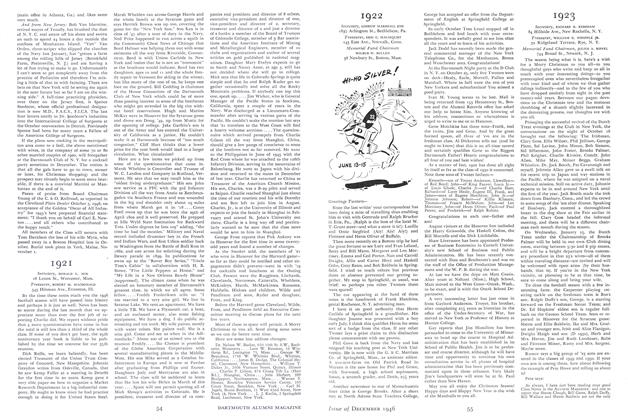
NEWCOMER. John W. Masland, who joined the Dartmouth faculty this fall as Professor of Government. After graduating from Haverford and completing graduate work at Princeton, he taught at Stanford for the past eight years. Authority in Far Eastern politics and international relations, he served earlier this year as research expert in government at Gen. MacArthur's Tokio headquarters.
MARITIME EXPERT. Daniel Marx Jr. '29, Assistant Professor of Economics, who specializes in ocean transportation and recently won his Ph.D. with a study of the U. S. Maritime Commission.
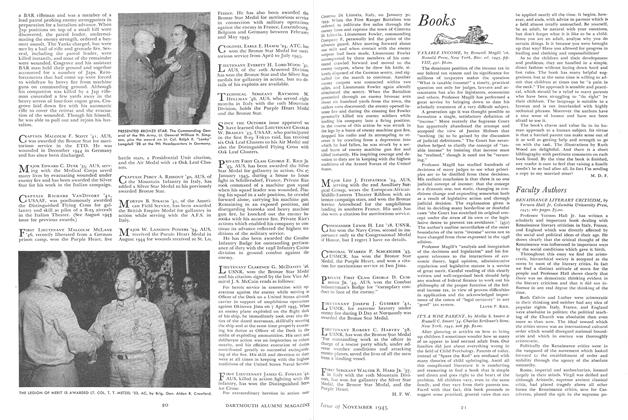
PLANNER. Russell R. Larmon '19, Professor of Administration on the Benjamin Ames Kimball Foundation, is chairman of the Hopkins Center Committee named by President Dickey. His administration course this year is more popular than ever and has of necessity been divided into three large sections.
EXECUTIVE STEERER. John M. Clark '32, former Senior Fellow and editor-in-chief of "The Dartmouth," who joined the College staff in October as executive secretary of the steering committee for the "Great Issues" course to be required of all Dartmouth seniors. He holds the rank of Assistant Professor. Mr. Clark published a weekly newspaper for two years after graduation and then proceeded to "The Wash- ington Post" as reporter and editorial writer. He later joined the International Labor Office for assignment in Latin America, transferring in 1940 to the Office of the Coordinator of Inter-American Affairs. His last government service before coming to Hanover was with the O.S.S. in Europe.