NAVY AT DARTMOUTH
by Ray Nash Dartmouth College Publications, 1946, 96 pp. text, is pp gravure illustrations, $2.50.
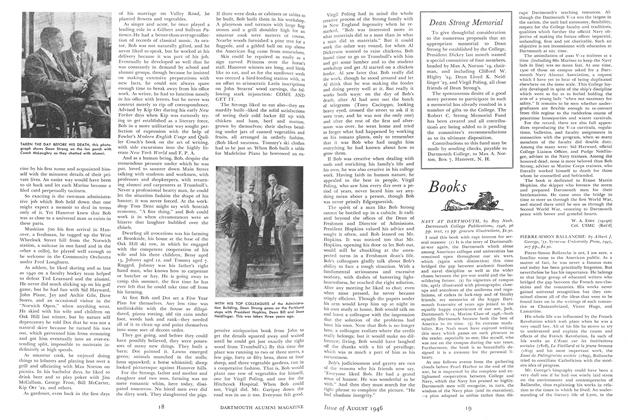
I read this book with rapt interest for several reasons: (1) It is the story of Dartmouth-at-war again, the Dartmouth which alone among American colleges and universities has remained open throughout our six wars, which (again with distinction) this time bridged the gap between academic freedom and naval discipline as well as the wider chasm between the pre-war world and the bewildering future. (2) Its vignettes of campus life, aptly illustrated with photographs; closeups and anecdotes of the uniforms and regulations, of cadets in lock-step and of faculty friends; my memories of the happy Dartmouth fraternity of years ago joined to the equally happy experiences of our son, Jack, Dartmouth V-12, Marine Class of 1946,—b0th equally Dartmouth because both the best of America in its time. (3) Its extreme readability. Ray Nash must have enjoyed writing this story which passes on such pleasure to the reader, especially to one, like myself, who was not on the campus during the war years. Furthermore, the book is so beautifully designed it is a treasure for the personal library.
As one follows events from the gathering clouds before Pearl Harbor to the end of the war, he is impressed by the complete and enlightened cooperation between College and Navy, which the Navy has praised so highly. Dartmouth men will recognize, in turn, the wisdom of the Navy plan (and its execution), —a plan adapted to utilize rather than disrupt Dartmouth's teaching resources. Although the Dartmouth V-12 was the largest in the nation, the unit had autonomy, flexibility, respect for the College faculty and traditions, qualities which further the official Navy ob jective of making the future officer impartial, unbending, firm and yet charitable. Such an objective is not inconsistent with education at Dartmouth at any time.
The assimilation of 2000 V-12 trainees at a time (including 660 Marines to keep the Navy lads in line) was no mean feat. At one time, 1500 of those on campus asked for a Dartmouth Navy Alumni Association, a request which I have yet to hear of being duplicated elsewhere on the same scale. This College loyalty developed in spite of the ship's discipline which went so far as to forbid holding the arm of a young lady "when not necessary for safety." It remains to be seen whether undergraduates are flexible enough to re-convert from this regime to the rudderless course of peacetime houseparties and winter carnivals.
For the record, there are also full appendices reproducing the V-12 curricula, regulations, bulletins, and faculty assignments in connection with the program, when so many members of the faculty did double duty. Among the many were: Sid Hayward, official College Liaison Officer, and Pudge Neidlinger, adviser to the Navy trainees. Among the honored dead, none is more beloved than Bob Strong, adviser to Marine Corps trainees, who literally worked himself to death for those whom he counselled and befriended.
The book is dedicated to Ernest Martin Hopkins, the skipper who foresaw the storm and prepared Dartmouth men for their battlestations. He came onto the bridge in time to steer us through the first World War, and stayed there until he saw us through the Second World War, restoring to Dartmouth peace with honor and grateful hearts.