DEMOCRACY IN TRANSITION
Structural Changes in Government by Public Opinion Are Under Way, Says Noted Authority, Who Supports Polls as a Helpful Tool in Modern Democratic Society
'28, DIRECTOR, OFFICE OF PUBLIC OPINION RESEARCH, PRINCETON UNIVERSITY
IT'S A RARE thing these days to find a complacent man. All of us are being buffeted around to some degree by events or conditions by no means entirely under our control. Most of us know it. If we don't all know it by now, the chances are we soon will.
No one who pretends to be an educated man and whose system of values includes anything beyond "self-interest" as defined in the narrowest possible way can calmly sit back and in a spirit of complete aloofness, impartiality or "objectivity," watch the world go by. Any reasonable definition of education implies that an educated man will try to make some sense out of the changing conditions, the emergences in the world around him. Automatic judgments and evaluations based on long standing stereotypes or prejudices unsupported by facts or by objective conditions are the earmarks of ignorance and unreason. Unfortunately, there is by no means a perfect negative correlation between amount of formal education and degree of ignorance. Also, unfortunately, there is by no means a completely negative correlation between amount of formal education and degree of cynicism or callous disregard of the common purposes and values of men.
It may seem trite and unnecessary to repeat here that those of us who happen to be living in most western societies today are going through a period of extremely rapid social transition. Yet, even though you may have heard or read some such statement dozens or hundreds of times, its full force may still not have struck home. Or you may feel that even though times are critical now or are going to be even more critical for most people, they are not likely to be very critical for you. You, like the rest of us, can make easy rationalizations. For example, surveys show that while most of us in the United States think that if there is ever another war atomic bombs will be used against this country, very few of us think that we or our families run much risk of being killed by atomic bombs. Somehow, we seem to think, we. would be smart enough or lucky enough not to be hurt.
I must bring up this talk about critical times and emerging situations in connection with the topic of public opinion and democracy I was asked to write about. I must do it for the simple reason that the superstructure of the political-economic system under which we in this country live and which we label as democracy is quite likely, I think, either to undergo some rather rapid alterations to take account of the mounting consequences of technological developments, or, to become so brittle and hard in its attempt to withstand pressure that it may before long crack apart. The intelligent man who believes in real democracy and in a government by an enlightened public opinion will know that modifications and alterations in the super- structure of society—its norms and values- are inevitable. And, what is more important, he will want to have some share and some voice in setting the direction of these changes. For if he and others like him don't set the direction, someone else will. Or the most hidebound representatives of vested interests will see that changes don't take place: this will only build up to a final and sudden debacle.
We've already come such a long way in our national history that we sometimes tend to take "democracy" for granted. We forget that at the time the Declaration of Independence and the Constitution were drafted the word "democracy" and all it stood for were feared by "respectable" people in most parts of the world. Democracy was a word used to describe mobs and mob rule. According to Charles Beard it was not until Woodrow Wilson created his famous slogan of World War I that the word "democracy" achieved widespread acceptance and respectability in the United States.
During the past century and a half there have, of course, been many changes in the direction of giving more and more people more and more direct political power and freedom. Within the framework of the Constitution, the right to vote has been provided all adult citizens irrespective of race, color, or sex. And yet any honest American is forced to admit that political democracy is still a mockery to millions of "citizens" in the country, especially the Negroes in the South. And he must also admit that most of us tend to define "democracy" in rather a circumscribed Way. We emphasize for example, as one of the main characteristics of our democracy the right to freedom of speech. Under this definition, one man or one group has the right to call another man a "stupid nigger," "dirty Dago," or a "Kike." To the Negro, the Italian, or the Jew so singled out, this must surely seem like democracy in reverse. On the other hand, in the Soviet Union the definition of democracy does not at present include freedom of speech, but it does make it a criminal offense for any individual or group to characterize any race or member of a race in derogatory racial terms. Paul Robeson has given frequent and eloquent testimony on this point.
Nor is it easy to provide an unequivocal definition o£ "representative government" with which all people will agree. There still exist varying points of view as to what a representative government really is and what the functions of our representatives should be. Some of these points of view found expression in the early days of the country. For example, Alexander Hamilton long ago voiced the sentiments of some men today to the effect that the great masses of people are really not intelligent enough to govern themselves:
"All communities divide themselves into the few and the many. The first are rich and well born, the other the mass of the people.... turbulent and changing, they seldom judge or determine right. Give therefore to the first class a distinct, permanent share in the government."
On the other hand, Thomas Jefferson squarely placed his faith in the people, or what he called "the common reason of society."
"Every man, and every body of men on earth, possesses the right of self-government. They receive it with their being from the hand of nature. Individuals exercise it by their single will; majority is the natural law of every society of men."
And former Senator Ashurst of Arizona has pointed out the lamentable lack of interest people have in the problems which must be decided by their representatives in the nation's capital:
"You send me down to Washington to represent you in the Senate. But you do not send me there because you are interested in grave questions of national or international policy. When I come back to Arizona, you never ask me about such policies; instead you ask me: 'What about my pension?' or 'What about that job for my son?' "I am not in Washington as a statesman. I am there as a very well-paid messenger boy doing your errands."
From the beginning of our nation's independence, we have not had to contend with certain powerful influences that in most European countries have made change difficult, adaptation and flexibility unlikely. For example, we have had no monarchy or titled nobility to deal with. We have not had any powerfully organized church seriously conflicting with government interests to date. Nor have we had a professional army influencing policy or threatening to turn a government out by force if the political program of a military clique were not followed.
Partly because of the absence of these established groups found in some other countries, and partly because of the freedom granted by our own form of government, the stage has been set from the very beginning of our national life for the rise of what we have come to know as. "interest groups," people whose views of public policy have been influenced by considerations of how their source of livelihood might be affected.
At the same time, another characteristic of political development in this country has been at work: what we might call the individual's sense of his own independence —a characteristic Americans have had a comparatively great opportunity to develop because of the resources of their own land, the expanding frontiers, the chance to make for themselves a place in society generally somewhat better than that held by their forefathers.
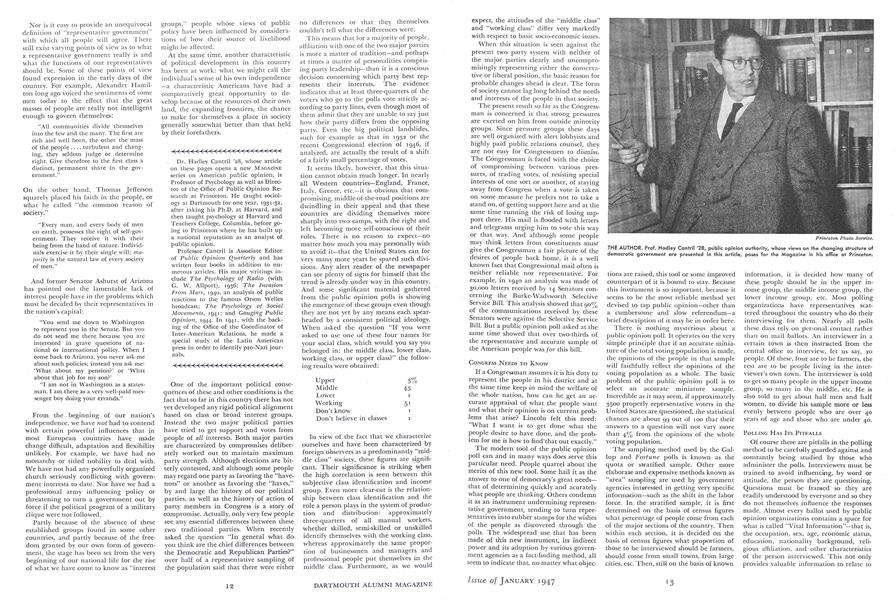
Dr. Hadley Cantril '28, whose article on these pages opens a new MAGAZINE series on American public opinion, is Professor of Psychology as well as Director of the Office of Public Opinion Research at Princeton. He taught sociology at Dartmouth for one year, 1931-32, after taking his Ph.D. at Harvard, and then taught psychology at Harvard and Teachers College, Columbia, before going to Princeton where he has built up a national reputation as an analyst of public opinion.
Professor Cantril is Associate Editor of Public Opinion Quarterly and has written four books in addition to numerous articles. His major writings include The Psychology of Radio (with G. W. Allport), 1936; The InvasionFrom Mars, 1940, an analysis of public reactions to the famous Orson Welles broadcast; The Psychology of SocialMovements, 1941; and Gauging PublicOpinion, 1944. In 1941, with the backing of the Office of the Coordinator of Inter-American Relations, he made a special study of the Latin American press in order to identify pro-Nazi journals.
One of the important political consequences of these and other conditions is the fact that so far in this country there has not yet developed any rigid political alignment based on class or broad interest groups. Instead the two major political parties have tried to get support and votes from people of all interests. Both major parties are characterized by compromises deliberately worked out to maintain maximum party strength. Although elections are bitterly contested, and although some people may regard one party as favoring the "havenots" or another as favoring the "haves," by and large the history of our political parties, as well as the history of action of party members in Congress is a story of compromise. Actually, only very few people see any essential differences between these two traditional parties. When recently asked the question "In general what do you think are the chief differences between the Democratic and Republican Parties?" over half of a representative sampling of the population said that there were either no differences or that they themselves couldn't tell what the differences were.
This means that for a majority of people, affiliation with one of the two major parties is more a matter of tradition—and perhaps at times a matter of personalities comprising party leadership—than it is a conscious decision concerning which party best represents their interests. The evidence indicates that at least three-quarters of the voters who go to the polls vote strictly according to party lines, even though most of them admit that they are unable to say just how their party differs from the opposing party. Even the big political landslides, such for example as that in 1932 or the recent Congressional election of 1946, if analyzed, are actually the result of a shift of a fairly small percentage of votes.
It seems likely, however, that this situation cannot obtain much longer. In nearly all Western countries—England, France, Italy, Greece, etc.—it is obvious that compromising, middle-of-the-road positions are dwindling in their appeal and that these countries are dividing themselves more sharply into two camps, with the right and left becoming more self-conscious of their roles. There is no reason to expect—no matter how much you may personally wish to avoid it—that the United States can for very many more years be spared such divisions. Any alert reader of the newspaper can see plenty of signs for himself that the trend is already under way in this country. And some significant material gathered from the public opinion polls is showing the emergence of these groups even though they are not yet by any means each spearheaded by a consistent political ideology. When asked the question "If you were asked to use one of these four names for your social class, which would you say you belonged in: the middle class, lower class, working class, or upper class?" the following results were obtained: Upper 3% Middle 43 Lower 1 Working 51 Don't know 1 Don't believe in classes 1
In view of the fact that we characterize ourselves and have been characterized by foreign observers as a predominantly "middle class" society, these figures are significant. Their significance is striking when the high correlation is seen between this subjective class identification and income group. Even more clear-cut is the relationship between class identification and the role a person plays in the system of production and distribution: approximately three-quarters of all manual workers, whether skilled, semi-skilled or unskilled identify themselves with the working class, whereas approximately the same proportion of businessmen and managers and professional people put themselves in the middle class. Furthermore, as we would expect, the attitudes of the "middle class" and "working class" differ very markedly with respect to basic socio-economic issues.
When this situation is seen against the present two party system with neither of the major parties clearly and uncompromisingly representing either the conservative or liberal position, the basic reason for probable changes ahead is clear. The form of society cannot lag long behind the needs and interests of the people in that society.
The present result so far as the Congressman is concerned is that strong pressures are exerted on him from outside minority groups. Since pressure groups these days are well organized with alert lobbyists and highly paid public relations counsel, they are not easy for Congressmen to dismiss. The Congressman is faced with the choice of compromising between various pressures, of trading votes, of resisting special interests of one sort or another, of staying away from Congress when a vote is taken on some measure he prefers not to take a stand on, of getting support here and at the same time running the risk of losing support there. His mail is flooded with letters and telegrams urging him to vote this way or that way. And although some people may think letters from constituents must give the Congressman a fair picture of the desires of people back home, it is a well known fact that Congressional mail often is neither reliable nor representative. For example, in 1940 an analysis was made of 30,000 letters received by 14 Senators concerning the Burke-Wadsworth Selective Service Bill. This analysis showed that 90% of the communications received by these Senators were against the Selective Service Bill. But a public opinion poll asked at the same time showed that over two-thirds of the representative and accurate sample of the American people was for this bill.
CONGRESS NEEDS TO KNOW
If a Congressman assumes it is his duty to represent the people in his district and at the same time keep in mind the welfare of the whole nation, how can he get an accurate appraisal of what the people want and what their opinion is on current problems that arise? Lincoln felt this need: "What I want is to get done what the people desire to have done, and the problem for me is how to find that out exactly."
The modern tool of the public opinion poll can and in many ways does serve this particular need. People quarrel about the merits of this new tool. Some hail it as the answer to one of democracy's great needs— that of determining quickly and acurately what people are thinking. Others condemn it as an instrument undermining representative government, tending to turn representatives into rubber stamps for the wishes of the people as discovered through the polls. The widespread use that has been made of this new instrument, its indirect power and its adoption by various government agencies as a fact-finding method, all seem to indicate that, no matter what objections are raised, this tool or some improved counterpart of it is bound to stay. Because this instrument is so important, because it seems to be the most reliable method yet devised to tap public opinion—other than a cumbersome and slow referendum—a brief description of it may be in order here.
There is nothing mysterious about a public opinion poll. It operates on the very simple principle that if an accurate miniature of the total voting population is made, the Opinions of the people in that sample will faithfully reflect the opinions of the voting population as a whole. The basic problem of the public opinion poll is to select an accurate miniature sample. Incredible as it may seem, if approximately 3500 properly representative voters in the United States are questioned, the statistical chances are about 99 out of 100 that their answers to a question will not vary more than 4% from the opinions of the whole voting population.
The sampling method used by the Gallup and Fortune polls is known as the quota or stratified sample. Other more elaborate and expensive methods known as "area" sampling are used by government agencies interested in getting very specific information—such as the shift in the labor force. In the stratified sample, it is first determined on the basis of census figures what percentage of people come from each of the major sections of the country. Then within each section, it is decided on the basis of census figures what proportion of those to be interviewed should be farmers, should come from small towns, from large cities, etc. Then, still on the basis of known information, it is decided how many of these, people should be in the upper income group, the middle income group, the lower income group, etc. Most polling organizations have representatives scattered throughout the country who do their interviewing for them. Nearly all polls these days rely on personal contact rather than on mail ballots. An interviewer in a certain town is then instructed from the central office to interview, let us say, 20 people. Of these, four are to be farmers, the rest are to be people living in the interviewer's own town. The interviewer is told to get so many people in the upper income group, so many in the middle, etc. He is also told to get about half men and half women, to divide his sample more or less evenly between people who are over 40 years of age and those who are under 40.
POLLING HAS ITS PITFALLS
Of course there are pitfalls in the polling method to be carefully guarded against and constantly being studied by those who administer the polls. Interviewers must be trained to avoid influencing, by word or attitude, the person they are questioning. Questions must be framed so they are readily understood by everyone and so they do not themselves influence the responses made. Almost every ballot used by public opinion organizations contains a space for what is called "Vital Information"—that is, the occupation, sex, age, economic status, education, nationality background, religious affiliation, and other characteristics of the person interviewed. This not only provides valuable information to relate to opinion, but it also makes it possible for the central organization to keep a constant check on this miniature sample.
The accuracy of the modern "scientific" polls has been demonstrated over and over again on the basis of election returns. During the last ten years, there have been over 340 predictions made either of national or state elections. The average error of these predictions is 4% and has been reduced to around 3% in the past few years. When one considers all the possible errors involved in sampling, in procedures, and, above all, in the difficulty of predicting turnout, this is really a remarkable performance.
No one would propose that the results of public opinion polls be followed blindly and thoughtlessly by Congressmen. At the same time, most people no doubt believe that representatives should have a maximum knowledge of public opinion as one of the factors upon which their decisions are based. For representatives of the people to act without getting the most reliable information they can on public opinion would be like an army acting without having the most efficient military intelligence possible. A Congressman, a Cabinet officer, or a President, need not make himself synthetic by following public opinion polls. If he does, the people are soon likely to spot him.
Polls provide an accurate and inexpensive tool to keep the government more in tune with the people. Polls find out what the areas of public ignorance are, what people need to be informed about, what some of the basic wants and desires of the people are in terms of their current standards of living, what people are worrying about, how intensely people feel about various issues of the day, and what, on election day, a vote for a particular candidate actually means. The intricate modern mechanisms needed to instrument public policy are, of course, something generally beyond the comprehension of the average citizen and on which poll data seem to me not to be particularly helpful.
DO POLLS INFLUENCE OPINION?
There is no clear-cut evidence that the publication of poll results influences elections for the simple reason that, as we have said before, the political attitudes of most people are fixed and rigid, not influenced by a mere reading of how the majority will vote. It might be expected, on the other hand, that the publication of poll results on issues not so well known, that people do not feel too strongly about, may have some influence both on the people and their representatives. Whether or not this is a good or bad thing depends on one's own conception of how the government should work. Analysis of poll results to date shows that by and large a majority of the people have been ahead of Congress with respect to issues—that is, that Congress usually lags some months behind the people in formulating legislation which will express majority desires.
One service that polls can provide is to counteract in part the influence of pressure groups. A classic example of this was seen some years ago in connection with the highly organized lobby of the Townsend movement and the flood of mail which was giving Congressmen the impression that they might have to vote for some modified form of Townsend plan in order to save their political skins. The publication of a Gallup poll, showing that the advocates of a Townsend plan were a very definite minority in the country, completely burst the Townsend bubble in Washington. But if propaganda campaigns are skillfully enough organized, if enough pressures are exerted on Congress, and if Congressional sympathies are for one reason or another basically in line with the interests of the pressure groups, legislation overwhelmingly favored by the majority of the public can be scuttled. The most recent example of this occurred in connection with the emasculation of OPA. For up to the last minute, over three-fourths of the American people favored continuation of wage and price controls.
Publication of poll results may also counteract some of the impressions of universality created by the press or radio which are, of course, certainly not under the control of people who would identify themselves with "the working class." I am not implying that majority opinion is always "right." I don't believe it is. What I am saying is that an intelligent legislator or citizen should not mistake the impression derived from group pressure or newspaper editorials as majority opinion.
Yet public opinion is a much more complex thing than "majority opinion." And although public opinion polls seem to me to be one of the most valuable instruments yet discovered to speed the democratic process, they can at best only ease the period of transition or help us predict its nature. For since the days of Washington and Jefferson the problems confronting the citizens of the United States have become much more complex and specialized as the frontiers have been absorbed and as modern technology has determined more and more the functional role an individual plays in society. We must remember that the thought and action of most people are largely absorbed with daily problems, with their own personal hopes and worries. It is not easy for the average man to understand in terms of his own welfare, in terms of his own purposes, some of the complicated decisions that have to be made by government officials. The late Raymond Clapper, newspaper columnist, once remarked that there were two things about the American people that always astonished him: their intelligence and their ignorance.
But in spite of the difficulty the average citizen has in understanding the significance of both domestic and international problems, once people do see the connection between a new policy and their own purposes or welfare, they are apt to push for action. If political and economic situations are such that group purposes are so opposed that long-time, stable compromises are impossible (and this seems to be the situation we are in today) then continued and intensified friction seems inevitable for the simple psychological fact that what an individual largely regards as himself is made up of his values and his purposes. As these values and purposes become more clear-cut, only inner conflict and frustration can result from compromise.
This brief discussion of public opinion today does not introduce this series of articles on a very cheerful note. It must be the hope of all of us who support Dartmouth that somehow the thing known as a Dartmouth education will minimize the number of reactions to complex social events made in a blind and automatic fashion. It must also be our hope that a Dartmouth education will somehow show that no matter how a man earns his living, there are basic, overlapping purposes common to all men. What the educated man must work for then is to establish those conditions in society which will make it possible for a man's own purpose to become a value of society while still remaining a personal purpose. That, it seems to me, is the best criterion by means of which to judge and act in this period of transition.
THE AUTHOR. Prof. Hadley Cantril '28, public opinion authority, whose views on the changing structure of democratic government are presented in this article, poses for the Magazine in his office at Princeton.
Article
-
 Article
Aero Club
February, 1911 -
 Article
MORE LETTERS PRESENTED BY MR. HAVEMEYER
-
 Article
ADMINISTRATION INCREASES DORMITORY ROOM RATES
May, 1922 -
 Article
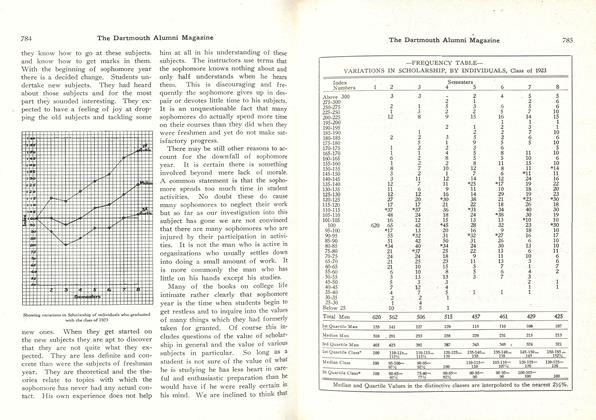
FREQUENCY TABLE VARIATIONS IN SCHOLARSHIP, BY INDIVIDUALS, Class of 1923
August 1924 -
 Article
Mountain Troops
March 1943 -
 Article
Best Class Agent
May 1953


