Technology: Trouble-Maker or Trouble-shooter
"Great Issues" Lecturer Charts Growth of Social Problems Resulting from Modern Applied Science
THE Chicago Tribune makes this English accent of mine a bit embarrassing; I should feel even worse about it if it weren't for the fact that my wife comes from Kansas, a state where anyone living as far east as Chicago is regarded as a city slicker. Of course, I see the Colonel's point of view. Having decided all the great issues to his own satisfaction, it must seem inefficient, if not positively irritating, to him to have a bunch of college boys, mostly Easterners at that, still talking them over.
Next Monday, Professor Fisk will be talking to you about some of the problems raised by the development of atomic energy. This morning I shall try to persuade you that these problems are a special, if highly dramatic, example of a general process; that the problem of what to do about atomic energy is, so to speak, a Walt Disney example in glorious Technicolor of the general truth that applied science is continually creating social problemsand probably at an accelerating tempo. This particular Disney is unique however in being highly unamusing to all thoughtful people. No one will leave 105 Dartmouth with the notion that I am an expert on this subject; I should like to make sure that no one even settles down in his seat with that illusion. I am just a plain chemist, occasionally taking notice and less often than I should of a few of the things technology seems to be doing to society from where I sit.
Before Hiroshima, the multiplication of comforts, the improvement of health, the security from so many former hazards had given us a taste for luxury and a confidence that everything must continue to grow better and better. The world and technology were on a glorious honeymoon. The harnessing of nuclear energy came as a distinct shock for many of us the first blemish on a beautiful romance. It was like the discovery on the first morning after the honeymoon that the bride does not make very good coffee. The husband has not yet cottoned on to the possibility that perhaps she cannot cook at all. Ultimately we must appreciate that the atomic bomb does not stand alone, but is part of the general development of technology and that no power is given by science that is not accompanied by a corresponding danger.
At the risk of laboring an obvious point, we might begin by making quite clear the distinction between science and technology. Science seeks to know, technology to do; the scientist concerns himself with finding a pattern in the events of the natural world. He is like someone laboriously piecing together a jigsaw puzzle; the technologist is not interested in the puzzle as a whole but looks over the scientist's shoulder, on the alert for a group of two or three pieces whose fit can be applied to some useful purpose.
This is a gross oversimplification of the state of affairs. The urge to understand and the urge to put to practical use are not always so completely divorced. The jigsaw puzzle is always being more actively explored in the regions where we think the fit of the pieces is most likely to be practically useful. The distinguished mathematician on his deathbed who was heard to murmur with satisfaction,
"Thank God, nothing I have ever discovered can ever be of any practical use to anybody" was a rarity. His faith in the permanent practical uselessness of his work was, as a matter of fact, an extremely risky speculation. An even more distinguished mathematician called Einstein in developing certain equations in the theory of relativity little knew that he was the father or at least the grandfather of the atomic bomb.
The pure scientist, as such, has not been without his influence on society. In the September Atlantic, Professor Stace has argued persuasively that what he calls "the disillusioned restless spirit of modern man" is the direct result of the fact that the founders of modern science deliberately excluded the idea of purpose as controlling nature. They did this because causes and not purposes were their subject of study but it led to a widely accepted picture of a universe without purpose, without meaning, and therefore, without values. In the terms used by Professor Ballard last week, Stace's argument is that by dismissing questions of purpose as "operationally meaningless" science bears the main responsibility for the present spiritual bewilderment of man.
It is not my task today to try to explore the truth of that argument, deeply important as it is. I am concerned with some of the mufti more concrete effects of technology, that is applied science, on society.
Here we are dealing with a modern problem—how modern it is, is sometimes hard for us to grasp. We picture Stephenson in distinctly old-fashioned dress, thoughtfully watching steam coming out of a kettle and we do not realize that the really extensive exploitation of mechanical power is a matter of living memory.
My first proposition is the horribly obvious one that technological development is happening very rapidly, is an essentially recent phenomenon, and is proceeding at an accelerated pace. Evidence of this may seem hardly necessary. The lush pages of every popular magazine have been carefully contrived to convince us that every advertiser has just discovered an important method of enriching human life, and at an absurdly low cost to the consumer.
I would like, however, to give a fewmore factual pieces of evidence in support of my point about the speed and recency of technological development. From a mountain of evidence I will choose only three facts.
(1) It has taken ten or fifteen thousand years for man to change from a hungry, prowling, rather unsociable being to the very sociable (at this time of day I hesitate to say well-fed) occupants of 105 Dartmouth. Against the sweep of 15,000 years set the fact that we have used up more mineral wealth in the past thirty years than in all previous history.
(2) In 1914 the United States had 270 combine harvesters; fourteen years later it was using 853,000.
(3) In 1800, the mechanical power available to the citizens of the United States averaged somewhere about onetwelfth of one horsepower per person. In 1900 the figure had risen to about onefifth of a horsepower. At the present time it is somewhat over ten horsepower per person. In other words, the share of each one of us is equivalent to the labour of about 300 able-bodied men. Please notice particularly that whereas the figure doubled in the nineteenth century, it increased fifty-fold in the first half of the present century.
This staggering crescendo of technical progress is brought out rather vividly by imagining the whole of human history compressed into the life-time of a man of, say, my own age. On this compressed time-scale, the dawn of primitive art was last year, and the alphabet was developed in mid-August. Last Friday Galileo dropped the light and heavy cannon balls down the Tower of Pisa. On Monday morning the first workable steam engine was constructed; automobiles came into general use yesterday afternoon. Air-mail and radio started during the night. Just before dawn, radar was developed, and the atom bomb went off about ten o'clock this morning. Can you blame me for feeling a little jittery now?
This snow-balling effect of technical progress is not difficult to understand. The possibilities of the application of scientific knowledge grow faster than the stock of knowledge itself because each new established fact can be used in conjunction with every other established fact.
If you will accept, then, my first proposition that technological development is a very rapid, definitely recent and probably accelerating process, you will agree that such problems as it raises for society are likely to grow more varied and more intense in the future.
The next thing to do is to track down a few of the types of problem that technology does create. The effects of technology upon our way of living make a multiply, ing sequence of events so complex as to make the chain reactions of the chemist and the nuclear physicist seem childishly simple. Our task is not that of finding a needle in a haystack but rather of picking a few threads out of a closely woven Persian carpet.
The first and most obvious effect of abundant power and of the machines it drives is increased output per man-hour. Fewer men to do a given job leads to unemployment (so called technological unemployment). The machine is, of course, by no means the only source of technological unemployment. Some of its most dramatic examples are drawn from applied chemistry; the production of synthetic indigo shattered the indigo planters of the Far East; the making of nitrogen fertilizers from the air shook the economy of Chile, with its beds of mineral nitrates, for years; the pumping of sulphur from deep rock strata of Louisiana virtually ruined the sulphur industry of Sicily. Although invention is always creating new industries, and in the long run almost certainly creates more jobs than it abolishes, these new jobs are not likely to be immediately available at the right time and the right place for the man dispossessed of his job. This situation cuts a lot of ground from under the comfortable belief that for a man to be out of work is clear proof of his lack of industry. This discovery stimulates the demand for some form of social security system.
A second well-known effect of the machine is that the capital needed to equip each worker has increased greatly, not only because more power and more automatic controls enable each worker to operate more equipment, but also because the added subtlety of the equipment increases its cost. In the presence of so many economics majors, I am going to leave the consequences of that effect most respectfully alone.
A third effect is a tremendous increase in the number of occupations. Most of today's jobs were non-existent a hundred years ago. Not only has the number of occupations increased, but their character has changed, and always in the direction from unskilled to skilled, from the laborer towards the engineer. Although technology builds up a nation of employees, it tends to swell the middle class rather than the proletariat.
I would like to digress at this point to correct what is, or certainly was, a prevalent fallacy. People often speak of the dehumanizing effect of the machine with the specific meaning that the worker becomes a mere "cog in the machine." Wherever this occurs it is a temporary result of immature technology. Further technical development makes the human being too expensive a cog, and finds mechanical methods of replacing him. Men devoted to production are increasingly engaged in making and repairing intricate machines, not in operating them. The more monotonous a job becomes, the closer it is to abolition.
The fourth effect of the machine arises out of the trend towards specialization. For example, improved transportation and new methods of preserving foods like canning and freezing now make it possible to grow food where growing conditions are best and not just anywhere that happens to be near a town and its consumers. Potatoes come from Maine and celery comes from Kalamazoo. The same specialization in industry means that the finished product comes from many industries; a single radio tube depends on the mining of coal, the distillation of coal tar, the manufacture of glass, the manufacture of plastics, the mining of tungsten, the mining of copper, and other operations besides the multitude of fabrication processes in the tube factory.
This subdivision of a task into specialised operations and their harmonious combination into a cooperative effort means that a radio tube costs a dollar, instead of a thousand dollars, BUT the integration of industry that it involves makes the economy more responsive than ever before to disturbance in one of its parts. A shock at one point is transmitted to unexpectedly remote parts of the structure. The paralysis that descends on a modern household when electric power fails is a rudimentary example of this fact. A slightly more complicated one was the menace to health unwittingly created by meat marketing regulations just after the war; these regulations had the effect of greatly reducing the. supply of livestock to established packing houses, and diverting it to black market operators. The established packing houses were the only places where medicinally invaluable by-products like insulin, thyroid, and liver extracts were processed from slaughtered livestock. The supply of these vital materials almost dried up. Fortunately diabetics and others were to survive on the reserve stocks of the pharmaceutical industry, but the incident illustrates the far-fetched ramifications of a single disturbance in the industrial economy.
This increasing interdependence of one part of the country on another, of one industry on another, extends, as we know, beyond the limits of a single country, but I would like to draw attention briefly to one of its unforeseen results within the confines of any single country. Technological progress has changed, and is changing, the nature of strikes for at least two reasons. In the first place in the most highly mechanized industries the concentration of output in a few companies in relatively few places has made unionization of workers easier; in the second place the interlocking of industries has enormously amplified the consequences of a strike in paralyzing other industries, and in affecting the remotest communities in the country. Technology then has greatly increased the power of the strike to hurt people in general, to become what may legitimately be called a "threat to the public welfare." It has broadened pressure formerly concentrated on the owners until it spreads over much of the community. The public anxiety to avoid or to end strikes is accordingly intensified. At first sight it might be thought that the net result would be sheer gain to wage-earners by enormously increasing the calibre of their principal weapon. On the other hand, the situation may well have the psychological effect of allying public opinion with management instead of with labour; it may stimulate far-reaching antistrike legislation or range public support behind what would formerly have been regarded as dictatorial powers for the executive in dealing with the situation. However the balance sheet works out and whatever your sympathies, the indisputable fact is that here technology has stepped in uninvited crashed the party so as vastly to complicate the use of the strike technique just as it was beginning to take a more or less stable and established place in the industrial system.
This seems to me to be a single example of a general effect; technology is perpetually shifting the basis of fact on which political decisions must be based. Any blue-print for society based on the information available at a single stage of technical evolution must be continually revised. For this reason, if you must be a revolutionary, Plato may give you more up-to-date ammunition than Karl Marx because a study of permanent moral values is a less shifting foundation than analysis and prophecy based on information available at a single phase of a rapidly evolving society.
A fifth effect of technological progress, so obvious that it may seem unworthy of comment, is the standardization of our lives that it has brought about. Just as the tirelessness of the machine makes possible exact repetition of a mechanical operation which the human hand cannot achieve and thus leads to Whitney's world-changing notion of interchangeable parts, the machine sometimes seems to threaten to turn the men and women of a technically advanced country into human interchangeable parts by standardizing our amusements, our tastes and our ideals. The notion of fifteen million people a day seeing precisely the same movies, to quote a single example, is a sobering thought. It is something of a paradox that while the simple and monotonous life of the farmer has given way to the variegated occupations of modern industrial society, at the same time life has been becoming more standardized.
In describing a few of the effects of technology on society, I have felt about as inadequate as a flea jumping over the hide of an elephant. I might have mentioned the influence technology now exerts on international affairs by stacking the cards so one-sidedly in favour of a handful of highly industrialized nations. It might have been interesting to explore how certain parts of the social fabric have the unhappy knack of focussing upon themselves the less desirable effects of technology for example of how the insecurity of old people is amplified by the prevalence of smaller families and other consequences of urban living, by the ease of transportation in moving their grown children to work in far-off places, by the introduction of machines whose complexity leads employers to prefer the alertness and adaptability of the young. It might have been entertaining to speculate on the indebtedness of the League of Women Voters to Mr. Otis: here the chain of events might be sketched somewhat as follows:
(1) Mr. Otis's development of the elevator leads to an increase in the number of homes in apartment houses.
(2) the increased density of population decreases the birthrate.
(3) the decreased birthrate gives women more leisure.
(4) the extra leisure increases the political consciousness of women, and obviously helps the League of Women Voters. I suppose we ought, perhaps, to credit the inventor of the tin can with an assist on this play. I merely quote this rather trivial case as one of an infinity of minor examples of the repercussions of invention.
Let us now abandon the pursuit of further examples and see if there is any common pattern in these multitudinous effects of technology. To me, at least, one seems to stand out. Technology, like science, is (in the true non-political sense of the word that Professor Ballard referred to) a persistently radical factor in society. Just as science with its non-traditional, forward-looking attitude is constantly influencing the intellectual climate of society, so technology, by changing material conditions is a permanent and deeply disturbing influence. It goes around applying the hotfoot with rather shattering impartiality. The process of invention that throws working men out of a job is the same process that a banker once defined as "that which made his securities insecure."
Technology, then, is a great disturber of the status quo, probably the greatest of them all. It brings change and expansion; change and expansion mean opportunity, but they also mean insecurity. The next step in the inevitable sequence is the demand for security and that becomes a demand for controls. This demand is independently reinforced by another effect of technology the increasing complexity it is causing in the organization of society. Just as the invention of the motor car demanded a degree of traffic regulation that would have seemed tyrannical and arbitrary to our forefathers, so, in a much more general sense, the forward march of technology must inexorably lead to further restrictions on what we like to think of as our sturdy individualism. Whether the pace set by progress in invention is too hot for intelligent control to overtake is the question. This is, in the broadest sense of the word, a great problem of government.
What are we to do about it?
Let me mention two widely contrasted answers that have been given in the past. The first I will call "the engineer or technocrat fallacy." Reduced to its simplest terms, the notion is this: engineers are honest chaps, who seem to be notably successful in solving very difficult problems and very practical problems; politicians, on the other hand are not always honest, and seem notably unsuccessful in achieving, at any rate, their avowed objectives. Let us, therefore, turn the country over to the engineers and have them run it like a huge engineering undertaking. If I may, I will let an engineer point out the defects in this grand idea by quoting from Mr. David Cushman Coyle: The kind of job that can be done in an engineering way has to have certain features that are not found in all human affairs. The objective has to be simple and universally accepted. The objective of Boulder Dam is to stop the Colorado River. The decision is made; the job is there; whether to change the structure at mid-height into a community theatre is not a question that need bother anyone. Other human projects lack such simplicity.
The second necessary feature of an engineering job is that the technical process of building must be within the range of human knowledge. We do not know everything about the chemistry of cement, but we know enough to build a dam that is almost certain to stay put. When the engineers have made their computations and checked their figures they are as right as mortal man can be. Fallible man can speak with authority about the size of a steel girder, and he will be correct almost every time. On the other hand, the right to declare what no layman dare question is not vouchsafed to economists and financial experts in their fields. Economic structures usually fall down, indicating that the technical problems are not within the range of existing knowledge or that the experts are over-rated, or both.
The second answer I will call the "scientific armistice fallacy." It goes to the other extreme and calls for not more engineering, but less. Its supporters have a wistful quality notably lacking among the technocrats. They believe that if the research laboratories of the world could be shut down for an unspecified number of years, society might recover from its current dyspepsia, digest the technological progress achieved so far, and be able to resume a light diet of further development at some future date. The task of enforcing this fantastic proposal makes the problems of atomic energy control look simple in comparison, and the enforce- ment of the 18th Amendment positively childish. In this case, however, the illicit laboratories and speakeasy research institutes would presumably be run by the governments of the world afraid of being outstripped in bootlegged technology by their rivals.
The supporters of this escapist notion remind me of my favorite comic character of the twentieth century. Perhaps some of you may remember him. I refer to the solid citizen of New Jersey who, at the time of the Orson Welles hoax radio news program about an invasion by the inhabitants of Mars, was observed to leave his house hurriedly crying, "All creation's bust to hell, and I'm beating it."
If neither the simple incorporation of technological methods into government, nor the suspension of all technological progress point the way to salvation, is there any other signpost left? There is, of course, the slightly sombre consoling thought that if we don't solve the specific problem of atomic energy control, many of us won't have to worry about the others. This is cold comfort for those who are left.
Is there a way out? I don't think there is a way out, but there is a way on. We must sweep out of our minds the fond foolish belief that we can reach some ultimate state of perfect, static equilibrium when problems will cease to come over the hill. That may be possible for ants or bees, but not for men. Robert Frost once defined the opposite to civilization as Utopia.
The way on is not a trail to be followed, but a trail to be broken. We shall have to steer between the temptation to believe on the one hand that the maladjustments of modern society are solely due to the efforts of conspiratorial groups and on the other that absolute security can be achieved by central planning.
Perhaps the trail is too reassuring a metaphor; a tightrope might be nearer the mark. By continuous small adjustments, we must maintain our balance. We shall have to discriminate between spheres that are fit for mechanization and those that are not. We shall have to establish a new balance between the individual and collective spheres, and maintain it under the continuous future changes that technology has in store for us. It will be just as mistaken to assume that the intelligent study of the past will not help us as to believe that any form of social organization already achieved necessarily represents final perfection or indeed simple adequacy. Professor Ballard has described some of the intellectual weapons forged by science that can help us with the job; there are perhaps others that will be suggested in later stages of this course. The middle road between extreme individualism and overpowering collectivism is the gusty tight rope that lies ahead. At all events, one thing we can be sure of it's certainly going to be exciting!
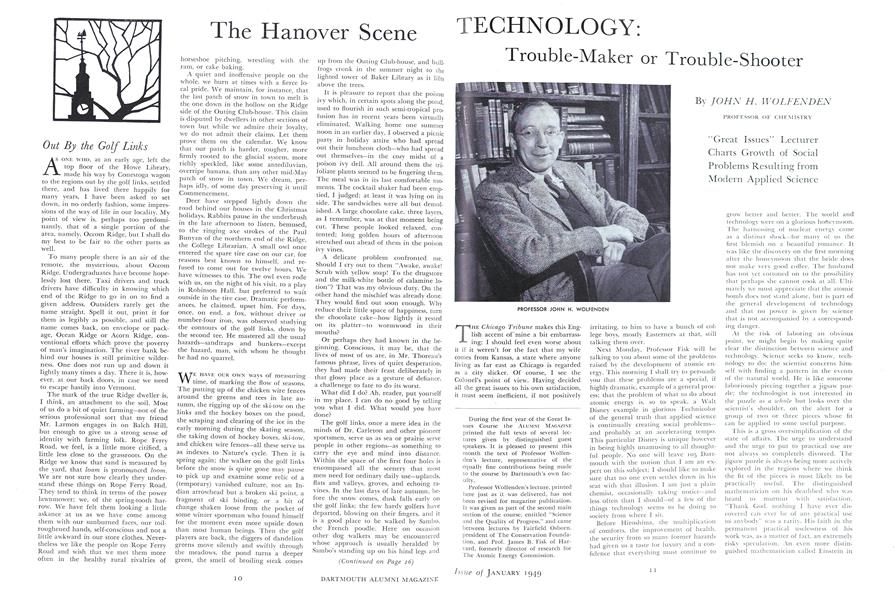
PROFESSOR JOHN H. WOLFENDEN
MEMBER OF GREAT ISSUES STAFF: John H. Halpin Jr. '47 (left), formerly with the National Institute of Public Affairs in Washington, joined the faculty this fall as Instructor in Great Issues. Shown with him in the Public Affairs Laboratory in Baker Library is Robert J. Schmitz '49, a senior.
PROFESSOR OF CHEMISTRY
During the first year of the Great Issues Course the ALUMNI MAGAZINE printed the full texts of several lectures given by distinguished guest speakers. It is pleased to present this month the text of Professor Wolfenden's lecture, representative of the equally fine contributions being made to the course by Dartmouth's own faculty. Professor Wolfenden's lecture, printed here just as it was delivered, has not been revised for magazine publication. It was given as part of the second main section of the course, entitled "Science and the Quality of Progress," and came between lectures by Fairfield Osborn, president of The Conservation Foundation, and Prof. James B. Fisk of Harvard, formerly director of research for The Atomic Energy Commission.