1889
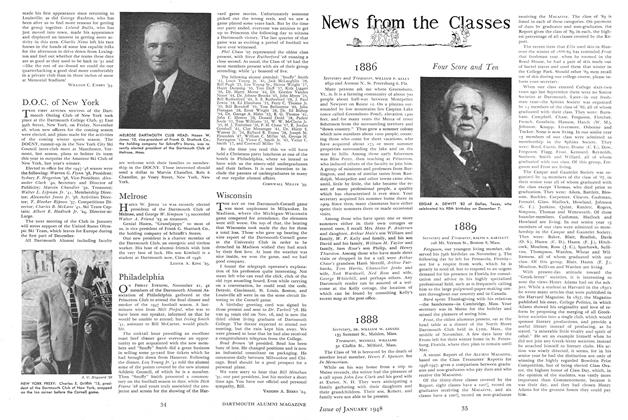
This issue will appear about the time several members of our class are in Hanover for an annual get-together at Commencement time. Fifty-nine, years have passed since we graduated. How different our Commencement was from Dartmouth's Commencement of today!
We wore no caps and gowns to receive our di plomas. We were attired in dress suits with long tails to the coat At the exercises held in the old white College church, President Bartlett received the candidates for. degrees by detachments, he himself sitting wearing a silk hat. Soon he arose, removed his hat, and, turning toward the trustees of the College they also arising, he addressed them in Latin. He then resumed his seat, replaced his nat, and in Latin, addressed our first detachment ot candidates. The diplomas were then distributed by Harold I J-. Knight, our class marshall, whereupon this detachment retired, each detachment leaving the church after it had received its diplomas The procedure was repeated until all degrees were conferred.
"Candidates for degrees of A.B. and Litt.B. received diplomas written in Latin. Diplomas for degree of B S (C.S.D. graduates) were written in French While we were in colle£e> the Victorian era still had several years to run. Although Queen Victoria s consort, Prince Albert, had been dead nearly 30 years, yet for Sunday and dress-up occasions the Prince Albert double-breasted black coat, with trousers of similar or different material, was largely worn by students, professors, and prominent townspeople. For head covering, the "Derby" —a stiff hat now rarely worn—was then popular. For foot-wear, black leather and patent leather shoes, laced or buttoned up above the ankle, were practically the only style of shoes worn. The low shoe and tan colored shoe of today were not then to be had. The trousers of that period were rather tight fitting, the legs were not creased and were not turned up at the foot. For sports wear, knee breeches, worn with a blazer jacket—generally with a broad stripe,with cap to match blazer, were popular. All athletic games took place on the old campus.Baseball—played at Dartmouth since the 1860's-led in popularity.The diamond was on the northwestern side or the campus opposite the College church.Rugby football,inaugurated in the early 1880's was played on the eastern side opposite Reed Hall. Tennis was popular. Grass courts were laid out opposite what is now Robinson Hall also opposite the Rood House, which stood on present site of Webster Hall. Field meetings of the Athletic Association were held each spring and fall on western side of the campus.Green was adopted as the college color in 1866.A decade later Daniel A. Rollins or the class of '79 originated the college yell "wah-hoo-wah."Attendance at 8 o'clock morning chapel service on week days, church service Sunday forenoons and vesper service Sunday afternoons was compulsory. Beginning at 7-50 a.m. each week-day, the college bell tolled 10 minutes to call students to chapel, and it was necessary to be there nor later than than the final double strokl of the bell. No recitations were held Saturday afternoons. Rhetoricals, an exercise when members of the senior class alternated in speaking before the entire student body, were held each Wednesday afternoon at 2 o'clock ing chapel in old Aart. mouth Hall. Studenbts were free the remainder of that day. The tuition for students studying for the degrees of A B. and Litt.B. was $90 per year of three terms, for degree of B.S. (C.S.D),$60 peryear. There was a graduation fee of $8. The cost of board at eating clubs, conducted largely in homes week TPeople' ranged from 43 to $4.50 per week. Room rent cost from about $40 to $75 per year. A student's entire expense for a collegiate year ranged from $350 to $500-some undoubtedly spent more.
Most college dormitories depended upon heat from stoves burning coal—and perhaps wood in some instances. Recitation rooms, also heated by coal stoves, were taken care of by students who occupied guard rooms, which usually adjoined the rooms they cared for. As a rule, students took care of the rooms they occupied. The College hired a man to renove ashes and waste material. When steam heat was installed in Reed Hall, the service of that hall was extended and care of the rooms there was given to a Mrs. Badger, whose work os pleased the students there that they gave her the title of "Queen Badger of Reed Hall." None of the college dormitories had running water toilet facilities, or sanitary arrangements of any kind For bathing porposes each strdent, unless he possessed a "tat tub," -there were no set bath tubs in Hanover, had to depend upon a pitcher and bowl, and a bucket of cold water, the heating of which was somewhat of a Problem, especially in Reed Hall where not even a coal stove could be made use of Had we been students at Dartmouth forty years ahead of our time> we would have been better served in the matter of bathing facilities Old records inform us that in the 1840's, a Mr. Kingman constructed a neat and convenient bathing house on the south side of Wheelock Street nearly opposite the present Episcopal church It enjoyed condiderable patronage for several years. Among other who made use of it were the young ladies of Mrs,Peabody's school, which was conducted in what in our day was the Rood House, then located on present site of Webster Hall. These fair maidens, in confornity with requirements of with soap and towels, and march thither across the campus for their weekly ablution.
directly behind old Dartmouth Hall in our day and a respectable distance away—was a dilapidated long and narrow low red brick structure, open at each end for entrance and exit, which served as the only place for easing nature for students domiciled in nearby dormitories. It was known as No. 10 of historic fame,-"infamy" better describes it. It demanded fortitude of the highest type of every person entering its portals.
There was no public conveyance between Hanover amd White River Junction. Students reached and left Hanover via Norwich, Vt., on the Passumpsic Division of the B. & M. Railroad. Dudley stage coach, accommodating 12 to 15 persons, ran from Hanover to Norwich to meet through trains, fare 25 cents each person. The station at Norwich was closed at night. Those wishing to take the night express south, passing through Norwich about 3 a.m., burned newspapers on the track opposite the station there to stop the train Locomotive engines on northern New England railroads often burnt wood as fuel. Passenger cars were heated by stoves in each car. Such practice caused tragic results in a railroad accident at Hart ford, Vt., February 5, 1887, in which our classmate, Edward F. Dillon, famous pitcher of the varsity baseball team, lost his life, and another classmate, Albin B. Veazey, narrowly escaped death. The accident resulted from the night express, bound for the winter carnival in Montreal where our classmates were headed, jumping the track as it was crossing a bridge over "White River at Hartford, plunging the cars down upon the ice covered river beneath in sub-zero weather. The wrecked train caught fire from the stoves heating the cars and it spread to the wooden structure of the bridge overhead, which soon fell in flames upon the wreckage below. About 50 persons perished. College exercises were largely suspended that day and most of us students rushed to Hartford to render all possible assistance in caring for dead and wounded. This accident led to the passage of laws forbidding use of stoves in heating of passenger cars, and heating by steam generated in the engine resulted.
"jabe" Ellis of our class, in his senior year, had a pair of skis made by a local carpenter which lie tried out that winter in the College Park with more or less indifferent success So far as is known, this is the record for first appearance of skis in Hanover. The sport of skiing at that time was in its infancy in America. It was "the horse and buggy days." Use of the telephone had not reached Hanover. There were no automobiles or airplanes, and, of course, no motion pictures, wireless or radio.
We lived simply and happily. A few of us are still left to witness and enjoy the wonderful growth Dartmouth has had, and we rejoice at the proud position she now holds.
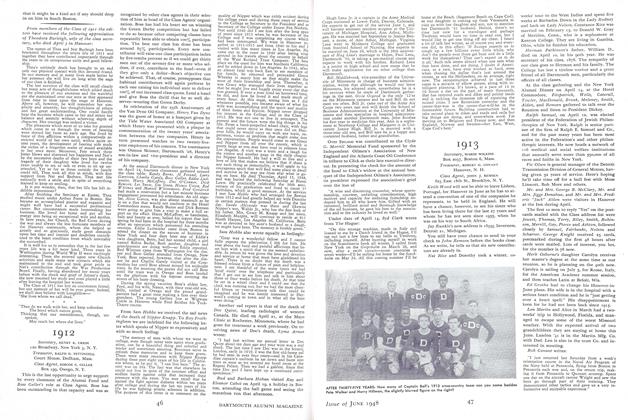
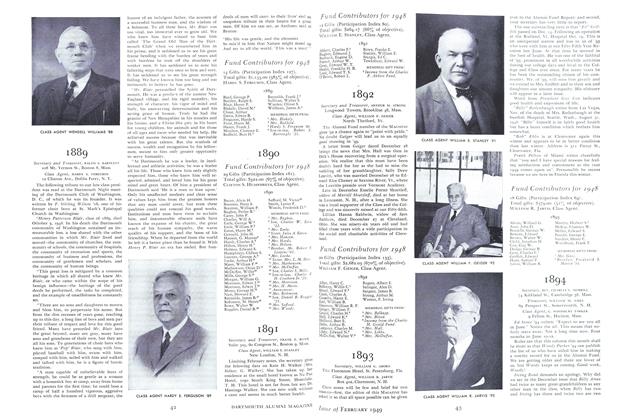
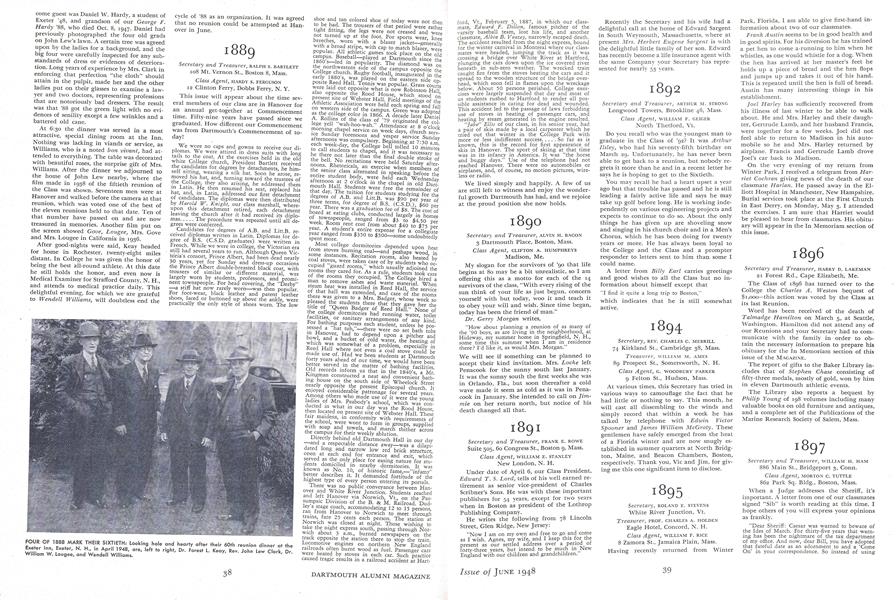
FOUR OF 1888 MARK THEIR SIXTIETH: Looking hole and hearty after their 60th reunion dinner at the Exeter Inn,Exeter, N.H.,in April 1948' are, left to right. Dr. Forest L. Keay, Rev. John Lew Clark Dr William W. Lougee, and Wendell Williams. '
Secretary and Treasurer, 108 Mt. Vernon St., Boston 8, Mass. Class Agent, 12 Clinton Ferry, Dobbs Ferry, N. Y.