1897
I have started to write my class notes three times this month, and someone has thrown a monkey wrench into the smooth flow of good literature from my pen before I got finished on the preliminary form of the article. These two things are so entirely difEerent and so engaging that each one of them should give me the go sign.
First, "Pa" Rollins, who has some Hale blood in his veins, knowing that I have Hale as my middle name, has pleaded with me to have the class help uncover some facts con- cerning a charge of plagiarism having to do with the actors and the schoolhouse referred to in that charming poem of childhood, "Mary had a little lamb, its fleece was white as snow," etc. This poem was written by Sarah Josepha Hale, 1790 to 1870, and was published in 1830. "Pa" starts his case by a statement that in Massachusetts there is a schoolhouse that was recently purchased for $35.00 and moved from a town near Boston to become a part of an Americana Exhibit, with a printed descriptive brochure being sold claiming that this, the $35.00 schoolhouse, is the building to which the little lamb followed Mary; and also presents to the public in this same brochure a sure enough Mary. "Pa" further states that there is reason to believe that the original schoolhouse to which the lamb followed Mary was located in Newport, N. H., which is the birthplace of Sarah Josepha. He sends me a letter from a man in Newport which seems to give a good deal of evidence.
Now "Pa" wants us, as a Class, to make an exhaustive search to find the facts. He has already found that a man in Newport helped raise a fund of $500 a long time ago, called the "Mary's Little Lamb Fund," to be used to build a monument in the center of Newport to commemorate Mary, the lamb and Sarah Josepha. This collection was made a long time ago before any $35.00 schoolbouse got into the picture. "Pa" also finds the savings bank still has the money plus interest earnings. I think this discovery alone may lead to something. In the brochure the lamb is referred to as a ewe. The poem reads, "He followed her to school one day," and there is some indication of a man or a boy putting the lamb over a wall instead of having the lamb do as I think he did, not only stick his nose in the door of the school but to walk right in as in the poem we read, "it made the children laugh and play to see a lamb in school."
I think we ought to help "Pa" out and go hunt for the facts, and if we can find some descendants of Mary's little lamb and I can get some wool from one of them I would have a suit made to wear on our trip to Newport to add color to the investigating expedition. Second, I want to take just a little while to tell my classmates about the interesting wind-up of summer on our baseball fields. Ford Frick came as my guest to a luncheon given at the University of Bridgeport at the time of the championship play-off with eight teams from three states. At this luncheon I had invited the leaders of business in Bridgeport, the baseball coaches of our 17 teams and the fathers and mothers of the boys playing in the final game for the championship, which I am happy to say our Bridgeport team won. Mr. Frick talked on sportsmanship and I think it was a symbol of what his great work in the baseball world has now developed to be.
At the game after the luncheon he called my attention to one boy on our team that had his pant legs down low to his ankles, and he said to me in a very earnest way, "Don't let your boys wear their pants down low like that. Let them look like baseball players."
I am sure that this simple remark is quite the feeling that has gone all over America, Cuba, the Canal Zone, Porto Rico, Hawaiian Islands, Canada and now Japan to have these young players 10 to 12 years old look like baseball players. Last year 15,000 boys played Little League ball and 15,000 mothers washed their britches after each game. This year 60,000 boys played Little League ball and that's a hell of a lot of britches to wash, and shirts as well.
Our Junior movement has been recognized as the next step in baseball for boys and we have been asked to formulate a program for broadening the scope of our activities next year to take in at least eight states which will have local leagues and state tournaments, and then send to Bridgeport the winning teams of the state or district to play in the National Tournament. These boys start at 8 in the Farm Teams and at 10 in the Little League teams, and 13 in the Junior teams, playing as they do on a field which has base lines suited to the boys' ages. The people are interested in this kind of ball. People respond to this ac- tivity with a great deal of enthusiasm and this last season I was able to raise about $8,000 for carrying out the building of a second complete new field and the operation of' a Junior tournament here.
I have asked the boys in our local teams to accept this as their motto, "Make it keen and keep it clean," and I am so convinced that the Little League movement, the American Legion movement, and now our Junior movement between them will have a great effect on the sportsmanship of American youth. I think we all feel that the catastrophe to basketball which has been for sale is very depressing, and that National Baseball is a beacon light show- ing the mandate of America to have sports kept away from the gamblers' clutches.
1897 Fund Contributors
35 Gifts (Participation Index 100). Total gifts: $1,231.00 (109% of objective). MORTON C. TUTTLE, Class Agent.
Appleton, Fred S. Bacon, Arthur A.1 Balch, William H. Bolser, Charles E. Brown, Jay D. Carr, Edward G. Chase, Henry M. Christophe, Herman Drew, Frank E. Gibson, H. Hamilton Gibson, Harry A.2 Ham, William H. Henderson, John R. Hilton, George F. Holt, Hermon Johnson, Frank C. Kelly, Walter F. Lull, Henry M.3
McCornack, Walter E.4 Marshall, Benjamin T.5 Meserve, John S. Mosher, Loren A. Noyes, Frank H. Pender, Horace G. Rollins, Weld A. Rowe, Brainard A. Ryan, Joseph F. Sibley, John O. Smith, Erdix T. Temple, Winfield Tent, George E. Tuttle, Morton C. Ward, Roy J. Watson, Albert P. Woodworth, Edward K.6
MEMORIAL GIFTS FROM: 4 Mrs. McCornack.'1 Son, Richard E. Bacon 5 Son< Andrew Marshall'30. '22.2 Brother. Hamilton Gib- 6 Daughter, Mrs. C. Laneson '97. Goss.3 MX. . Lull.
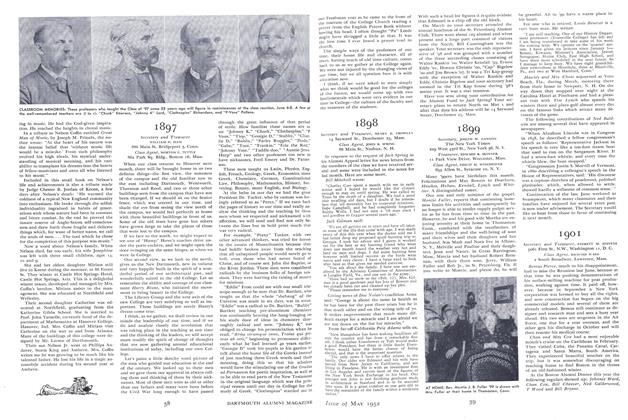
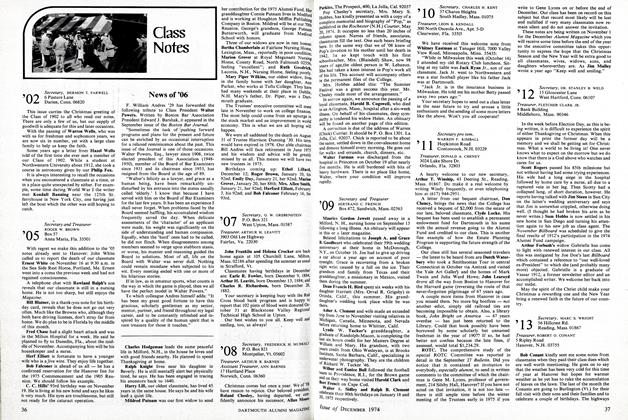
FUTURE BIG LEAGUERS are congratulated by Baseball Commissioner Ford Frick and Class Secretary William H. Ham '97 (right) who sponsors Junior Team and Little League play in Bridgeport, Conn.
CLASS AGENT MORTON C. TUTTLE '97
Secretary and Treasurer 886 Main St., Bridgeport 3, Conn.