1933
Ever since we made a virtue of our forgetfulness by devoting enough space to it in last month's notes to fill out our quota, any number of people have shown us a special consideration that this column, to put it mildly, very seldom inspires. For example, one raw, wet and miserable morning a couple of weeks ago we met the Secretary of the College in front of the Ad Building, and Sid said: "It's good to see you wearing both overshoes this morning." And when Dot Manchester called one day to arrange a bridge game she thoughtfully suggested: "You'd better make a note of this, George. You might forget it."
It gives us a sense of security that we otherwise would not have to think that people will go out of their way to make life a little easier for us, now that they know that we're absentminded just like all professors. But the advantages of our confession do not stop there. Some people have even taken it as a cue to write to us. For years now we've cajoled and threatened and cussed and fumed, with precious little result. Then, when we simply admit that we can't be trusted to buy and bring home the daily paper, Monagan drops us a note saying: "Didn't I tell you we had a son, Charles Andrew, born March 8, 1950!"
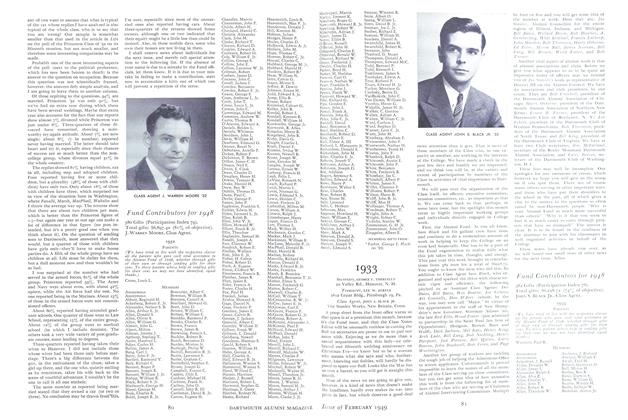
And Sam Black wrote: "The ALUMNI MAG just arrived and, having read the '33 column, we can relax. Jean and I have been wondering who in hell belonged to the extra pair of rubbers out on our back porch. Any time it's convenient, just stop by and pick them up."
Come to think of it, this forgetfulness of ours may have had something to do with our appointment to a special Committee on Emergency Adjustments, recently appointed by the College to deal with such problems as acceleration, summer session, etc., created by the national emergency and new draft legislation that will hit college enrollments very heavily. If you have to make plans for a situation that nobody yet knows hardly anything about, it might be useful to have somebody on the committee who could forget that you really didn't know how many students would be drafted, how many, if any, would attend a summer session, and how many in each class will be here next year. Such a person would find it much easier to keep his thinking focussed upon overall objectives and the niceties of blueprint planning. And so, they say, little oaks out of big acorns grow.
Last month we announced the election of Manny Sprague as Speaker of the Connecticul Legislature. As more dope has reached us about the manner in which he was elected, the more we have been impressed by the reputation Manny enjoys among the legislators and the good people of his State. It appears that there were two principal candidates for the speakership, that both were long-time politicians and leaders of rival factions in the Republican Party, and that, as the time of election approached many observers, both within and without the Legislature, feared the possible consequences of an internal party fight just at the outset of the new Lodge (Republican) administration. The rest of the story can best be told by excerpts from a Connecticul political commentator's column, published in January, entitled "The Job Sought Mansfield Sprague." Alan Olmstead, writing in the Waterbury Republican, wrote: "Once in a lifetime, on the average, that thing which seems supremely right happens in politics. It happens against all the preconceived possibilities. It comes as a surprise. And yet it seems almost ridiculously easy in its happening, so that one asks why the same kind of thing can't happen more often." Sketching in the background, Mr. Olmstead mentions the dangers at that particular time of an internecine party feud between the two leading candidates, and adds that neither had great personal appeal, having been "rather routine legislators."
"Then," he continued, "one of those rare miracles of politics occurred. The office actually began seeking the man. It began seeking him through casual expressions of opinion on the part of individual legislators. One after another... would say something like this: 'What do you think of it? Not so hot either way, eh? Too bad we can't have somebody like so-and-so for the job.' In each case, the identity of 'so-and-so' was the same. The one individual who continually got such wistful mention was Rep. Mansfield Sprague of New Canaan. Finally, all these individual mentions of him cascaded together. The informal wishes of the legislators themselves for an individual possessing the full dignity, the high degree of integrity, the poise of character, and the democratic decency fitting the office of speaker added up to enough of a mandate to send the proposition to party leaders.... And with that development, the new governor got a leadership in the House of Representatives which will do much to establish the kind of atmosphere he would obviously like to have surround his administration." Mr. Olmstead concludes his column with these words: "We do not wish to overburden Speaker Sprague with praise. He has a hard job ahead, in which he will be entitled to his mistakes. But it is our prediction that the House will appreciate him at the end of his term even more than it valued him, in anticipation, when it itself talked him into the post." That is a mighty fine tribute to Manny, and richly deserved. Our congratulations and best wishes to him in his new position. The kind of democratic leadership that emerges from Mr. Olmstead's account of him, and the regard in which he is held by his colleagues, is all too rare in public life and merits every recognition.
Had a very nice visit with Hoppy and EarleGordon some weeks ago. Earle, as you know, is a Commander in the Navy. They spent a few days in Hanover while en route from Seattle to Washington, where Earle will have a term of duty in J. A. G. (military law). A recent note from Hoppy reported they were settled in brand new quarters in Arlington, which they were lucky enough to find as soon as they arrived, and that Earle was finding his new assignment very interesting. It was the first time we'd seen them since Earle went back into the Navy three years ago, and over the tea cups we heard some of the gorier details of a couple of the criminal cases Earle prosecuted during his first post war duty at Guam and Hoppy made pur mouths water with her descriptions of some of the native dishes they enjoyed out there.
We received word recently of StirlingWheeler's appointment as advertising director of Pepsi-Cola. Stir had worked for eight years with Young & Rubicam before he joined the company as assistant advertising director last July. From Tulsa a press clipping brings us the news that Chuck March was recently appointed director of the Brookside State Bank. Aside from his service in the Navy during the last war Chuck has been practicing law in Tulsa since 1936.
Dick Goldthwaite, professor of Geology at Ohio State, who last figured in the news a few years ago when he was on a Reynolds scientific junket in China, made the headlines again recently when he returned from several months' isolation on Baffin Island within the Arctic circle to learn that there was a war going on in Korea. He was quoted in the press as saying, "We knew there was some trouble in Korea, but I didn't know the United States was involved." Dick's purpose up north was to Study the ice cap on that huge Arctic island. Howie Wilson, whom we last saw years ago when he was starting at the bottom of the ladder working for Nabisco in Lebanon, was recently named merchandising manager of that company. His is one of the outstanding success stories in the class. Starting with the company in Leb in 1934, he moved on to a sales branch in Providence, R. I. In 1946 he entered the New York office in the sales section, in 1948 moved up to sales program manager, in 1949 he became assistant merchandising manager, and now with his new appointment assumes one of the most responsible positions in the company. Congratulations, Howie.
The Journal of the American Dental Hygienists' Association recently published an article by Al Strock describing a new rotary toothbrush Al has developed, which, it is claimed, is both more effective in cleaning the teeth and much less damaging to the teeth than the conventional toothbrush. Dick Gerstell was the author of "How to Survive an Atomic Bomb," recently published by the Armed Forces Press. In his easily-read, lucidly written account Dick describes the measures that should be taken by an individual and his family in the event of an atomic bomb attack. Dick, who received his Ph.D. from the University of Michigan, is a consultant to the Civil Defense Office of the National Security Resources Board.
John S. Marden, with the Prudential Insurance Company in Chicago, was married on November 11 to Julie Clark Iglehart of Katonah, N. Y. The marriage was performed in Plainfield, N. J. Bill Starr, Manchester, N. H., attorney, was recently elected president of the Manchester Bar Association.
Have we forgotten anything?
Secretary, so Valley Rd., Hanover, N. H.
Treasurer, 2812 Grant Bldg., Pittsburgh 19, Pa.
Class Agent, The Stanley Works, New Britain, Conn.