1933
If you read Variety you may have caught this item about one of Paul Weston's latest songs. Reviewing the Columbia recording of "Shrimp Boats," Variety wrote: "Jo Stafford of late has been booting around wild, weird (for her) shouts, in an attempt to catch an offbeat item which could improve her shellacsales standing. She just might have it in "Shrimp Boats," a pseudo-folktune which Paul Weston has woven with not inconsiderable proficiency. It's a poor man's bayou version of "Red Sails In The Sunset," with none of the supercilious nose-tilting which might have been expected of a Dartmouth man visiting the docks." Just where, by the way, do you carry your nose when you visit the docks? Anyway, it's a nice plug for Paul, but we'll carry our nose—well, it depends on the docks.
Before we range farther afield, there's that big event, our Twentieth Reunion, coming up in June—a lot quicker than you thinkand you'll want to circle these dates, June 13, 14, 15, the week after Commencement, on your calendars. Things are shaping up. We've gotten a lot of inquiries about the date from the more far-sighted brethren, who don't want to be caught in the middle of a drummer's trip to South Dakota when that date rolls around.
Bill Dewey, whom we elected our Permanent Reunion Chairman after the Fifteenth, both for the superb job he did and for his unique qualities as a weather prophet, told us the other day that the Reunion Committee would get together for a meeting this month and that the ball would be rolling before the end of January. You will get further details both in this column and in the newsletter in due course. In the meantime, make your plans, if not your reservations.
Gay Milius was one of the early birds to inquire about reunion dates, and he also told us about his current work as Lieutenant Commander in the Navy. He wrote: "... since August I have been back in the Navy. The job is Fiscal Officer and Budget Administrator for the Research and Development Branch of the Bureau of Ordnance with Cognizance over Guided Missiles. Very interesting to say the least. The only '33er I've seen here in the Navy Building has been Bill Sampson, who is over in the Bureau of Aeronautics. I have contacted Dick Bradshaw several times. He is redoing his house, which contains his office, and which had a fire in it some months back." We'd heard Gay was back in the Navy, but it was good to have further details.
Christmas brought us a record number of greetings from classmates and occasional gleanings of news as well. June Drowne reported that he had recently joined the staff of the American Management Association in N.Y.C., as Placement Manager and Manager of the Office Management Division and that he found the work stimulating and a challenging opportunity as well as very enjoyable. June is coming to Reunion in June, if he possibly can. From the Charles Clarks in Tulsa came The Scoop, described on its masthead as "published haphazardly by Charles T. Clark Corporation. The Scoop told us in some detail of the bewildering array of activities Charles and Gene are engaged in, he in civic affairs, Church School Superintendent, numerous other extra-curricular activities; she as Secretary of the P.T.A., Campfire Leader, Treasurer of Rotary Ann, Children's Home Board, etc., etc. And, withal, the Clarks have managed this past year to build a large new ranchtype house for themselves and brood, namely, Judy, Nancy and Carolyn. The Scoop had a floor plan of the new home, as well as an account of the "thrills and troubles" of "thebuilding-of-Clark's-house," which,"the largest undertaking of our career" turned out to be "just what we want," and among other things, "ideal for teen age dances and parties."
And there was a raft of other greetings. Among them, from the Rockwells, the ErnieTurners, the Marshalls (Peggy Sayre), the Werrenraths, the Holmes, Woods, Ruth and MelKatz, Hal Mackey, the Rideouts, and, from Paris, Drew Dudley. Greetings also from Jean and Sam Black, Muggs and Don D'Arcy, the
Manchesters and the Aliens. Ted and LauraAllen brought us up to date, incidentally. We'd heard that they had moved away from Claremont, N. H., their former home, but only learned where they'd lit when the card came saying: "I have been with the General Electric Company in Schenectady since July 17 as Assistant Manager of Freight Classification, in their General Traffic Department. We have bought a house in Scotia, and moved in on September 29. We like it very much." Also a nice card from Henry and Helen Smith, out North Tonawanda way. Now let's see, who's been forgotten? Think that's it.
In many ways the most interesting Christmas greeting of all, however, came to us indirectly, via Professor and Mrs. Lyon, who received a long letter from the John Rccds, sent from the heart of Africa. You will perhaps recall our announcement last fall that John, professor of botany at the University of Wyoming, was spending a year's leave of absence doing research in the Belgian Congo. Here is a fascinating report on their life there, written by Mrs. Reed to the Lyons:
"John's work is difficult but very interesting. Five days a week he camps and works with a young Belgian agronomist in the Mosso Valley only four or five miles from Ruyigi in a straight line over the mountains but 50 to 75 miles by the narrow, torturous road. They are collecting, studying plant communities and making vegetational maps of the area—working together with several soils men and pedologists, one Canadian and three Belgians. The Mosso is far more primitive and remote than the area around Ruyigi. Almost every kind of animal native to central Africa is found there, and John has seen most of them at one time or another. Ihe vegetation, of course, is all new and strange. Most of the natural forests have been destroyed by nres and you can't imagine anything like the fires during the dry season. Set off by natives to drive out game for hunting, to clear land for gardens, and for goodness knowns what other reasons, the whole country burns. Only the heavily forested galleries along streams escape and there one can get some idea of the natural climax vegetation—quite jungle-like.
"Recently the King of Urundi (the Mwami Mwambutsi) visited the Mosso camps on a royal tour of inspection, and sptat an afternoon chauffeuring John in the royal Cadillac to points of interest in their field work. He has had no formal education but has been taught by tutors. John round him a very interesting, intelligent person. He had never heard of the theory of plant succession but seized upon it enthusiastically and soon was pointing out to John local incidents of changing vegetation Ever since the Mwami's visit, John is addressed by the Mosso natives, wherever he goes, as Bwana Makuba (Lord Most High) !
"I too, have acquired a new title of I am proud, though it is a simpler one than John's. At first I was Madame, like all other white women here but in six weeks I had become Mama—the Kirundi word for "mother" and the highest title they can bestow on a woman. According to a nearby medical missionary, it means I have won their love and respect, but I assure you it's a strange feeling to be mother to a whole African village. Johnny, Bob and Jim share a common title of respect, Bwana Umubunga (Mr. Little Boy).
"The five-way tangle of tongues with which we struggle is really a headache—our English, the Belgians' French and Flemish, and the natives Kiswahili and Kirundi. The latter is the most difficult and complicated of African languages, but it is such a rich one that all missionaries here use it exclusively in their teachings because it already contained all the ideas and words necessary for the mysticism, poetic conceptions and philosophy necessary for religious instruction. Of necessity, our French is becoming quite fluent, though the grammar is still atrocious. After four months here, I find myself thinking in French more than m English, and all my dreaming is done entirely in French so that I wake exhausted every morning.
"We have a very roomy, 7-room, brick house here. The village is a tiny one (4 Belgian families, 4 bachelors of assorted nationalities and the 5 Reeds). There are no modern conveniences, no communication system, not even stores. Our staple groceries must be brought from Usumbura, 150 miles away, whenever an INEAC truck makes the long, hard trip to town. Our stove is a primitive brick affair whose1 oven is an empty kerosene drum; yet it bakes beans, bread and cakes very successfully. We have four house servants (a cook, a washer man, a cleaning boy, and one who tends the fire and washes dishes), 5 yard boys who bring wood and furnish the Congo equivalent of running water (only it walks, balanced in two buckets on each shaven head), and John has a personal 'boy' for his Mosso camp. Yet with ten servants our life is anything but one of leisure and ease. I must oversee each detail of household management, I must boil and filter all water, sterilize all milk, disinfect all fruits and vegetables, give our children their lessons, and see to a thousand other things. On the whole, life in America, without servants, is much easier.
"Yet the natives are interesting, friendly and intelligent people. Few of them have any education for, as I said, the province of Urundi has been completely untouched until the last few years. It has great potentialities for the future, but even in these days of fast progress, its development will take generations. It is practically a stone-age environment, and surely we have an oppor- tunity in being able to see and know it intimately. When things go well, it is a very interesting experience. At other times—well, we'll be home again next summer!"
Remember! Reunion is on June 13,14,15.
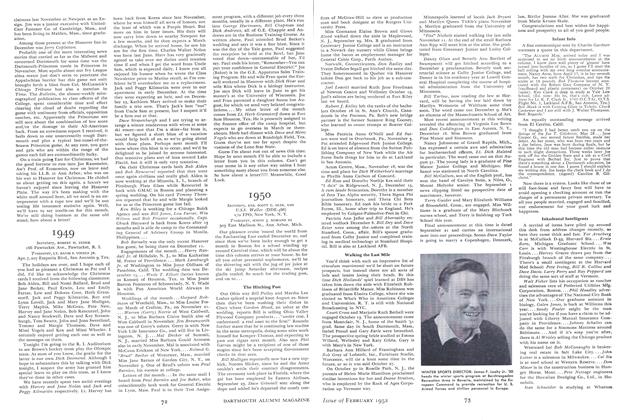
NEW PARTNER: Clyde C. Seney '34 has been made a partner in the management consulting firm of Booz, Allen and Hamilton, New York City. Seney, who first joined the firm in 1944, lives in New Rochelle.
Secretary and Acting Memorial FundChairman, 20 Valley Rd., Hanover, N. H. Treasurer, 2812 Grant Bldg., Pittsburgh 19, Pa.