1905
By the time this appears in print the Eight Class (1900-1907) Dinner will be a thing of the past. The date for this pleasant get-to-gether is May 1; the place, Schrafft's in Boston. This is just too late for me to include an account of the party, for, unfortunately, I cannot attend myself. However, here is a list of those '05 men who have informed me that they expect to be there: Besse, Camp Campbell, Elsie Grover, Sliver Hatch, Lillard, McCabe, Nourse, Peyser, Cliff Pierce and BobHarding, who, as usual, is managing this dinner. Bob, however, has announced that he is turning over this chore to Sliver, our efficient Class Agent, for next year. Perhaps Sliver will include a first hand account of this dinner in his 1905 Reporter.
I am indebted to Walter May for calling my attention to this item that appears in the recent Dartmouth Financial Report the gift of $1,000 by Royal Parkinson to establish the William D. Parkinson '78 Memorial Fund.
Fred, Chase is back from Florida and as busy as ever. These "retired" men!
It was good to learn that Hump Hazen is still working "at seventy" and in excellent health.
Walt Conley gave me a ring recently. He and Ethel were back from their very pleasant trip about the Caribbean and Walt was plunging into the work of his lovely country home.
My ever-faithful New York correspondent, Tub Besse, informs me that Bill Knibbs has had to undergo a further serious operation but that he was making steady, if slow, improvement. Our best wishes to you, Bill, in your progress to recovered health.
Winfield Barney writes interestingly of his new home, 13 Springdale Court, Greensboro. It sounds very attractive and homey and is very conveniently located for stores and church. In the front lawn are two dogwoods given Winfield by his department when he was in the hospital a year ago.
Walter Nourse, back in his island home (Vineyard Haven) after his sojourn in Los Angeles, is reported as remodeling his home. Also, on Saturdays, he has a class on the geology of the area at the Fessenden School, Newton, where he was formerly principal.
I'm told that Roger and Frances Brown are back from Florida and looking fine.
Hugh McLean, I'm told, has a grandson. Sorry but I have no further details my fault!
The secretary was greatly shocked to learn of the sudden death of John Laing on May 13, just as the MAGAZINE went to press. No further details are available at this time.
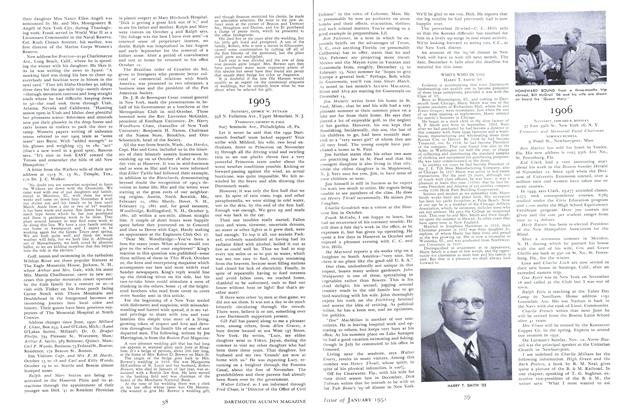
You will note, in the profile of Henry Norton, the added distinction and responsibility that has been given him in his appointment by Gov. Dewey as a member of the five-member New York City Transit Authority.
'05 UP! Note the date of our reunion in Hanover at the Inn, July 10, 11, 12. Let's have a full count of the class there. Don't forget to bring your wives, and other members of your family, too! If you didn't attend last summer, you'll be surprised and delighted to find how thoroughly enjoyable a reunion all by ourselves actually is. Let C. C. Hills know early that you'll be with us.
Who's Who in '05
HENRY KITTREDGE NORTON '05
Second youngest and most ornamental of the Class of 1905, is Henry Norton, who originated in Chicago, son of a businessman and Dartmouth "79 graduate, and who came to Dartmouth from the Chicago Manual Training School. In college he was editor on the Dartmouth and Aegis boards, member of the mandolin club, and a good student. However, Dartmouth was a sort of kindergarten for him. Seven years later he earned an M.A. degree at Pomona College in California, and for the next three years thereafter did graduate work at the University of California. Since then he has been demonstrating remarkable versatility until, after 45 years of paddling his own canoe, he is president of three companies, vice president of two and director of ten, simultaneously.
His first year out of Dartmouth was spent with the Pullman Company in his home city Henry says "licking stamps." Then his family moved to California. Then for two years Henry was in the machinery business with his father in Los Angeles. Selling this business, he practiced law for ten years in the same state, having been admitted mysteriously to the bar in 1908, probably not on the law he learned in the Dartmouth Mandolin Club.
In 1917 he entered military service as Ist Lieutenant and spent two years in the Spruce Production Division of the Army Air Service. Here he was concerned for a time with purchasing the right of way for a new railroad to bring material for airplane wings out of the forest. Later he was personnel adjutant in Oregon. Henry then spent a year as executive officer for the California Immigration Commission at San Francisco. Gaining from this experience an idea of how to emigrate, he set out in 1920 for the Orient and then to Europe on newspaper work for three years. Interrupting this activity briefly for a year as assistant to the General Counsel of Armour & Company in financial work in Chicago, he returned to travelling and writing for another nine years, until 1933.
These nine years included newspaper work in New York, Europe, the Caribbean and South America, a part of the time at the 1928 Pan American Conference in Havana under Secretary of State Charles Evans Hughes, and another part representing the Carnegie Endowment for International Peace in 1931 in South America.
From 1933 on, Henry, back in America and hav- ing attained the top drawer, glides entirety at the executive level. A year as treasurer of the National Broadcasting Company on network reorganization and finance problems, two years as assistant to president David Sarnoff of the Radio Corporation of America, a year as vice-president of the Radio Marine Corporation and, since 1937, with the New York Susquehanna & Western R.R. Company, with headquarters in New York. His first six years here were as executive officer under receivership- trustee Walter H. Kidde. Upon the death of Mr. Kidde, and since, he has been the trustee of the New York Susquehanna & Western R.R. and treas- urer and director of Walter Kidde & Company, Inc., and for two years as its director and vice- president of finance until 1950. He is director too of three other Kidde construction, manufacturing and engineering companies. As trustees, Kidde and Norton have modernized and dieselized this New York commuter railroad company. They have been publicly credited with remarkable success. The concern is on the point of emerging from trustee- Sh'i?' t TJ kn iUinn „ winter
For retirement, Henry has been building a winter home and shop in California. He is still smart enough to avoid doctors. With three daughters and a son and five grandchildren, he will not lack for absorbing occupation, especially as one son-in-law is director of Red Cross in San Francisco and another is a professor in Swarthmore College, while his son Rockwell is an attorney.
Henry's recreations, like his occupations, reflect his wide interests reading, bridge, gin rummy, golf by land and sailing by sea. He belongs to two country clubs, one yacht club, the Newcomen Society of England, and social clubs in New York, Newark and Paterson.
He is a director of the Paterson (N. J.) hirst National Bank and Trust Company and the American Short Line R.R. Association. For two years until 1948 he was vice-president of the Bergen County Chamber of Commerce. For 13 years until 1949 he was a member of the Council on Foreign Relations and the American Academy of Political & Social Science. He served three years as President of the N. Y. Railroad Club and is on the Board of Governors of the Railroad Machinery Club.
As to what Henry K. Norton does in his spare time listen to this: In 1913, he was author of a hook. The Story of California. In 1921, he wrote The Far Eastern Republic of Siberia. In 1926. with Woodhead and Arnold, he published OccidentalInterpretations of the Far Eastern Problems. In 1927 came China and the Powers from his pen. In 1928 came Back of War. In 1928, with Jones & Moon, he published The U. S. in the Caribbean. The same year alone. Foreign Office Organization. In 1932, with A. L. Dean, came Investing, inWages, and alone. The Coming of South America.
From 1924-31 he published a series of weekly articles in the New York Herald Tribune, syndicated cated far and wide, on "The Background of Foreign Affairs." He has addressed Chatauqua, Williams Institute of Politics, and the University of Virginia Institute and conducted round tables. In 1919 he was offered the professorship or political science at Dartmouth but was not in a position to accept. He has written for the World's Work Magazine, the New York Times, Herald Tribune, World and other periodicals. His counsel concerning China has been free from suspicion or scandal.
Lacking a comptometer for scoring, the impression is abroad that his career is one of notable-resourcefulness and versatility and some little distinction.
Shortly before sending in this profile for publication, we note in the press the new mark of confidence in Henry Norton's ability and experience in his appointment by Gov. Thomas E. Dewey as one of the new five-member New York City Transit Authority. Henry will have a heavy responsibility in helping to carry through the plan, sponsored by Gov. Dewey, to stabilize the shaky finances of the city by turning municipal subway and other transportation lines over to an Authority which will have power to raise fares in order to eliminate operating deficits.
HENRY K. NORTON '05
Secretary. 358 North Fullerton Ave. Upper Montclair, N. J.
Class Agent, 11 Lakewood Rd., Natick, Mass.